From Europa to other icy moons, scientists are studying how surface features form and what they might reveal about the potential for life.
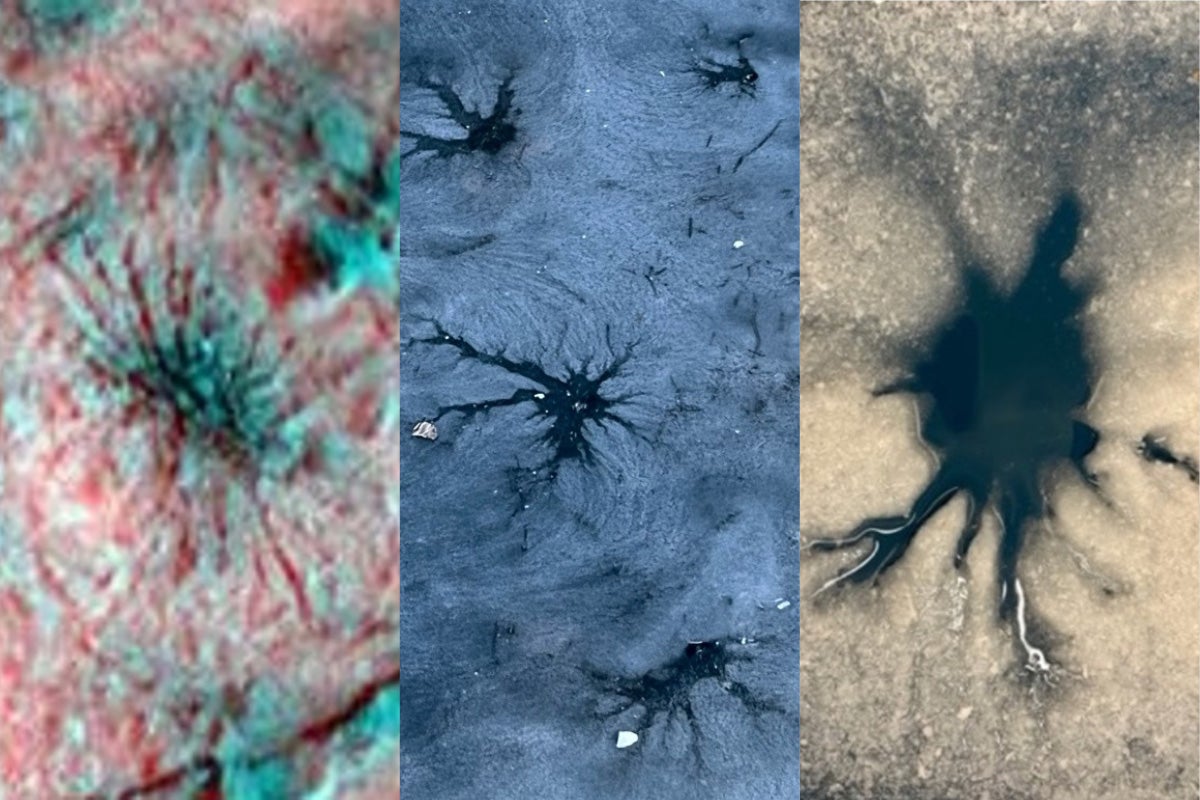
In a new study published in The Planetary Science Journal, researchers from UCF, NASA’s Jet Propulsion Lab (JPL) and other institutions explored a unique, spider-like feature in Manannán Crater on Europa, one of Jupiter’s icy moons.
First observed by NASA’s Galileo spacecraft, the feature may have formed from briny water eruptions beneath the ice, offering clues about subsurface liquid water and potential habitability on Europa.
“Europa is a fascinating moon to study because its subsurface ocean may have the conditions to support life.” — Lauren Mc Keown, assistant professor at UCF
“By understanding surface expressions, we can learn more about processes and conditions where liquid water may exist below the surface,” says Lauren Mc Keown, assistant professor at UCF’s Department of Physics.
Using Earth’s lake stars as analogs, combined with field observations, lab experiments and modeling, the researchers hope to gain valuable insights into how these icy features form, which could have implications for future missions that might land on Europa and other icy airless worlds.
Originally from Ireland, Mc Keown’s interest in space began as a teenager when she first learned about the Cassini spacecraft, which explored Enceladus, a small icy moon of Saturn.

“I was fascinated by the animations showing a water plume shooting miles above the moon’s surface and the possibility that liquid water, or even an ocean, might exist there,” she says. “It encouraged me to explore NASA’s website to learn more about icy planetary surfaces and eventually pursue a career in planetary science at Trinity College Dublin.”
As an icy planetary geomorphologist, Mc Keown studies surface features and processes on icy planets, moons and small bodies.
“My research includes analyzing Martian ‘spiders,’ which are dendritic — branching, tree-like — features that form in the regolith near Mars’ south pole,” she says. “Now, I’m applying that knowledge to other planetary surfaces, including Europa.”
While Martian spiders form when dust and sand are eroded by escaping gas below a seasonal dry ice layer, Mc Keown believes Europa’s “asterisk-shaped” feature may have formed after impact, when liquid brine within the icy shell extruded through broken-up ice from impact to form a pattern similar to Earth’s lake stars.
“Lake stars are radial, branching patterns that form when snow falls on frozen lakes, and the weight of the snow creates holes in the ice, allowing water to flow through the snow, melting it and spreading in a way that is energetically favorable,” she says.
Dendritic patterns like these are common in nature, appearing in Lichtenberg figures created by lightning strikes, in beach rilles where tides flow through sand, and in many other systems where fluid flows through porous surfaces.
“I’m fascinated by these beautiful features on Earth, and there is very little research on how lake stars are formed”, Mc Keown says. “This inspired my team to explore whether similar processes could explain the pattern on Europa, albeit under different pressure and temperature conditions.”
In the study, researchers proposed a new explanation for the feature, informally naming it Damhán Alla, Irish for “spider,” to distinguish it from Martian spider formations. They suggest it may have formed in a way similar to lake stars on frozen Earth lakes, under locally temporary elevated temperatures and pressures caused by an impact that created Europa’s Manannán crater.
“Lake stars on Earth are star-shaped or branched melt patterns that form when warmer water rises through thin ice and spreads through overlying slush or snow before freezing,” Mc Keown says. “On Europa, we believe a subsurface brine reservoir could have erupted and spread through porous surface ice, producing a similar pattern.”
To test this hypothesis, Mc Keown and colleagues conducted field and lab experiments, observing lake stars in Breckenridge, Colorado, and recreating the process in a cryogenic glovebox at JPL, using Europa ice simulants cooled with liquid nitrogen.
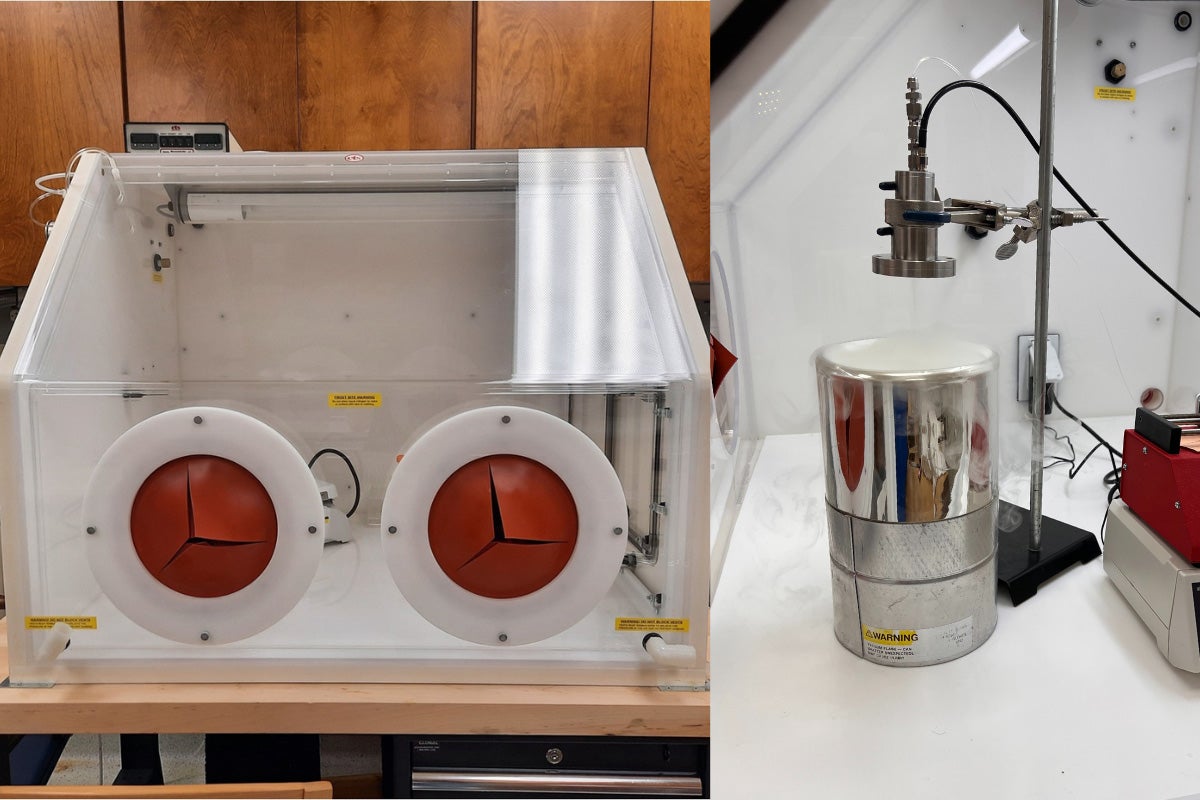
“We flowed water through these simulants under different temperatures and found that similar star-like patterns formed even under extremely cold temperatures (-100°C), supporting the idea that the same mechanism could occur on Europa after impact,” Mc Keown says.
Elodie Lesage, a research scientist at the Planetary Science Institute and co-author of the study, modeled how a brine pool might behave beneath Europa’s surface after this impact, and the team created an animation illustrating the process.
Observations of Europa’s icy features have been limited to images from the Galileo spacecraft.
Mc Keown’s team hopes to resolve this question with higher-resolution imagery from the Europa Clipper mission, a NASA spacecraft scheduled to arrive at the Jupiter system in April 2030.
“The significance of our research is really exciting,” Mc Keown says. “Surface features like these can tell us a lot about what’s happening beneath the ice. If we see more of them with Europa Clipper, they could point to local brine pools below the surface.”
The findings provide insights for possible patterns on Europa; however, researchers caution against relying solely on Earth analogs to understand other planetary surfaces.
“While lake stars have provided valuable insight, Earth’s conditions are very different from Europa’s,” Mc Keown says. “Earth has a nitrogen-rich atmosphere, while Europa’s environment is extremely low in pressure and temperature. In this study, we combined field observations with lab experiments to better simulate Europa’s surface conditions.”
Mc Keown is also proud of the collaborative nature of the work.
“This study came together organically and reflects a value that’s important to me: community,” she says. “I’ve had the opportunity to work with an incredible group of scientists — including JPL Planetary Geologist Jennifer Scully, with whom I collaborated to name the feature — whose multidisciplinary expertise was essential to this research. There are not many Irish planetary scientists, so working together has been rewarding, particularly because many of Europa’s features have Irish and Celtic names.”
Looking ahead, Mc Keown plans to investigate how low pressure affects the formation of these features and whether they could form beneath an icy crust, similar to how lava flows on Earth to create smooth, ropy textures called pahoehoe.
“I’m setting up a new lab at UCF, called the FROSTIE (Facility for Research Observing Simulated Topography of Icy Environments) Lab, where I’m designing a chamber specifically for these experiments. I am currently involving students to create icy simulants for this work while continuing to collaborate with JPL,” she says.
Although geomorphology was the main focus of this study, the findings offer important clues about subsurface activity and habitability, which are crucial for future astrobiology research.
“I’ve spoken with astrobiologists interested in these patterns, including how microbes might inhabit lakes on Earth,” Mc Keown says. “There’s great potential for collaboration across disciplines with this research, and I look forward to connecting with colleagues and students at UCF who are as passionate and excited about this work as I am.”