Highlights
-
Assistant Professor Han Zhao is developing a new method that uses tiny mechanical vibrations and superconducting systems to make quantum operations more resistant to noise and errors, addressing one of the biggest challenges in quantum computing.
-
Supported by the Oak Ridge Associated Universities Ralph E. Powe Junior Faculty Enhancement Award, Zhao’s research uses a topological “braiding” approach —similar to tying a knot — to stabilize quantum states by focusing on overall patterns.
-
The project leverages advanced quantum infrastructure at UCF and aims to improve the reliability of quantum systems, helping enable future breakthroughs in areas such as medicine, energy and advanced materials.
Quantum computers could one day solve problems beyond the reach of even the world’s most powerful supercomputers, accelerating everything from drug discovery to the development of advanced materials and cleaner energy technologies.
But the fragile quantum states that make such machines possible are notoriously easy to disrupt. Even tiny changes in the environment — such as stray radio waves, small fluctuations in temperature or slight physical vibrations — can interfere with calculations, introduce errors and disrupt quantum coherence.
To help address this challenge, Assistant Professor of Physics Han Zhao is developing a new approach that combines superconducting quantum systems with nanomechanical devices to make quantum operations more resistant to noise and errors.
Supporting New Quantum Research
“The future of quantum computing will be its real-world breakthrough applications in science and the economy,” Zhao says. “So it is absolutely true that practical quantum computers need to address the fragility of quantum states.”
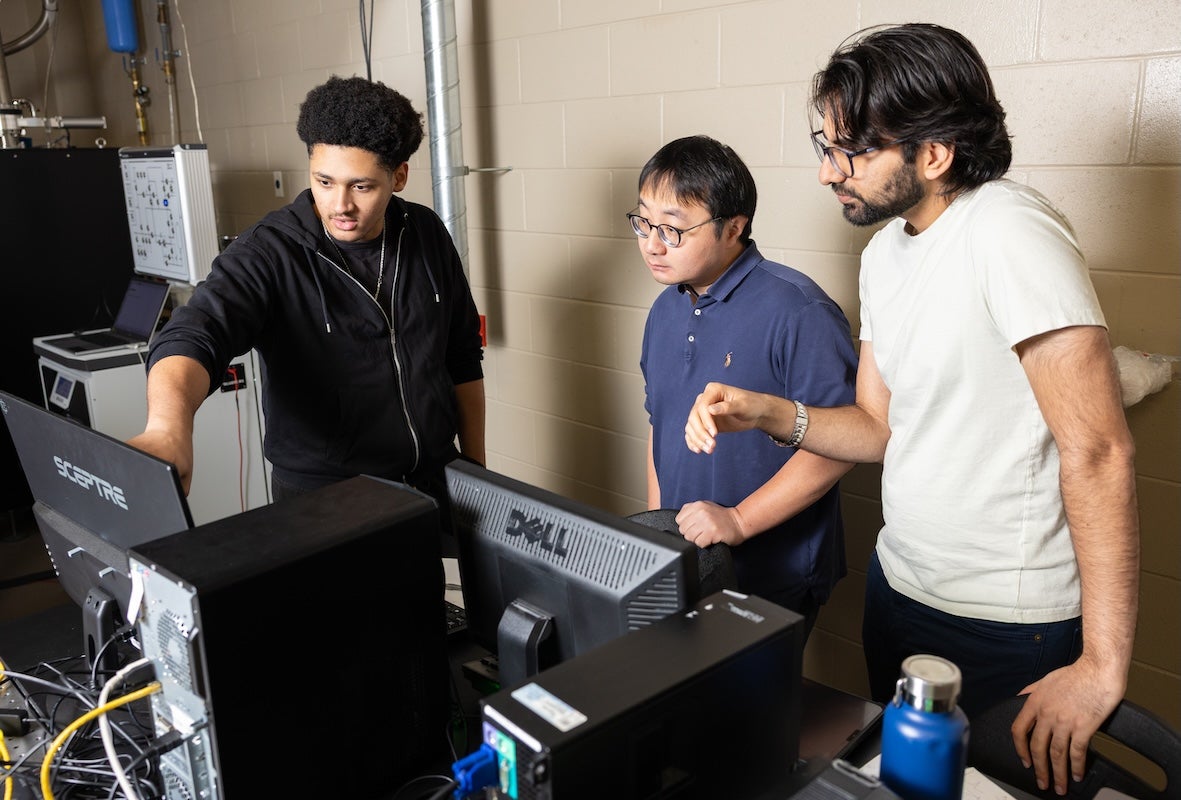
The project is supported through the highly competitive Oak Ridge Associated Universities Ralph E. Powe Junior Faculty Enhancement Award program, which provides seed funding to early-career faculty conducting research in science and engineering. The funding supports graduate student research and the acquisition of specialized superconducting quantum hardware used in the experiments. The project will also leverage UCF’s nanofabrication facilities and quantum research infrastructure, including advanced waveform control systems and superconducting quantum hardware.
“The most inspiring aspect of receiving the award for me is to know that the scientific merit of the proposed research received extremely positive recognition in the community,” Zhao says. “This means our lab is on the right track to accomplish research of high importance. We are also grateful for the support of getting students involved in advanced experimental quantum research.”
Entangling Quantum States Through Braids
“Now, imagine the strands as the evolution of the quantum excitations and the knots as the entangled quantum states. The process of achieving a certain quantum state, i.e., the knot, can have various wiggles due to noise and control imperfection, but as long as it follows a certain pattern, it will result in a high-fidelity quantum operation.”—Han Zhao, assistant professor of physics
There are generally two approaches to mitigate error rates in quantum computing, Zhao says. The first is quantum error correction (QEC), which uses multiple physical qubits (the basic unit of quantum information) to protect logical qubits, the encoded units of quantum information used for computation. However, QEC requires substantial hardware resources.
Zhao’s research explores an alternative approach that seeks to make quantum operations themselves more resistant to noise and errors. His efforts focus on developing a more fault-tolerant method for quantum entanglement using superconducting quantum systems and nanomechanical devices operating at temperatures near absolute zero.
At the center of the project are tiny mechanical resonators — microscopic vibrating structures capable of interacting with microwave signals inside superconducting quantum circuits. By carefully controlling these interactions, Zhao aims to create a topological “braiding” process in which quantum states cyclically exchange properties in a predictable and stable way.
Unlike conventional quantum operations that rely on extremely precise control sequences, the braiding process is designed to be inherently more resistant to environmental noise and small operational errors. Because the process depends more on the overall pattern of the interaction rather than every exact microscopic detail, the approach could help reduce the impact of noise and small hardware imperfections. Zhao compares the process to tying a shoelace.
“Braiding means winding multiple strands to form or undo knots,” Zhao says. “The formation of a knot, like how you tie a shoelace, does not need to be exact every time and can tolerate large wiggle room for the strands to deviate.”
“Now, imagine the strands as the evolution of the quantum excitations and the knots as the entangled quantum states,” he continues. “The process of achieving a certain quantum state, i.e., the knot, can have various wiggles due to noise and control imperfection, but as long as it follows a certain pattern, it will result in a high-fidelity quantum operation. And this certain pattern is dictated by the intrinsic topology of the engineered interaction between superconducting quantum circuits and the mechanical resonators in an open quantum system.”
A Stable Quantum State at Absolute Zero
To perform these experiments, Zhao’s lab uses superconducting quantum systems inside a specialized dilution refrigerator. Operating at these extreme temperatures helps eliminate thermal noise that would otherwise disrupt delicate quantum behavior. The refrigerator, which cools the system to just a fraction of a degree above absolute zero, creates the ultra-stable environment needed for superconducting circuits and quantum mechanical interactions to function reliably.

Within this environment, Zhao’s team studies how microwave signals and tiny vibrating mechanical resonators can exchange quantum information through carefully controlled interactions.
Traditionally, researchers have sought to isolate quantum systems from the external environment as much as possible when building quantum computers, says Zhao. However, these physical systems are constantly interacting with their environment and should be used to generate new ways of thinking about the methods of quantum information processing.
“Practically, the ultimate success will be a big step towards a fault-tolerant quantum computing that solves problems beyond the capability of modern computing technology for applications in quantum simulations, complicated optimizations in relevance with the global economy and information security,” Zhao says.
This research is supported by the Oak Ridge Associated Universities Ralph E. Powe Junior Faculty Enhancement Award program under Award No. FP00012463. Matching support for the project is provided by UCF.