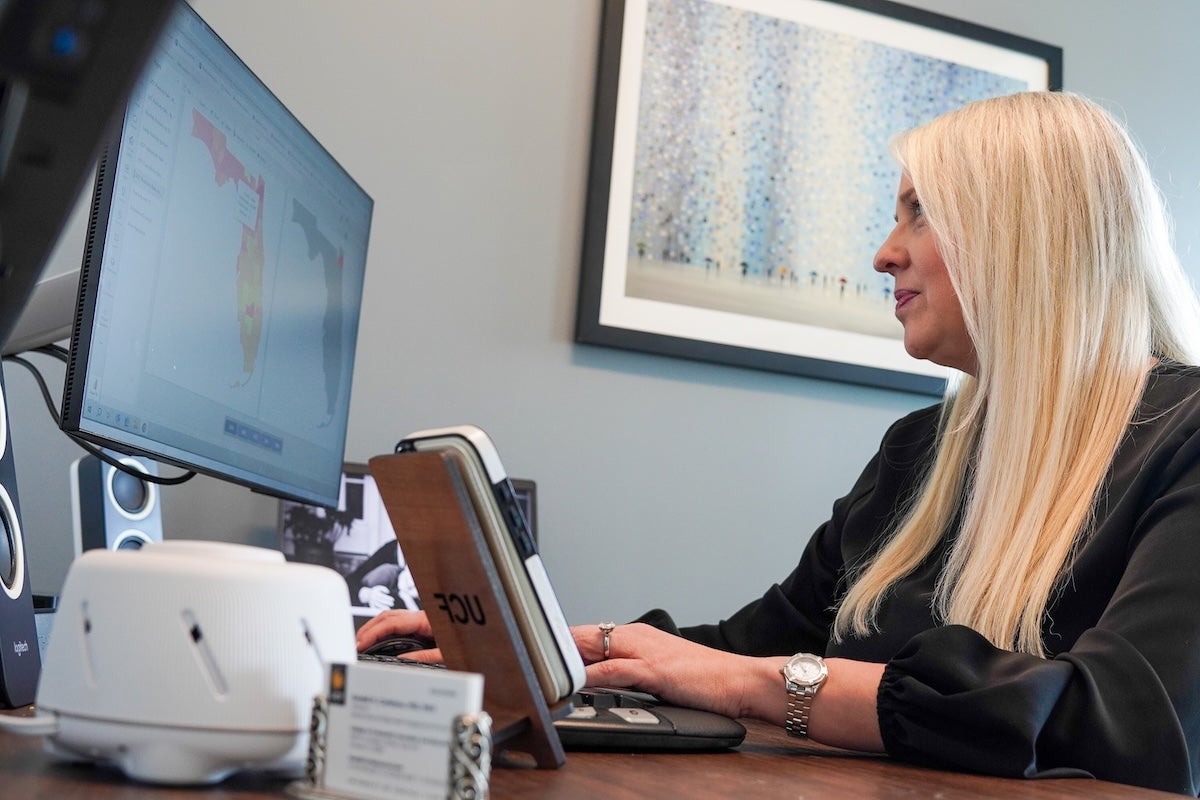
More than 5,500 fatal overdoses occurred in Florida last year, with 353 occurring in Orange County alone, according to data compiled by the Florida Department of Health. School of Global Health Management and Informatics Director Kendall Cortelyou aims to reduce this number by helping predict when and where overdoses could occur before it’s too late, an area health researchers have long suffered a disadvantage.
The needed breakthrough may be just around the corner with the development of an online dashboard DrugTRAC, which uses an AI-powered algorithm to synthesize information provided from statewide lab records — allowing for nearly real-time insights on the local drug supply.

“Even though I’m an administrator, this research is something I think I’ll always be involved in because it is so important,” she says. “This is how we save lives — by reaching out and doing things proactively instead of retrospectively.”
This initiative was created through Project Overdose, a community-based nonprofit focused on combating overdoses resulting from the opioid and drug epidemic that Cortelyou worked with for six years. Formerly called Project Opioid, Project Overdose partners with local business, faith, philanthropy and public health leaders to address substance use in Florida.
How DrugTRAC Works
Cortelyou collaborated with tech developer Social Innovation Technologies to help design DrugTRAC, which stands for tracking, reporting, advocacy and coordination. The data, which is anonymized and privacy-protected, relies on routine lab tests like urine and toxicology screens to offer researchers new insights into which substances are circulating in Florida communities.
“One of the biggest challenges in this field is that we’ve always been behind,” Cortelyou says. “The only real data about what is happening in the drug supply in your community has been from mortality data, which takes almost 12 to 18 months to get after someone dies from an overdose. That means you’re dealing with yesterday’s problem. If you’re trying to make decisions based on trends that were happening a year ago, you’re always behind.”
The dashboard compiles nightly drug-screen results and tracks more than 90 different substances before mapping emerging trends down to the ZIP code level. That information can then be used to alert community leaders and first responders to potential spikes and co-occurring substances, like the presence of fentanyl in cocaine.
DrugTRAC’s Current and Future Impact
The tool recently detected the presence of carfentanil, an extremely dangerous synthetic opioid that is nearly 1,000 times more potent than morphine and 100 times more than regular fentanyl. It could require four or five administrations of Narcan to revive someone from a fatal overdose, making it crucial that first responders and community leaders are alerted to any presence in the community.
However, artificial intelligence will take the tool’s impact to the next level. Cortelyou and the Social Innovation Technologies team anticipate being able to launch a more proactive approach with the help of AI in the next six months. By integrating an innovative, AI-powered algorithm into the system based on a range of data — including economic indicators, major events, arrest records and time of year — to predict future trends. That information can be used to provide early warnings to hospitals, emergency medical services, law enforcement and community organizations.
“I’m working with the programmer to help them identify the data sources that will feed into the algorithm, like the factors that cause spikes in drug usage,” Cortelyou says. “The dream is that once this system becomes predictive, we’ll be better prepared and able to say, ‘Hey, in the next couple of weeks, we’re expecting to see X, Y and Z happen in your community. Get ready.’”
Cortelyou says they are also currently investigating ways to make the alerts and information more accessible, like social media content targeted toward younger, more at-risk age groups.
Ultimately, Cortelyou hopes this technology can help communities get ahead of drug overdoses and help communities respond faster than ever before.