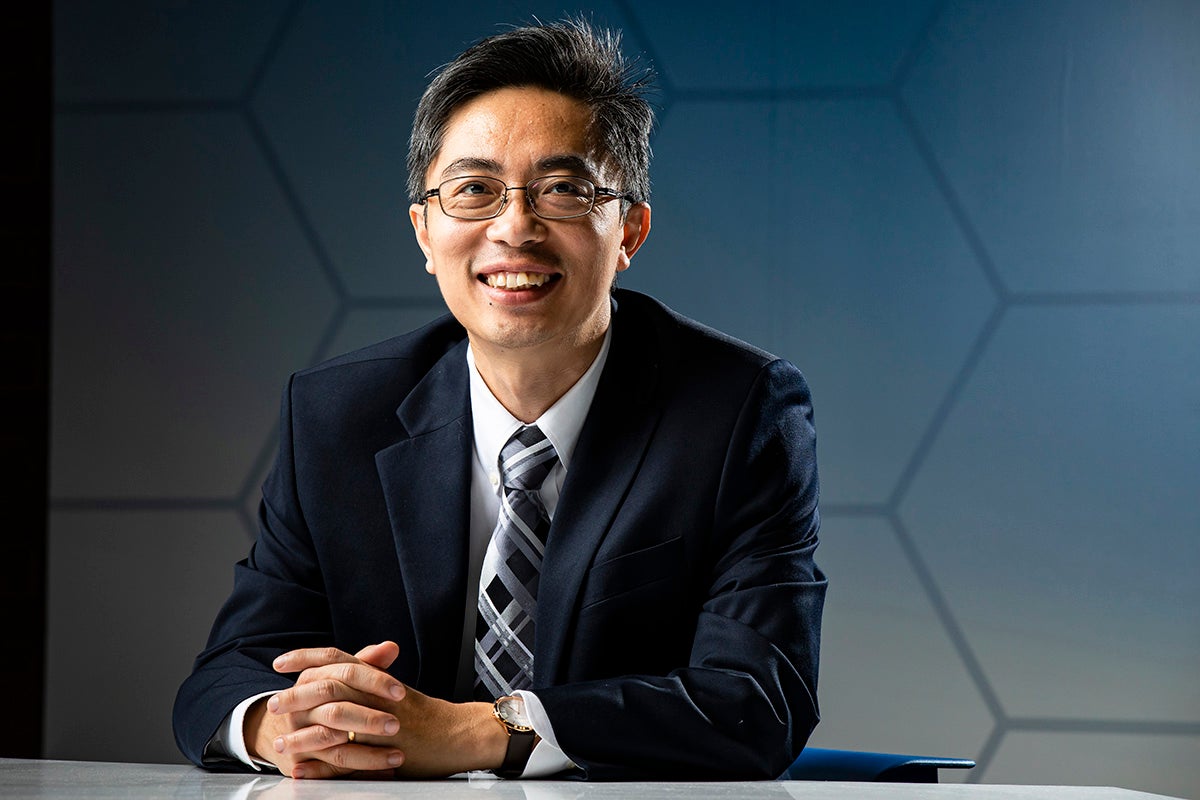
After decades of pushing the boundaries of how computers think, Pegasus Professor Yan Solihin of the Department of Computer Science has earned the highest professional distinction in computer architecture.
The Association for Computing Machinery (ACM) has named Solihin to its 2025 class of fellows — a distinction awarded to just 71 professionals worldwide for their remarkable achievements, technical innovations and lasting contributions to the field.
Selected from ACM’s 100,000 members, the new fellows will be formally inducted at the ACM Awards Banquet in June.
For Solihin, the recognition represents something deeper than a title.
“Being one out of 71 selected for this designation worldwide in 2025, I feel deeply honored,” he says. “This recognition is the culmination of decades of research in computer architecture, with contributions from my former and current Ph.D. students and collaborators.”
A Pioneer in Computer Architecture
Long before today’s cloud-powered, security-conscious computing era, Solihin was asking questions others weren’t.
In the early 2000s, as research focused on single-core processors, he turned his attention to multicore systems and uncovered a hidden flaw. His research group identified a critical performance challenge in shared cache architecture: uneven slowdowns caused by cache sharing. When multiple programs run simultaneously and share a common cache, some slow down more than others due to resource limitations.
“I feel deeply humbled because, at the time I chose to work on these problems, it was not clear how important they would turn out to be.”
Groundbreaking when it emerged in 2003, this phenomenon is now widely known and studied by computer scientists. Solihin and his group coined the term “fair cache sharing” and introduced a technique to partition the cache so programs slow down equally, ultimately improving overall performance. They also coined the term “cache quality of service,” advocating for cache policies that enable differentiated performance levels. Solihin also pioneered research on secure processors, which allow applications to run in an environment protected from vulnerabilities in system software.
Today, those once-theoretical ideas are foundational. Cache partitioning and secure processors are now standard features in graphics processing units and central processing units, particularly those powering cloud computing systems worldwide.
“I feel deeply humbled because, at the time I chose to work on these problems, it was not clear how important they would turn out to be,” Solihin says. “I started working on … cache partitioning when the hot research topics of the day were single-core processors. I started working in secure execution environment design when it was still unclear if hardware architecture should play a major role in computer security.”
Making an Impact in Industry and Education
After earning his doctorate in computer science from the University of Illinois at Urbana-Champaign, Solihin worked as a professor at North Carolina State University. He then joined the U.S. National Science Foundation, where he served as a program director for secure and trustworthy research on cyberspace and computer systems.
When he joined UCF in 2018, that bold ambition and pioneering spirit came with him.
As director of the Cyber Security and Privacy Cluster at UCF, Solihin helped expand the university’s research footprint and developed the Cyber Security and Privacy master’s program within the Department of Computer Science. Under his leadership, the program has grown to 200 students, the research cluster has added 13 faculty members and his findings have been incorporated into the computer processing industry’s design and development of computer architecture.
Yet Solihin doesn’t claim any of these achievements as his greatest.
“The achievement I am the proudest of is the positive impact I have made on students that I have advised,” he says. “Some of my past students have established good careers of their own, including becoming professors at Oxford University, Northeastern University, UC Santa Cruz and Binghamton University.”