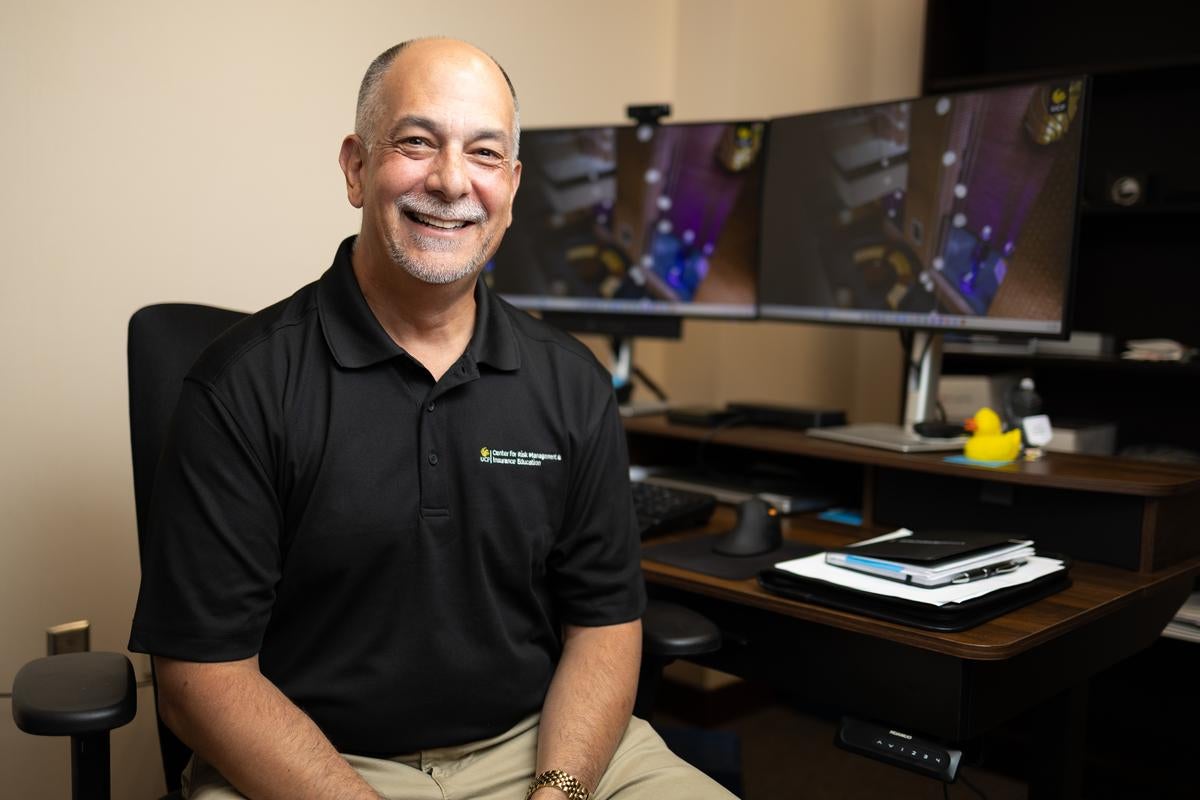
The world Gabriel Carrillo has known for his entire professional life is approaching “a cliff.” He’s seen it coming: The end of 2026 closing a five-year period when the insurance industry loses 400,000 workers to retirements. According to the U.S. Bureau of Labor Statistics, half of the once-robust workforce is expected to retire by 2036, leaving behind a gigantic void.
Carrillo is not among those planning to retire. He isn’t panicking either. After 30 years in underwriting, actuary work, risk management, research, and product development, Carrillo believes he’s just getting started. He embraces the workforce chasm as an enormous opportunity. It’s why he brought decades of experience to UCF in July 2025 to direct the Center for Risk Management and Insurance Education.
“I came here because UCF’s strengths in areas like technology and innovation give us a head start to transform this field in spaces where it’s lagged and build something special from scratch.”
“I came here because UCF’s strengths in areas like technology and innovation give us a head start to transform this field in spaces where it’s lagged and build something special from scratch,” Carrillo says.
He credits Ron Piccolo, associate dean for strategic initiatives in the Barry S. Miller College of Business, for preparing a smooth runway. They’ve worked hard to have a major and minor in risk management in place by Fall 2026. In April 2026, UCF’s Board of Trustees approved a new bachelor’s program in risk management and insurance education, pending Florida Board of Governors’ approval. Carrillo and Piccolo aim for an MBA and a continuing education program to follow. Experts trained at UCF will eventually partner with industry leaders to identify problems, apply research and deliver cutting edge talent.
“I can see what’s ahead, and it’s amazing,” Carrillo says. “At the same time, I’m fully aware of the serious challenges directly in front of us.”
Shattering Perceptions of Insurance
To infuse the program at UCF with as much optimism as he exudes, Carrillo must first face down the insurance industry’s most significant obstacle.
“Perception,” Carrillo says, bluntly. “Negative depictions of insurance professionals are everywhere. We even see it in kids’ movies, like The Incredibles, where the boss at an insurance agency is a villain. People grow up believing the entire industry is complicated and greedy.
“Our first step is to blow up those perceptions.”
To do that, Carrillo has been inviting professionals to show UCF students what the future of risk management looks like (young and enthused) and where their talents are being applied (Disney, the PGA Tour, the New York Yankees, and Marriott, to name a few). The diverse skillsets (drone operators, investors, accountants, and experts in fintech and cybersecurity) and personalities (extroverts and introverts) do not perfectly match old stereotypes.
The casual “get-to-know-us” events have stirred enough interest to fill as many as 144 seats, with others at The Exchange reaching the capacity of 120.
“Students sit up and say, ‘Wait, we thought working in this field meant shlepping life insurance to people who don’t want it or sitting in cubicles to deny claims.’ Their minds open up when they hear about professional playgrounds that don’t fit the mold.”
“I believe this calling is among the most noble things we can do. We’re helping people put their lives back together at a time of great loss.”
Interest heightens when “the cliff” enters the conversation. In addition to jobs opening because of mass retirement, analysts expect risk management and insurance to grow 17% per year into the foreseeable future, with average starting salaries ranging from $60,000-$90,000. Carrillo says a recession-proof career is all but guaranteed. To the skeptical question, “But is it fulfilling?” he candidly answers from his own experience.
“I believe this calling is among the most noble things we can do,” he says. “We’re helping people put their lives back together at a time of great loss. Is that what people think we do? Maybe not. It’s up to us to change that.”
And that leads to a second canyon-size gap: the knowledge gap. Sound personal advice has been replaced with search engines that find the cheapest rates for the minimum coverage, which can turn out horribly for customers when coverage is actually needed.
“Financial literacy has to be a big part of what we build,” Carrillo says. “With it, graduates can help people make informed decisions and have better lives.”
The 85-15 Ratio
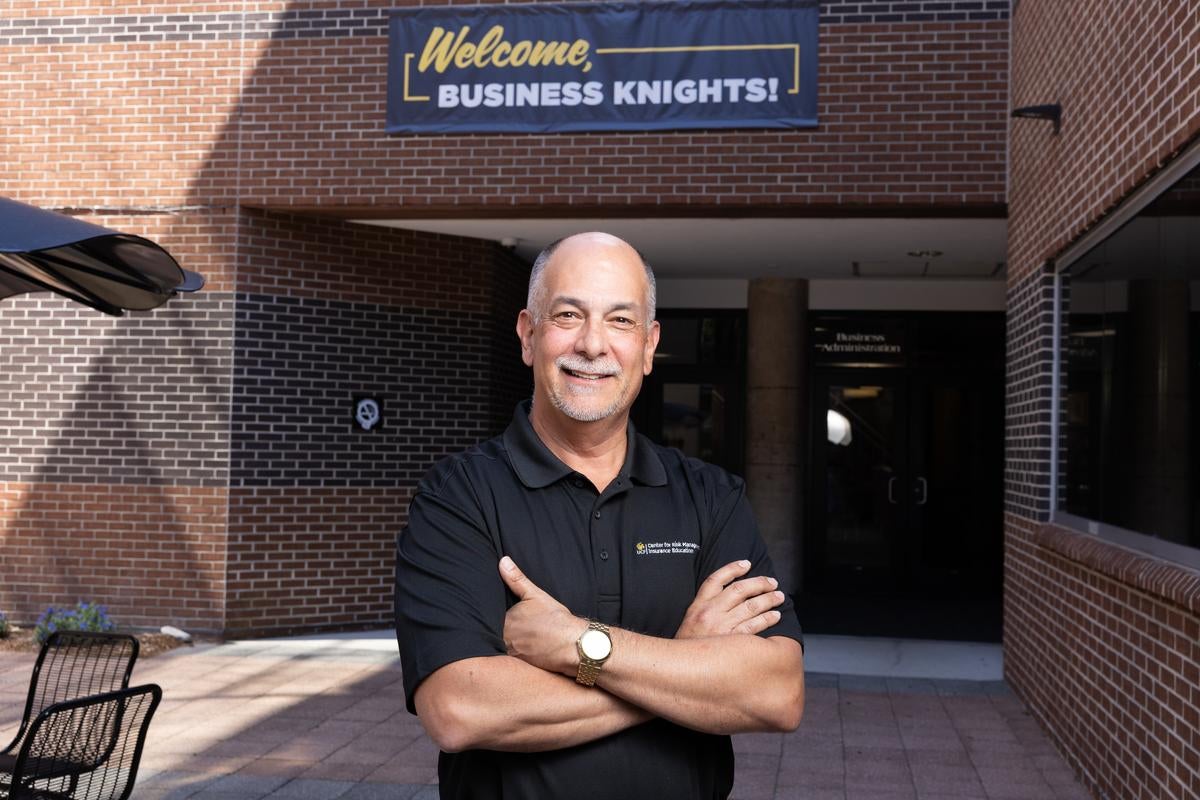
Carrillo plans to launch a podcast soon called, “No One Does This on Purpose.” From his own research, he estimates only 15% of the people working in insurance and risk management intended to enter the industry. The other 85% have stories like Carrillo’s.
As an undergraduate at Purdue University, he took a summer job in the mailroom of an insurance company. An underwriter welcomed Carrillo on his first day and told him, “You’ll stay in this business.” Shortly after, the president of the company and shared more welcoming encouragement.
“I didn’t pay much attention because I wanted to be a pilot,” Carrillo says, “but everyone at that place blew up my own perceptions. The culture hooked me.”
He’s identified hooks all around Central Florida. UCF will be the 77th institution with a risk management and insurance education program, but Carrillo says few have a comparable location or a blank slate to do something truly new — another reason he chose to come here from one of the oldest such programs in the country at FSU. The Center will partner with major risk management companies, collaborate on research with other colleges on campus and with Daytona State, and match students to internships where fresh perspectives are coveted.
“I expect this to explode,” he says, sounding very much like a man who’s about to ride a clean wave into the future with a new generation of students. Like him, they might never want to leave.