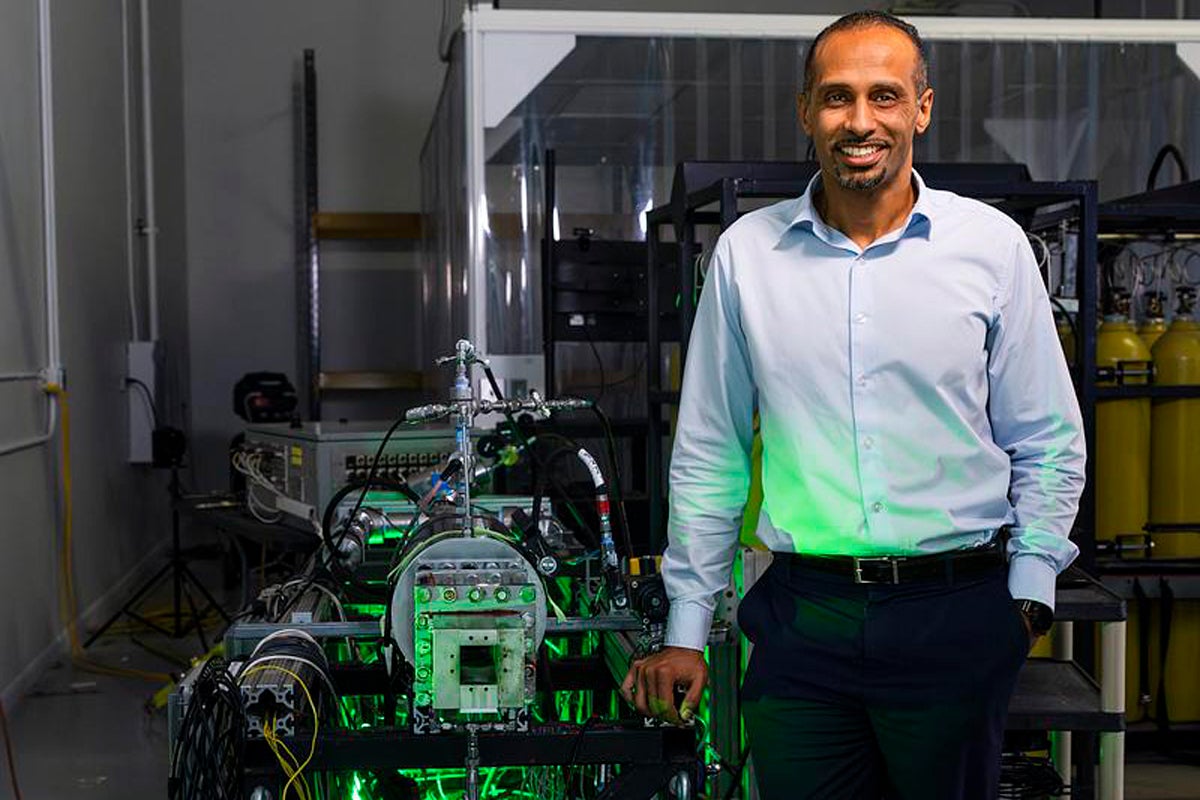
UCF Professor Kareem Ahmed is developing a dual-mode liquid detonation propulsion engine that will operate as an air-breathing engine at hypersonic speeds and transition into a rocket engine.
Funded by the Department of War’s Joint Hypersonics Transition Office, the UCF-led project aims to develop and test a design for a dual-mode, liquid, rotating detonation engine at UCF’s brand-new Center of Excellence in Hypersonic and Space Propulsion (HyperSpace Center).
The project builds on previous UCF research and may improve energy efficiency and reduce costs for commercial space access and transatlantic travel.
The research is in its early stages, but Ahmed says he’s hopeful this transformative technology will be realized over the course of the project.
“In simple terms, it could propel you at Mach 5 and above.”
“In simple terms, it could propel you at Mach 5 and above,” he says. “It will work like an aircraft engine that ingests air but transitions into a rocket engine that could take you to space or at faster speeds and bring you back into air mode propulsion again.”
Continuing to advance the emerging field of hypersonic travel and build upon previous successes is something Ahmed is looking forward to with his dual-mode detonation engine research.
Ahmed’s proposed engine technology may lend itself to making hypersonic travel possible – meaning that transatlantic travel may be possible in a fraction of the time it takes for conventional aircraft.
“We have significant plans of using that technology for hypersonic travel and other initiatives, reducing cost for commercial space access and making transatlantic travel quicker.”
“We’re very excited about this program because it builds up a lot of the capabilities that we have at the lab with exploring detonation-based propulsion, where we could drive high energy efficiency propelling you at faster speeds and functioning in different modes,” he says. “We have significant plans of using that technology for hypersonic travel and other initiatives, reducing cost for commercial space access and making transatlantic travel quicker.”
For this project, UCF is collaborating with researchers at the University of Michigan, Johns Hopkins University Applied Physics Laboratory, Raytheon Technologies and Pratt & Whitney.
Researcher’s Credentials
Ahmed joined UCF’s Department of Mechanical and Aerospace Engineering, part of UCF’s College of Engineering and Computer Science, in 2014. He is also a faculty member of the Center for Advanced Turbomachinery, Director of the Center of Excellence in Hypersonic and Space Propulsion (HYPERSPACE Center) and the director of the Propulsion and Energy Research Laboratory. He served more than three years as a senior aero/thermo engineer at Pratt & Whitney military engines working on advanced engine programs and technologies.
He also served as a faculty member at Old Dominion University and Florida State University. At UCF, he is leading research in propulsion and energy with applications for power generation and gas-turbine engines, propulsion-jet engines, hypersonics and fire safety, as well as research related to supernova science and COVID-19 transmission control. He earned his doctoral degree in mechanical engineering from the State University of New York at Buffalo. He is a DoD Distinguished Faculty Fellow, American Institute of Aeronautics and Astronautics associate fellow, and a U.S. Air Force Research Laboratory and Office of Naval Research faculty fellow.