Highlights
-
Today, U.S. News & World Report released its 2027 Best Colleges rankings, in which UCF earned recognition for:
-
No. 5 Most Innovative Public University in the nation and first in Florida
-
Top 10 public universities for Best Undergraduate Research/Creative Projects
-
Top 15 public universities for Best Undergraduate Teaching
-
Top 30 public universities for Best Value for In-State Students
Powerful innovation changes more than technology. Put to work for UCF students, it expands what they can learn, discover and achieve.
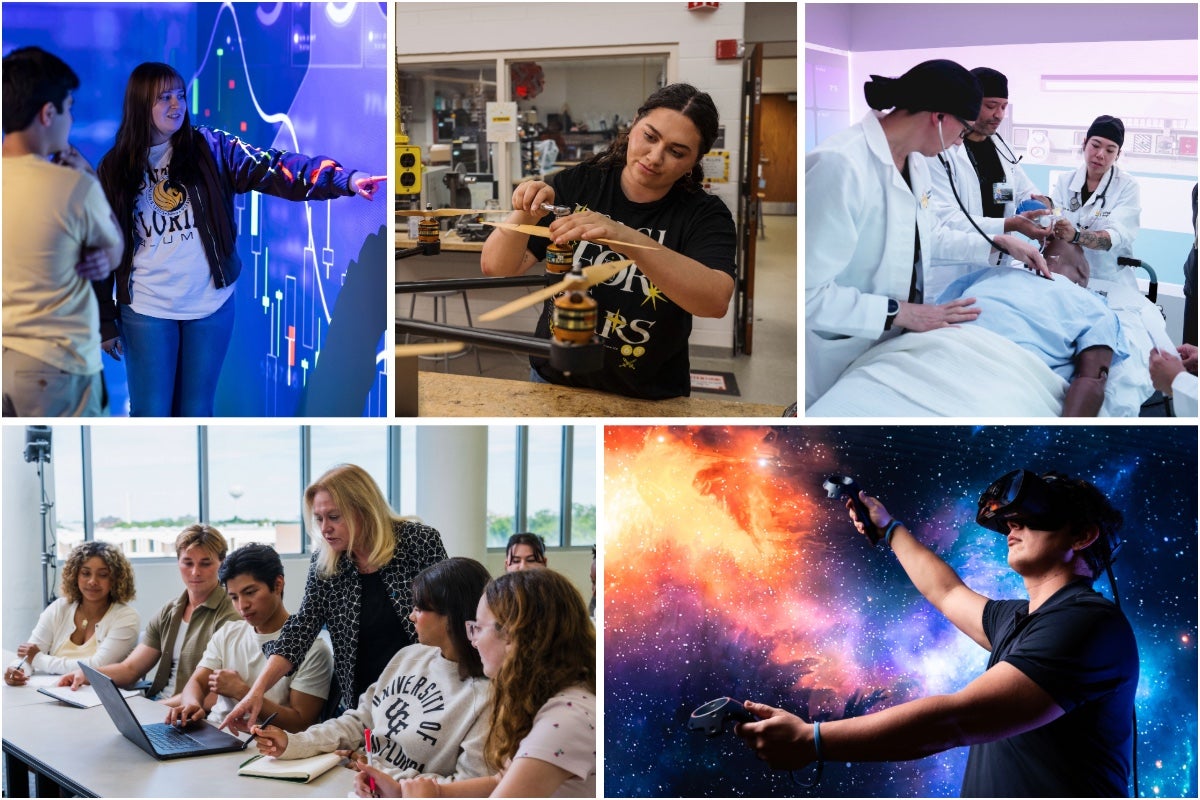
Across UCF, innovation takes shape through meaningful experiences. Students navigate patient care through immersive simulations, explore new possibilities for prosthetics, and learn from world-class faculty who bring industry expertise and mentorship into the classroom.
That approach has helped place UCF among the nation’s top five most innovative public universities and earn recognition as Florida’s most innovative university for the 10th consecutive year, according to the 2027 Best Colleges rankings released today by U.S. News & World Report.
“We are proud to see UCF recognized as Florida’s most innovative university and among the best in the nation for the opportunities we provide our students,” says UCF President Alexander N. Cartwright. “Our students work alongside outstanding faculty, contribute to meaningful research and gain experience taking on real problems. We want them to graduate from UCF knowing what they are capable of and ready to put that experience to work in our state and beyond.”
The distinction reflects the university’s commitment to elevating how students learn, how discoveries are made and how higher education strengthens the state it serves.
Preparing Talent That Strengthens Florida
For UCF nursing students, learning to care for critically ill patients can begin well before they enter a hospital room.
At UCF’s Helene Fuld Health Trust Simulation, Technology, Innovation and Modeling (STIM) Center, a global leader in healthcare simulation education, nursing students build patient care skills in realistic clinical environments.
“[We] continue to evolve the way we teach our nursing students because healthcare and technology are constantly evolving.” — Frances Armstrong, UCF clinical assistant professor
Clinical Assistant Professor and Graduate Simulation Coordinator Frances Armstrong recently combined the center’s immersive cave, a virtual ventilator and an artificial intelligence-enhanced platform to create a simulation for acute care nurse practitioner DNP students. The experience brings theory to life, challenging students to apply what they’ve learned as they prepare for the complexities of patient care.
“It’s important for us to continue to evolve the way we teach our nursing students because healthcare and technology are constantly evolving,” Armstrong says. “One of the main ways to do that is by being innovative.”
That impact extends beyond the classroom. UCF has educated more than 17,000 Knight nursing alumni to date, with over 80% living and working in Florida. Our undergraduate nursing program also ranks among the top 50 public universities nationally.
When Research Meets the Real World
UCF also ranks among the nation’s top 15 public universities for Best Undergraduate Teaching and top 10 for public universities for Best Undergraduate Research/Creative Projects — and is the only Florida university recognized in the latter category. Those strengths converge as students work alongside faculty to answer questions without obvious solutions.
More than 2,000 UCF undergraduate students conduct research each year. For computer science graduate student Eugenio Diaz ’26, that opportunity began as a sophomore through a research event that matches students with faculty experts.
There, he connected with Mohsen Rakhshan, an assistant professor in UCF’s Department of Electrical and Computer Engineering. Together, they began exploring a question with life-changing potential: Could technology help a prosthetic hand recognize what it touches?
Their project, “Texture Classification Using Neuromorphically Encoded Tactile Sensing Data,” combines AI, neuroscience and engineering to identify textures from tactile data. The technology relies on spiking neural networks, which more closely mimic how biological neurons communicate. The research could eventually help prostheses restore a sense of touch.
“This project showed me how satisfying it can be to take [theoretical] ideas … and turn them into something that addresses a tangible problem.” — Eugenio Diaz ’26, UCF student
Diaz helped redesign the data-collection system, train models, analyze results and author a paper now under review.
Progress wasn’t immediate. For months, the models performed little better than random guessing. Guided by Rakhshan, Diaz kept experimenting until accuracy surpassed 80%.
“Mentoring undergraduate students is both teaching and research,” Rakhshan says. “I try to teach students how to think and guide them to find answers to what is known and unknown.”
For Diaz, the breakthrough revealed what his skills could accomplish.
“This project showed me how satisfying it can be to take ideas that are interesting theoretically and turn them into something that addresses a tangible problem,” Diaz says.
Putting More Opportunity Within Reach
Experiences like these have a greater impact when more students can reach them.
UCF is among the nation’s top 30 public universities for Best Value for In-State Students.
Value goes beyond the cost of a UCF degree. It’s reflected in the opportunities students have to learn and collaborate with faculty experts, contribute to hands-on research, work with emerging technology and develop skills that prepare them for graduate study and the workforce.
Together, the rankings reinforce innovation with a clear purpose: creating more possibilities for students to learn, discover and build what’s next.
To see the full list of U.S. News & World Report rankings, visit ucf.edu/academics/us-news-rankings.