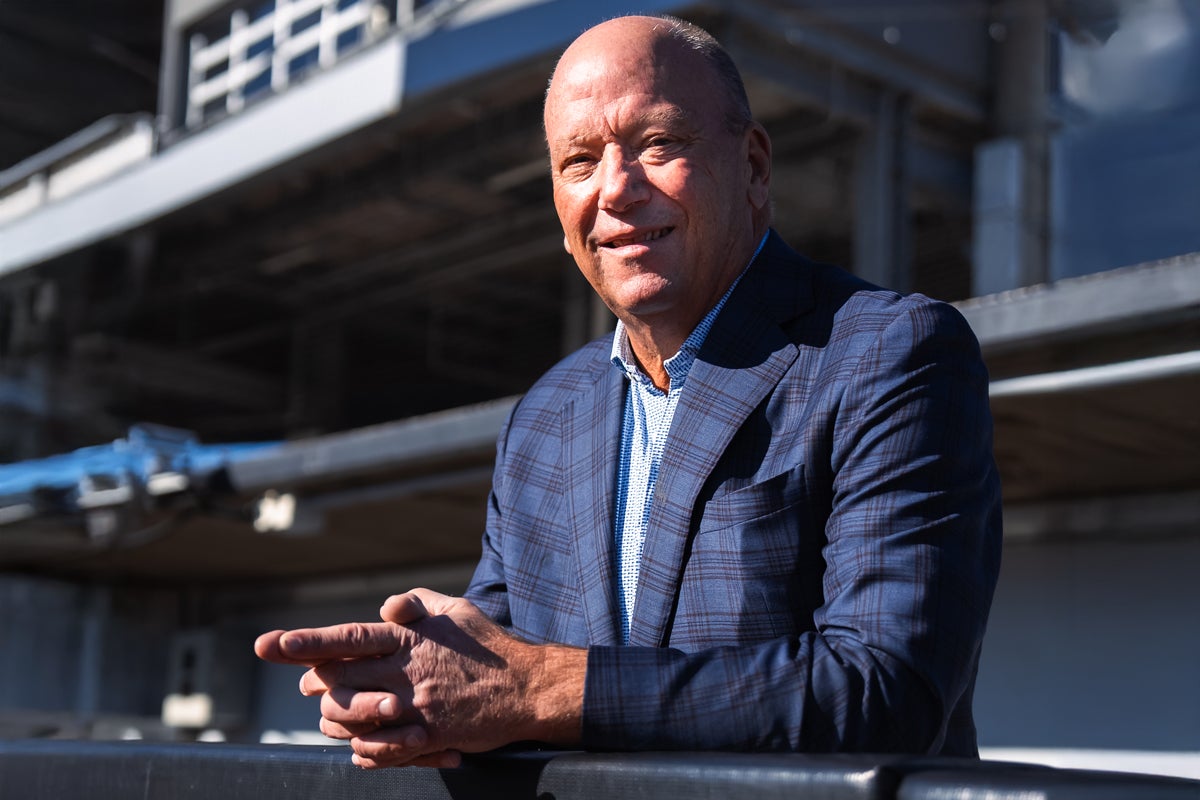
Paul Ryan ’83 was never formerly a basketball player, but his career got its start on the courts.
It was there that the accounting major — and former Division I baseball player — was first introduced to Kenneth Dixon ’75. It was the spring of 1983, the middle of a recession, and Ryan was struggling to line up a job after graduation. He had his sights set on working for one of the Big Eight accounting firms, and didn’t yet know that he’d not only become one of the most successful and well-respected partners at PwC — now part of the Big Four — but that he’d go on to pioneer the field of real estate taxation.
At the time, all he knew was that graduation was looming, job openings were scarce, competition was fierce, and he needed a job.
Ryan discussed his predicament with friends, lovingly referred to as “the fellow jocks,” who lived near him on Walden Wood Drive across from campus.
“One day, one of them said, ‘Hey, you know our friend is a senior manager at one of those big accounting firms,’ ” Ryan says. “‘We told him about you — that you’re a good guy, a good athlete and almost got a 4.0. He said, ‘Wow. We don’t see a lot of people like that. Tell this guy to call me,’ and they handed me Ken Dixon’s card.”
That was in June. Ryan was scheduled to graduate in July. The two met at a pickup basketball game. As it turned out, Dixon was in charge of recruiting for the Orlando office of what was then Price Waterhouse. At some point during the match, Dixon leaned over and said, “Well, you know, you’re hired.”
There would, of course, be a formal interview, but Ryan says he “was on cloud nine.” For his part, Dixon already knew Ryan had the skills — after all, both had gone through the same accounting program at UCF. But on the court, Dixon saw the qualities he knew would lead to Ryan’s success at what they both call simply The Firm.
“I saw right away that Paul was a good athlete, and good athletes are disciplined,” Dixon says. “They’re into team play. They have all the things that that you need to be successful, and you can see that from Paul’s career. He’s a great soldier, and he became a great leader. Plus, he’s a charming, wonderful guy. I probably would have hired him and liked him, even if he wasn’t an athlete, but after playing with him, I hired him right away. And I’m glad I did. Obviously, I made a good call.”
Turning Luck into Opportunity
The first thing to know about The Firm is that internally, they deal with a lot of numbers —big numbers — but externally, they share few of them. The three numbers that have been shared are 2 (the number of partners in the real estate practice when it was created), 49 (the number of partners in the national practice when he retired in 2022) and $55.4 billion (the firm’s global annual gross revenues last year, which his team contributes to).
Without more numbers, it’s hard to grasp the full scale of what Ryan achieved at PwC. But those who know, know.
“We both do real estate tax, but New York is the big leagues,” says Dixon, who has donated more than $20 million to UCF to support everything from the School of Accounting and Career Development Center to the Athletic Village. “I’ve done pretty well in Florida as an entrepreneur, but Paul was dealing with some of biggest names in the world in terms of real estate taxation. He really ascended all the way to the top of the field — serving as one of the leaders of PwC for a long time.”
For his part, Ryan will tell you that getting there involved a lot of hard work, a knack for building relationships and a healthy dose of luck.
The first bit of luck came in 1986, three years after starting at The Firm’s Orlando office. Back then, new hires at PwC started in auditing.
“There was no such thing as going into tax, so I spent two years in auditing, learned a lot and worked on interesting projects, including for Disney,” Ryan says.
Still, tax was his goal. So he spent time with people on that side of The Firm, soaking up everything he could. Soon after, he was recruited to join them, but felt behind. There was so much to know about tax codes, and his peers had a head start. Then came the Tax Reform Act of 1986. When President Reagan signed it into law on Oct. 22, it leveled the playing field. Ryan saw his opportunity.
“Luckily, I was able to catch up really quickly because everybody was starting from zero, and I made manager,” Ryan says.
Four years later, another opportunity: Ryan landed a position in PwC’s New York office working in financial services, which, at the time, covered everything from asset management to banking and insurance.
“There were no subgroups,” he says. “It was all just financial services, so you did a lot of everything. I ended up getting very lucky and being assigned to JP Morgan and working alongside a guy by the name of Bob Mortiz, who became our U.S. chairman and senior partner and then our global CEO. He just retired.”
By 1996, Ryan had made partner but he needed a big client to truly distinguish himself. No one would hand him that. But as luck would have it, he was asked to lead the real estate tax group. Ryan admits at first that move didn’t exactly feel so lucky. It was only two partners and a handful of people, some who technically made more than him. Why would they need — or want to listen to — him?
“I figured this would be a little side job,” Ryan says. “Then I’d get back into banking, take over JP Morgan and conquer the world. But, you know, luck is everything.”
That luck looked a lot like foresight. Ryan began closely following real estate trends and found a promising — if then modest — client: Starwood Capital Group.
Back then, Starwood was not part of PwC’s real estate portfolio. They brought in money, but not as much as others. Ryan asked the partner who oversaw them if he could have them, and was granted his request. In only three years, Ryan had transformed Starwood into one of The Firm’s largest tax clients.
“That move really propelled our group to grow,” Ryan says.
“Paul really led PwC to become the market leader in real estate tax.” — Jay Thibodeau, director of the Kenneth G. Dixon School of Accounting
And grow it would. With Starwood, Ryan saw the potential in the complicated new landscape of real estate taxes. He realized consulting and tax couldn’t be siloed. He merged the two and began building a powerhouse portfolio. The work piled up. So did the talent.
“Paul really led PwC to become the market leader in real estate tax,” says Jay Thibodeau, director of the Kenneth G. Dixon School of Accounting. “Because of his excellence in that highly specialized space — particularly international taxation — PwC became the go-to firm for large private equity shops in New York. They built an entire practice around it.”
Thibodeau first met Ryan in 2024 and was “blown away” not just by his legacy, but by the number of current partners — busy people with little free time — who will still drop everything for a reception or a meal if Ryan invites them.
To understand why is not just to understand the range of Ryan’s influence but also the time, effort and care Ryan put in to building authentic relationships not only with his direct reports but also his clients, fellow partners and others.
‘There Is a Story in Every Game, but the Story Is Not Always the Score.’
“Paul was definitely the driving force behind building a strong brand, lasting client relationships and attracting top talent in the marketplace,” says Addhyan Vora, a director in PwC’s national real estate tax practice. “But for Paul, it often went beyond the numbers. For him, it was about building a culture.”
Vora met in Ryan in 2014, when he was brand-new associate. His desk sat just outside Ryan’s office. One day, Ryan tapped him on the shoulder, invited him to lunch and told him to grab two other people of his choosing. It would not be the last time he did it. As it turned out, this was a common occurrence for Ryan with all new associates and others across PwC.
“We would always go to the Michael Jordan’s Steak House in Grand Central — it was his favorite,” Vora says. “It surprised me that someone at his level, a partner, would take the time to invest in relationships with associates like me. That’s just the kind of person he is.”
It’s been three years since Ryan retired, but the two remain close. Just this past November, Vora spent a week at Ryan’s home in Florida, playing golf, riding ATVs and hanging out with his family.
“If you worked with him or for him, you were his family,” Vora says.
Perhaps that’s why the people closest to him will also tell you Ryan’s biggest legacy is not just his career. It’s how he invested in people, personally and professionally.
The sentiment is echoed by Brandon Bush, who now holds Ryan’s former role as real estate tax leader at PwC. Bush met Ryan in 2004, and a rejection with the Chicago team led him to the New York team — and to Ryan.
“Paul is someone who took risks on people and invested in them in a good way. He gave me a shot at PwC that others didn’t and brought me into his team right out of school. ” — Brandon Bush, real estate tax leader at PwC
“Paul is someone who took risks on people and invested in them in a good way,” Bush says, who has been with the company for more than 20 years. “He gave me a shot at PwC that others didn’t and brought me into his team right out of school. That started a long mentorship.”
For Bush, Ryan’s leadership style stood out. He trusted his team to lead.
“Paul was the boss — and would tell you he was the boss — but he was comfortable with other people taking the lead and learning from their mistakes while he advised in the background,” he says.
Ryan still, on occasion, mentors from behind the scenes. During Bush’s first 18 months leading the group, the two spoke as often as three times a week.
“Brandon has been running the team since he was 38, and he’s been through the thick of it during his time at PwC,” says Ryan. “We would often discuss strategy, which I dealt with very differently than he does. He’s much more strategic internally than I ever was, and he needs to be, because he’s not me.”
Externally, so much of Ryan’s approach while at PwC was focused on bringing people together.
Darren M. Berk — a fellow CPA and chief financial officer for Dune Real Estate Partners — first met Ryan in 2005 and “brought [PwC] on right away.” During their time together, Ryan and his team not only designed a structure that met Dune’s tax requirements but also delivered practical tools to provide comprehensive tax solutions to their investors.
But Berk will tell you Ryan’s greatest strength wasn’t just his technical expertise — it was his collaborative instincts.
“What Paul did better than most people I’ve worked with is bridge relationships,” says Berk. “Paul really did a fantastic job in creating networking opportunities so people in the industry or related positions could meet each other and the PwC team’s deep bench.”
Today, Berk is part of an informal network of roughly 100 real estate CFOs. The group started with just 10 people that Ryan brought together, and that small circle grew organically as Ryan continued to foster collaboration and offered his team’s expertise to keep members informed on evolving tax issues.
As an example, Berk cites President Donald Trump’s Tax Cuts and Jobs Act of 2017. When this law was passed, Berk and his colleagues were fielding questions from executives and investors. He called Ryan — who, true to form, stepped in to help. Ryan rented a venue, brought in a fellow PwC partner and hosted a three-hour workshop for the CFO group.
“They went through basically the whole bill — section by section — and made it understandable,” Berk says. “It’s common practice for accounting firms to host classes on a special topic and networking events, but what Paul really did well was bring together tax-minded people with similar roles and industry focus.”
That recognition of individual strengths and shared interests combined with his encouragement earned him the nickname Ted Lasso, after the fictional American college football coach turned British professional soccer manager. Vora bestowed it on Ryan for his enduring optimism and ability to build a strong team.
“Under [Paul’s] leadership, we felt like a cohesive unit rather than individuals on a team. We were out there winning together, supporting each other and never letting any one person take all the blame if something went wrong.” — Addhyan Vora, national real estate tax leader at PwC
“Paul would often compare a successful team to a football squad,” Vora says. “Not everyone’s a quarterback. You need running backs, linemen, wide receivers. Paul is a master at figuring out who was good at what — and how to bring everyone together. That’s why under his leadership, we felt like a cohesive unit rather than individuals on a team. We were out there winning together, supporting each other and never letting any one person take all the blame if something went wrong.”
Those qualities that Dixon noticed on the basketball court all those years ago — knowing how to work with others to win, who to pass the ball to in different scenarios, when to fall back or charge forward — proved to be exactly what Ryan needed to succeed not only at PwC, but in building a legacy with the people around him. Now, he’s continuing that legacy by helping establish a pipeline to make it easier for today’s Knights to become tomorrow’s leaders and make a name for themselves at The Firm’s NYC offices. Ryan says so many UCF grads have what he looked for a good employee: the skills from majoring in accounting at UCF and a hunger that can’t be taught.
“The thing about so many UCF students is that they have a fire in their belly,” says Ryan, whose wife and two daughters also graduated from the university. “They want to learn. They want to work hard. If you show up to PwC with a brain and that attitude, you’re going to go places.”
Ryan certainly did.