Highlights
-
Larry Cooper helped establish UCF’s book arts program and shaped the School of Visual Arts and Design as an educator, master book artist, printmaker and collaborator.
-
Cooper introduced generations of students to book arts, mentored aspiring artists through Flying Horse Editions and served as assistant director of the UCF Gallery, supporting exhibitions, artists and connections with the broader community.
-
Cooper’s work and collaborations reached prestigious collections around the world. A faculty exhibition featuring his work is planned, with a celebration of life Oct. 26 at 5 p.m. in the UCF Art Gallery in connection with the exhibition.
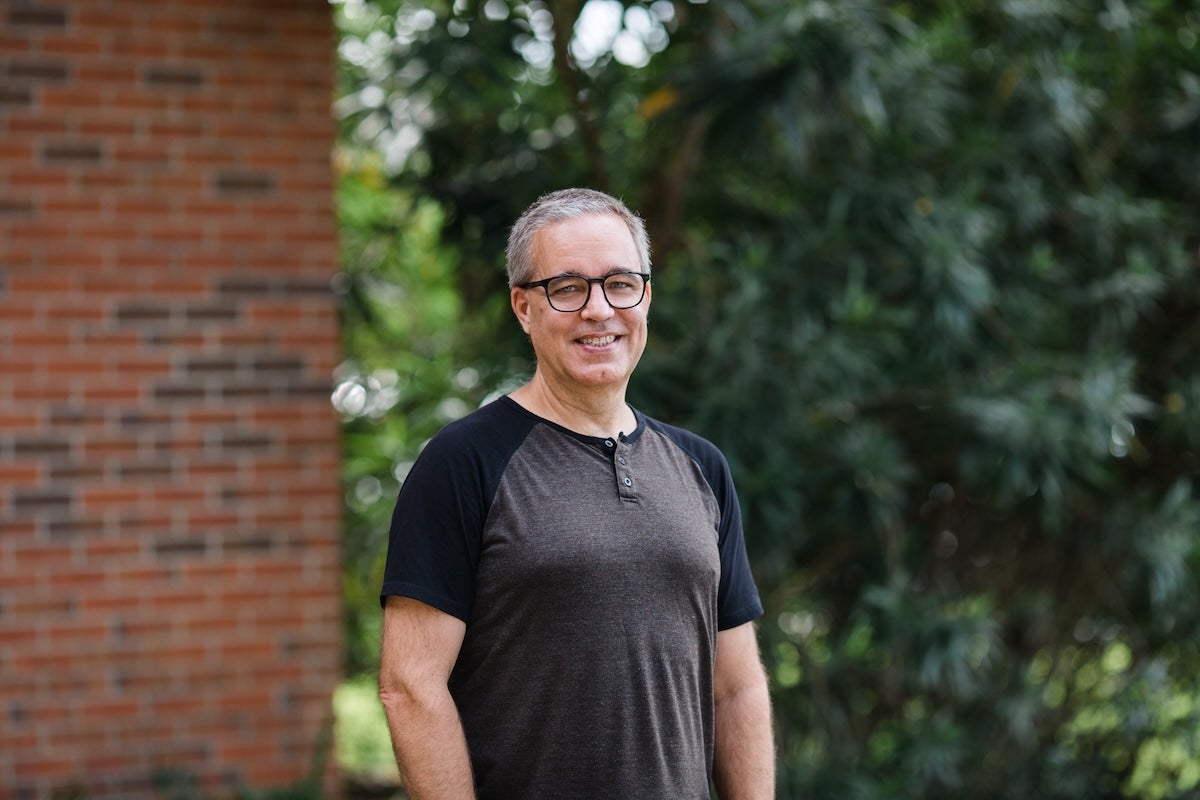
For nearly three decades, Larry Cooper helped shape the UCF School of Visual Arts and Design through his work as an educator, master book artist and printmaker. Cooper, who died Sept. 4, 2026, helped establish UCF’s book arts program, introducing generations of students to the craft of making books by hand.
Cooper earned a Bachelor of Fine Arts in Studio Art from Memphis College of Art and a Master of Fine Arts in Studio Art from the University of Georgia. When he joined UCF in 1996 as an assistant printmaker working with Ke Francis, he began a career that would touch nearly every corner of the visual arts community at UCF. He taught across undergraduate and graduate curricula, served as assistant director of the UCF Gallery and Flying Horse Editions, and became one of the school’s most respected educators and collaborators.
Francis first met Cooper in Memphis, Tennessee, where Cooper had been a classmate of Francis’ daughter, Kerry, at Memphis College of Art. The two later took a workshop together on case-making and their friendship continued as Cooper pursued his career in book arts and printmaking.
“I knew Larry for almost 34 years,” Francis says. “He was a master craftsman, a creative collaborative partner with the visiting artists who came to work at the press, and a much-loved, patient and thoughtful teacher of printing and the book arts. He was a generous and supportive friend, a kind and patient man with a great sense of humor, who will be missed by all of us who knew him.”
“There is not an area of SVAD that Larry did not impact,” says Kevin Haran, professor and associate director of studio art and Jenkins Distinguished Professor in Community Arts.
Haran describes Cooper as a warm friend who was also an exceptional collaborator.
“Larry was gifted at teamwork and was an extremely creative problem solver,” Haran says.
Building Programs and Mentoring Students
For many students, Cooper was their first introduction to book arts, sharing the technical skills and attention to detail that defined his own work. Cooper was an influential mentor to student interns at Flying Horse Editions and oversaw the internship program in the UCF Gallery.
Chris Saclolo ’09, who studied under Cooper before becoming a book conservator at UCF Libraries, remembers him as both an influential teacher and longtime supporter of Special Collections and University Archives, where he regularly brought his students to engage with the university’s book arts collection.
“Larry had a very calm demeanor about himself, which made learning from him so much more enjoyable, especially when learning a very detailed craft like bookbinding. I grew to love book arts because of Larry.” — Chris Saclolo ’09, UCF Libraries book conservator
“Larry was my first instructor who introduced me to book arts. He would always take the time to help you figure out a specific binding structure and would make it look so easy,” Saclolo says. “Larry had a very calm demeanor about himself, which made learning from him so much more enjoyable, especially when learning a very detailed craft like bookbinding. I grew to love book arts because of Larry.”
Cooper’s mentorship continued to influence Saclolo’s career. He wrote a recommendation letter for Saclolo’s application to a book arts graduate program in Chicago, where Saclolo received a fellowship. After graduating, Saclolo returned to UCF as a book conservator at Special Collections and University Archives, where Cooper continued bringing his book arts students to the library.
“Since my return, I have had the pleasure of speaking to his classes and sharing the book arts collection with his students every semester,” Saclolo says. “To me, it was a full circle moment that I could share our book arts collection with his students the way Larry introduced it to me.”
Cooper regularly brought classes to Special Collections and encouraged students to engage directly with artist books and rare materials. Cooper’s own work also became part of the university’s collections. One of his own artist books is held in the department’s permanent collection and was one of the first artist books donated to the archive.
Extending UCF’s Reach Through Book Arts
While Cooper’s influence was felt daily on campus, his work also helped raise the profile of UCF’s visual arts programs nationally.
Working through Flying Horse Editions and Gardyloo Handmade Books, Cooper collaborated with artists including William T. Wiley, David Humphrey and James Siena. His design for Siena’s Sequence One, published in 2009, contributed to the Museum of Modern Art’s acquisition of the book for its permanent collection.
Cooper also worked closely with artist Robert Rivers, helping transform drawings from Rivers’ Patagonia travels into handmade books that eventually entered collections including the National Gallery of Art and the Scottish National Gallery of Modern Art.
“Larry was a great friend who I’ve known since 1994,” Rivers says. “If you needed help, Larry would jump right in to assist without you having to ask. He liked being part of a team. Larry never interrupted anyone and was a calm, steady presence. He would always listen and never made it about himself.”
“[Larry] was an influential mentor to many student interns at [Flying Horse Editions], sharing with them his unique perspective on a profession in the arts.” — Theo Lotz, Flying Horse Editions director
Cooper’s own work is represented in collections including the National Gallery of Art, the Library of Congress, the J. Paul Getty Museum, the Corcoran Gallery of Art, the Scottish National Gallery of Modern Art and the San Francisco Museum of Modern Art.
At Flying Horse Editions, a collaborative research studio, Cooper worked alongside Director Theo Lotz and external artists and printmakers on projects such as Carmon Colangelo’s O LAND O, a limited-edition portfolio that was acquired by the Saint Louis Art Museum.
“Larry’s interest in the idea of the book as an art object, in and of itself, was important to the early Flying Horse projects. His expertise in conceptual bookbinding drove collaborative projects with artists such as William T. Wiley, David Humphrey and James Siena,” says Lotz, who is also a senior lecturer of studio art. “Cooper’s design for Siena’s book, Sequence One, published in 2009, was a contributing factor to the Museum of Modern Art in New York acquiring the book for its permanent collection. His easygoing collaborative spirit can be felt in FHE’s studio culture to this day.”
Lotz also remembered Cooper as an influential mentor to many student interns at Flying Horse Editions, sharing his perspective on a career in the arts.
“He was an influential mentor to many student interns at FHE, sharing with them his unique perspective on a profession in the arts,” Lotz says.
A Presence Throughout SVAD
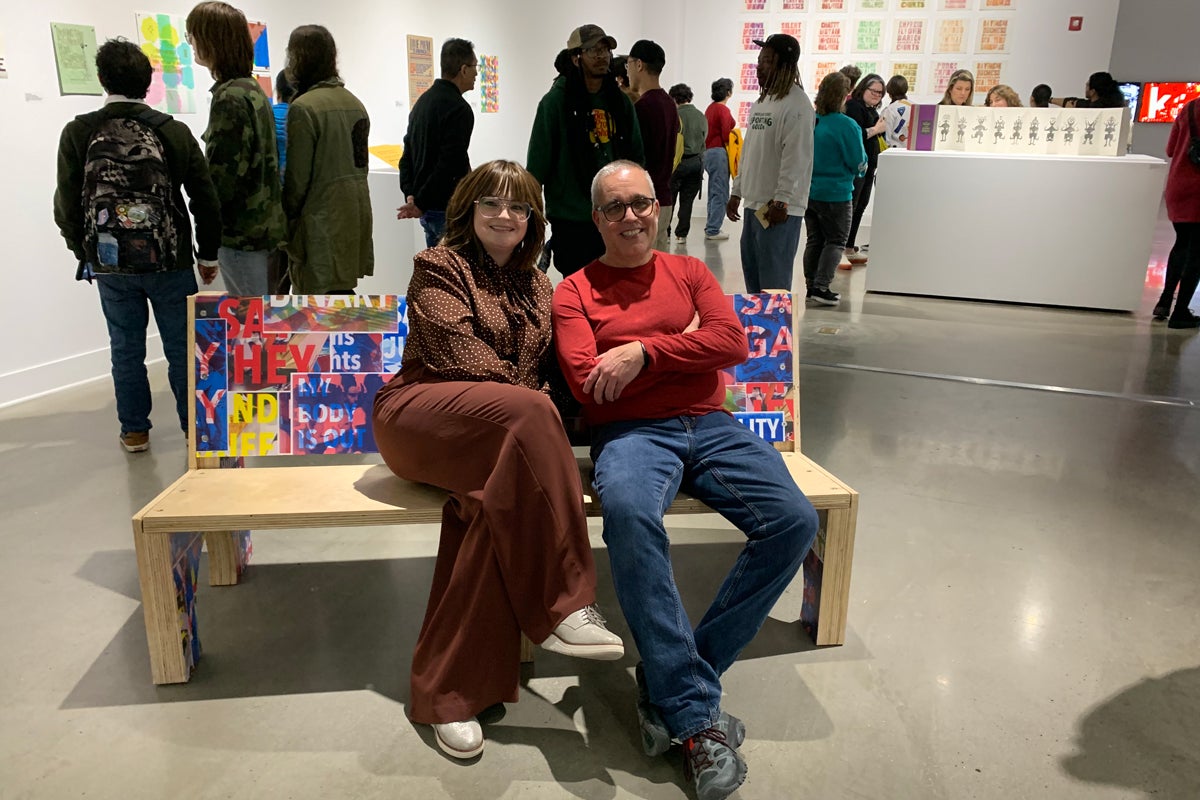
In addition to his teaching and studio work, Cooper served as assistant director of the UCF Gallery, where he helped organize exhibitions, support artists and connect the university with the broader community.
“Larry played a vital role in the UCF Art Gallery, sharing his expertise during installation and careful handling of artwork for every exhibition,” says Shannon Lindsey, associate lecturer and director of the UCF Art Gallery. “His keen understanding of materials, attention to detail and remarkable ability to solve even the most complex installation challenges made him an invaluable part of the gallery and the success of our exhibitions.”
The Legacy He Leaves Behind
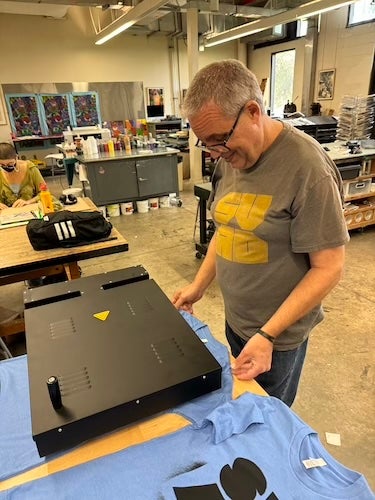
Many colleagues recalled Cooper’s sense of humor, his interest in pop culture, B horror and science fiction films, and quirky T-shirts.
Haran has a fond memory from the print shop, when Cooper laid out a collection of animal skins that had arrived for use as book covers. Among them was a yellowish, diamond-shaped piece that Haran could not identify.
It was stingray leather.
Cooper’s legacy is best measured through the people and programs he influenced — the students he taught, the artists whose work he helped bring to life and the books that remain in collections around the word — but also in the friendships he built over a lifetime.
Cooper is survived by his daughter, Raia Cooper ’26, his former wife, Micaela Riseling, and his mother, Jane. He will be missed by his SVAD colleagues and the countless students he mentored.
A faculty exhibition featuring Cooper’s work is planned, with a celebration of life taking place in connection with the exhibition on Oct. 26 at 5 p.m. in the UCF Art Gallery.