Highlights
-
UCF’s animation program, which blended traditional hand-drawn techniques with emerging digital tools, paired with direct access to working Disney animators, prepared Luke Cormican ’01 to thrive in a rapidly evolving field.
-
Today, he leads one of television animation’s most enduring franchises as a showrunner, overseeing every part of production.
Luke Cormican ’01 still remembers a time when animation meant stacks of paper, sharpened pencils and long nights hunched over a drawing table. It was a far cry from today’s fully digital pipelines and global productions. That hands-on foundation, paired with a willingness to evolve alongside rapidly changing technology, helped propel the UCF art graduate to the top of one of television animation’s most enduring franchises.
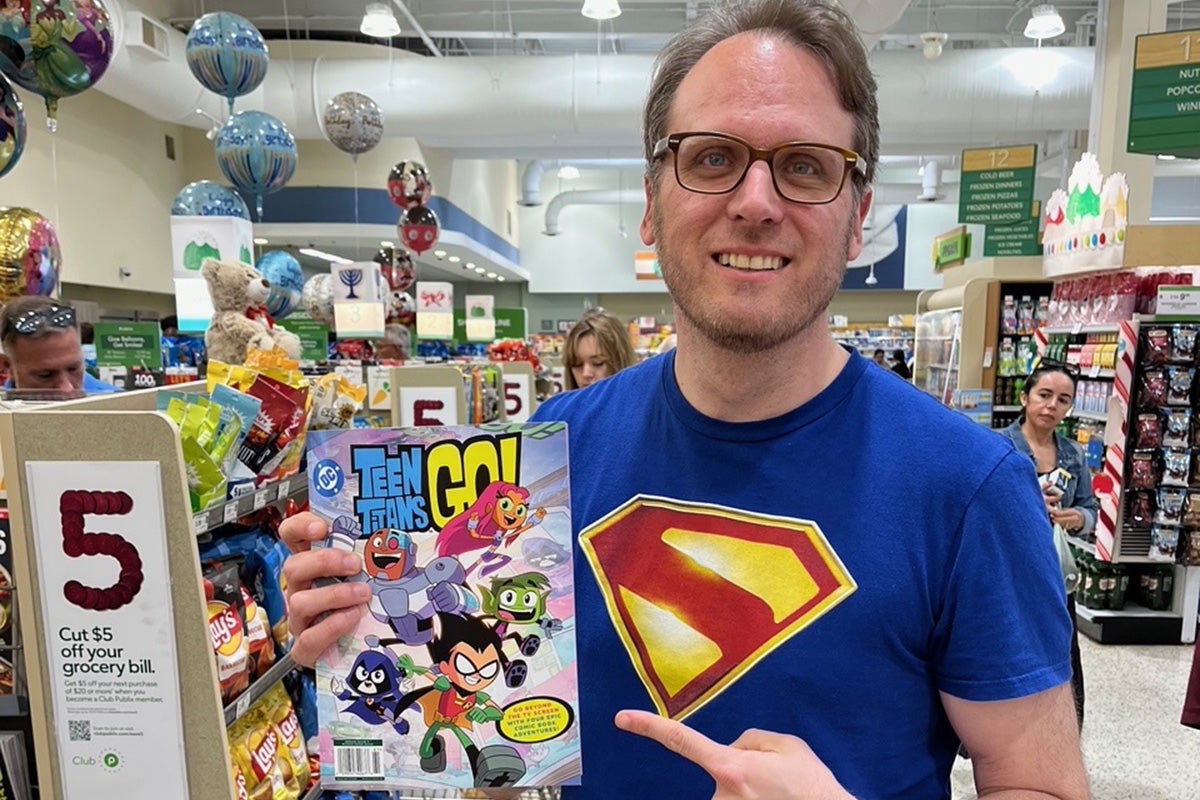
A 2001 graduate of UCF’s visual arts program, Cormican now serves as the showrunner of Teen Titans Go!, a globally recognized series that has redefined how superhero stories can blend slapstick humor, heart and cultural commentary. He oversees every facet of production, shaping a show that has entertained audiences for more than a decade.
But his path to that role was anything but immediate.
Betting on the Basics
Growing up in Hollywood, Florida, Cormican knew early on that drawing and storytelling were more than hobbies. Animation captured his imagination — from flip books and stop-motion experiments to studying The Illusion of Life, the seminal Disney animation text. When it came time for college, he explored top art schools and even earned a scholarship to the Savannah College of Art and Design.
Then he visited UCF.
“We had Disney animators giving lectures and even teaching classes. That kind of access was huge.”
What stood out wasn’t just the campus — it was the animation program, which at the time was uniquely split between traditional hand-drawn animation and emerging computer animation. In the early 2000s, as Pixar ushered in a new era of computer-generated imagery and many questioned whether traditional animation would survive, UCF offered both paths.
“I opted for the traditional route,” Cormican says. “I always loved to draw.”
At UCF, Cormican immersed himself in storyboarding, visual storytelling and collaborative creative work — skills that would become foundational throughout his career. Just as impactful was UCF’s proximity to Walt Disney World Resort’s then-active Orlando animation studio, which brought industry professionals directly into the classroom.
“It was kind of a secret gem,” Cormican says. “We had Disney animators giving lectures and even teaching classes. That kind of access was huge.”
Rising Through the Ranks
After graduating in 2001, Cormican did what many aspiring animators eventually must. He packed up and moved to Los Angeles with little more than a portfolio and determination.
His first job paid just $8 an hour at a small independent studio — modest by any standard but monumental to someone being paid to do what he loved.
From there, he worked project to project, studio to studio, navigating an industry defined by constant change. His career took him through Disney Television, Nickelodeon and Cartoon Network, each stop building both his creative credibility and leadership skills.
That persistence paid off in 2012, when Cormican joined Teen Titans Go!, a comedic reboot of the earlier Teen Titans animated series, as an episode director.
Cormican rose through the ranks, serving as head of story on the franchise’s theatrical film before stepping away briefly to direct animated Diary of a Wimpy Kid movies for Disney+. Working closely with author Jeff Kinney, he gained valuable experience guiding stories from script to screen — experience that proved critical when he returned to Teen Titans Go! as showrunner.
Evolving with the Tools
Cormican’s role as showrunner requires both creative vision and operational discipline, a balance he credits in part to his upbringing and education.
“Animation is collaborative at every level. You’re guiding hundreds of creative decisions, but it all starts with the story.”
Over his 24-year career, Cormican has witnessed dramatic technological shifts within the animation industry. When he entered the field in 2002, animation was still largely analog.
“We were drawing with paper and pencil, using Xerox machines to resize drawings and fax machines to send images and notes between studios,” he says. “Around 2006, everything started to go digital.”
While digitization has increased efficiency, it has also raised expectations.
“The technology allowed people to do more things in less time,” Cormican says. “And so, they were expected to do just that.”
Still, even as animation continues to evolve, with artificial intelligence emerging as the next frontier, Cormican approaches change thoughtfully.
Lessons From Sketching His Path
Despite leading a globally successful series, Cormican prefers working behind the scenes and values the long view of a career built step by step.
“It’s taken me about 25 years to get where I am,” he says. “I started at the very bottom and worked my way up.”
That perspective is exactly what he hopes to pass on to UCF students and alumni with ambitious creative dreams.
“If you have an interest in something that feels out of reach, just take it one step at a time,” Cormican says. “Keep the goal in view and keep moving toward it.”
For Cormican, that journey began at UCF — a place he credits as the launch point for everything that followed, and one he hopes to continue supporting through mentorship and engagement with future Knights.