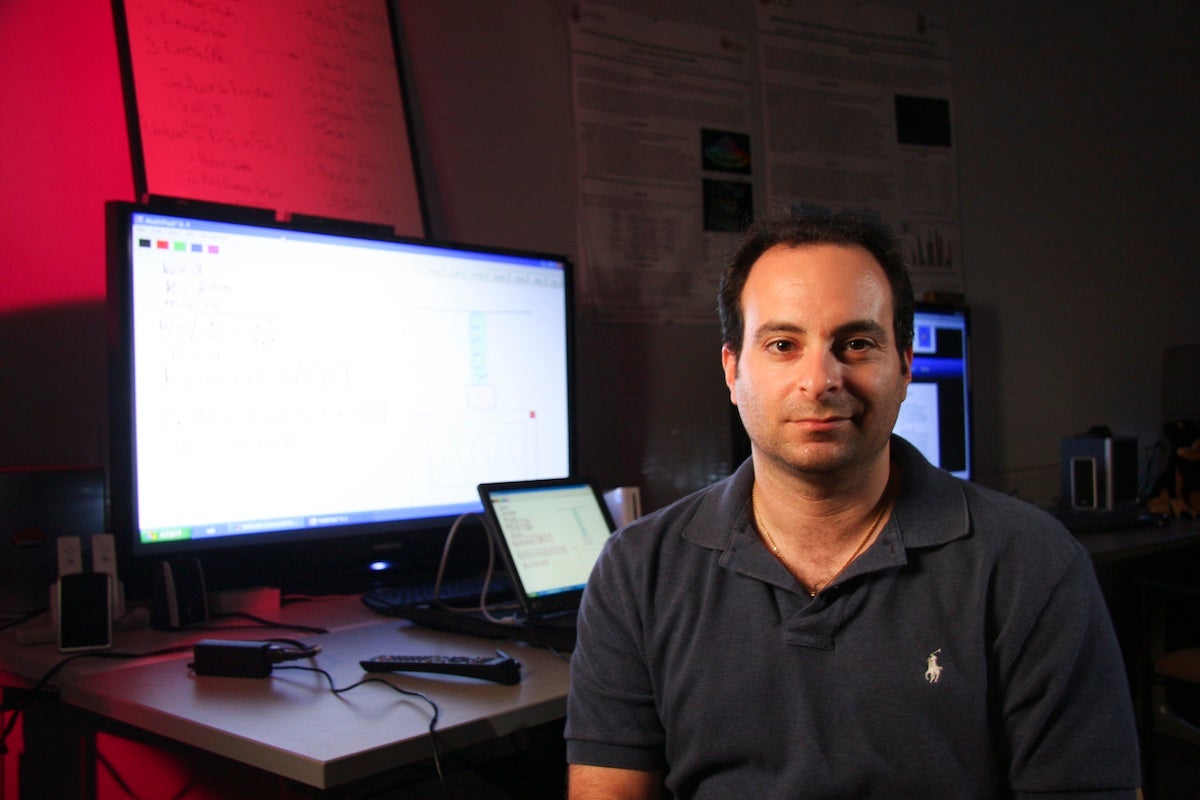
Professor Joseph LaViola Jr. has been fascinated by human-computer interaction (HCI) since his undergraduate days in the mid-1990s. Decades later, that interest has propelled him to the forefront of the field, earning him global recognition from his peers.
LaViola is one of 11 computer science academics and professionals selected for induction into the Association of Computing Machinery’s Special Interest Group on Computer-Human Interaction (ACM SIGCHI) Academy this year. He will be honored during an awards ceremony at the 2026 CHI conference in Barcelona, the leading international conference on human-computer interaction.
“It means a great deal to me, both personally and professionally, to be included with so many outstanding HCI researchers and pioneers in the field,” LaViola says. “This honor helps recognize the work I have done over the last 20-plus years in the field, and I am truly humbled to be part of this select group.”
LaViola manages the Interactive Computing Experiences Research Laboratory at UCF, where his work with 3D user interfaces, 2D and 3D gesture recognition and sketch- and touch-based interfaces contributed to his induction into the ACM SIGCHI Academy. He and his team are currently developing multimodal interfaces that use visual language models to track users’ movements and eye gaze and interpret their speech. The goal is seamless human-computer interaction, enabling computers to predict user needs without requiring exact commands. He’s also the lead author of the second edition of 3D User Interfaces: Theory and Practice, the first comprehensive book on the topic.
Since joining UCF in 2007 as an assistant professor, LaViola has risen to become the Charles N. Millican Professor of computer science and director of the Interactive Computing Experiences Research Cluster. He has published more than 200 refereed journal and conference articles and written eight book chapters. He contributed to leading research that demonstrates how stereoscopic 3D viewing, head tracking, gestural control and eye tracking can affect a player’s performance in video games.
In 2025, LaViola was inducted into the Institute of Electrical and Electronics Engineers (IEEE) Visualization and Graphics Technical Community’s Virtual Reality Academy. He is a senior member of both IEEE and ACM.
LaViola says his induction is a shared achievement and thanks those who helped him along the way.
“Being inducted into the SIGCHI Academy is not an honor that is achieved in isolation,” he says. “I would like to thank my Ph.D. advisor, Andries van Dam, for his guidance over the years, as well as Robert Zeleznik, with whom I have collaborated closely on many human-computer interaction projects during my career. I would also like to thank my book collaborators Doug Bowman, Ernst Kruijff, Ivan Poupyrev and Ryan McMahan, as well as my graduate students who did a lot of the work that I am being recognized for. Finally, I would like to thank Steve Feiner for nominating me for inclusion into the SIGCHI Academy.”