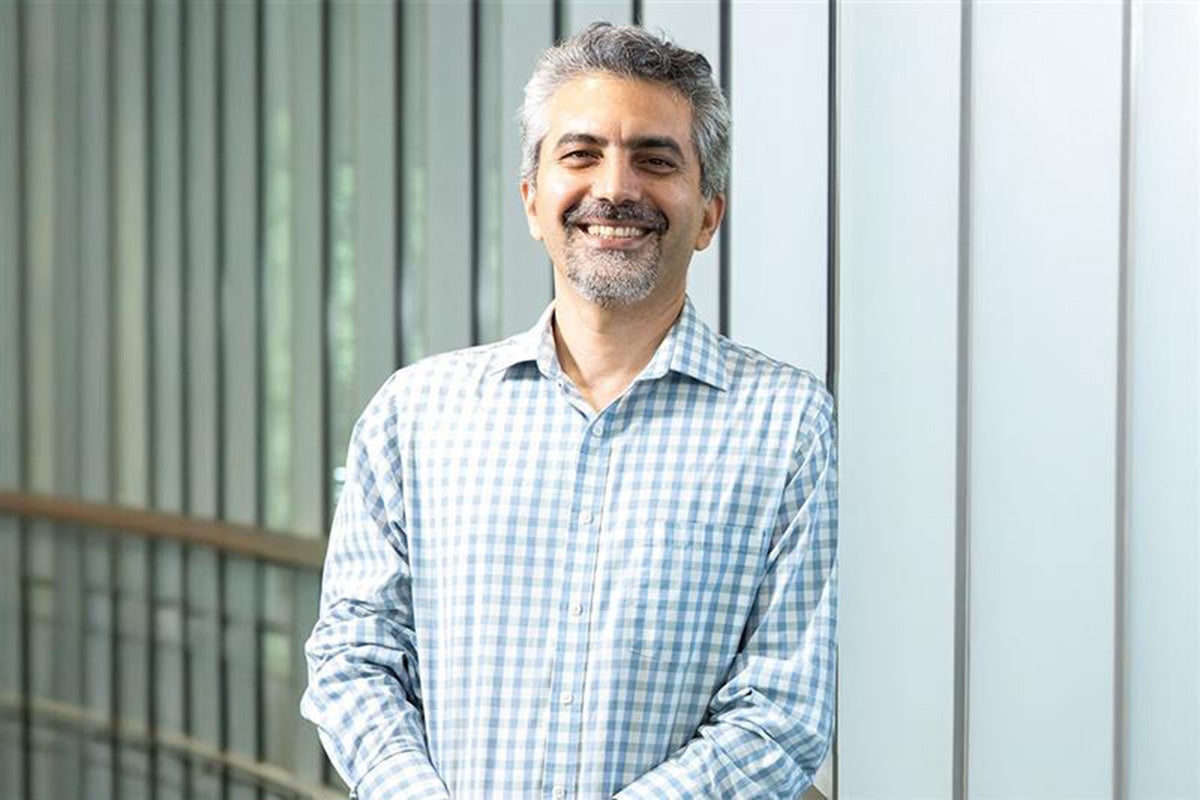
Professor Reza Abdolvand has built a career defined by invention, impact and daring ideas. Among them is a system that converts radio waves into electricity, capable of powering small electronic devices or measuring signal strength. Breakthroughs like these have led to him being named an inventor on 18 issued patents and, most recently, earning national recognition among the world’s leading innovators.
Abdolvand has been elected to the National Academy of Inventors’ (NAI) 2025 class of fellows. He’s the only UCF faculty member selected in 2025 for the honor, the highest professional distinction awarded solely to inventors whose work has made a tangible impact on society.
“I hope to use this position to inspire my young colleagues and students to deepen their belief in the power of innovation.”
The 2025 class includes 169 inventors from across the globe, representing every major field of discovery. NAI fellows will formally be recognized at the NAI 15th Annual Conference in California in June.
For Abdolvand, an expert in microelectromechanical systems and chair of UCF’s Department of Electrical and Computer Engineering, this recognition is deeply humbling.
“Personally, this achievement serves as a powerful reminder that curiosity and persistence eventually yield a meaningful harvest,” he says. “Professionally, I view this induction not just as a milestone, but as a platform. I hope to use this position to inspire my young colleagues and students to deepen their belief in the power of innovation, encouraging them to sharpen their creativity and pursue every opportunity to translate complex research into real-world solutions.”
Curiosity as a Catalyst
Invention and innovation have been the hallmark of Abdolvand’s career, though becoming an inventor was never a goal he set out to achieve. Instead, it blossomed naturally from his curious nature.
“For me, invention is not an isolated goal; it is the natural byproduct of trying to understand,” he says. “I find my mind is constantly ‘connecting the dots’ between my existing knowledge and new information. Once that clarity is achieved, innovation follows naturally.”
That mindset fuels the work of Abdolvand’s Dynamic Microsystems Lab, where he and his students design microsystems that apply the principles of energy conversion at the micro-scale. Their research focuses on developing efficient transducers — devices that allow electronic systems to interact with their environment with minimal energy loss.
Recently, the team developed a device that converts high-frequency signals into direct current, enabling easy sensing without sophisticated electronics. One of Abdolvand’s former students is now working to commercialize the technology, which he says is the most satisfying part of the research process.
Abdolvand works closely with the Technology Transfer team to ensure these promising innovations are not only properly protected through patent filing but also strategically positioned for commercial success.
Embracing Failure to Find Breakthroughs
“It is almost always the lessons learned during those unsuccessful attempts that provide the clarity needed to reach a … breakthrough.”
For the next generation of inventors, Abdolvand’s advice is refreshingly candid: reconnect with childhood curiosity, find the “why” behind everything and don’t shy away from failure — even when it happens often.
“Invention is a process of elimination,” he says. “We should not fear failure but rather embrace it as a necessary teacher. It is almost always the lessons learned during those unsuccessful attempts that provide the clarity needed to reach a new understanding and, ultimately, a breakthrough.”
Through his research, mentorship and leadership, Abdolvand is shaping a future where innovation is fearless — driven not just by answers, but by the courage to keep asking questions.