Highlights
-
UCF is a finalist for the Association of Public and Land-grant Universities’ 2026 Excellence in Student Success Award, recognizing its university-wide commitment to helping students feel connected, overcome challenges and graduate on time.
-
Through proactive coaching, real-time data and cross-campus collaboration, UCF has reimagined how it supports students — spotting challenges sooner and helping drive a 23.4-percentage-point increase in its four-year graduation rate over the past decade.
At a university serving nearly 70,000 students — one of the nation’s largest student bodies — student success can’t depend on chance or on students figuring out complex systems on their own.
UCF has built something different.
Over the past decade, the university increased its four-year graduation rate by 23.4 percentage points, from 40.4% for the 2011–15 cohort to 63.8% for the 2021–25 cohort. Preliminary projections for the 2022–26 cohort indicate the rate could surpass 68%.
That progress has transformed student outcomes and placed UCF among just three finalists for the Association of Public and Land-grant Universities’ (APLU) 2026 Excellence in Student Success Award.
The annual award recognizes institutions demonstrating a comprehensive, systemic commitment to advancing student success. Through innovative initiatives, honorees reduce barriers to educational attainment, increase graduation rates and improve outcomes such as time to degree, civic engagement and career readiness.
The award winner will be announced at the APLU’s Annual Meeting, Nov. 15–17 in San Antonio.
“We have listened to students, strengthened cross-functional collaboration, used evidence to guide timely support and embedded student success practices into the university’s daily operations.” — Alexander N. Cartwright, UCF president
The distinction reflects a fundamental shift in how UCF approaches student success: not as a collection of programs, but as a university-wide operating model designed to help more students thrive.
“What distinguishes UCF’s approach is the way our community has translated that belief into sustained action,” UCF President Alexander N. Cartwright says. “We have listened to students, strengthened cross-functional collaboration, used evidence to guide timely support and embedded student success practices into the university’s daily operations.”
And UCF has done it while operating with fewer resources than many of its peers. The university receives the lowest funding per full-time equivalent student among Florida’s 12 State University System institutions and ranks in the 11th percentile nationally for expenditures per student among public universities.
UCF didn’t wait for permission or for more resources to improve outcomes. It transformed how the university works.
Community Is the Starting Line
In 2022, UCF made Student Success and Well-Being its highest strategic priority. Then it asked students a simple question: What does it mean to thrive?
Their answers helped create BEAM — Belonging, Engaging, Achieving and Meaning — a framework for success that gives students, faculty, and staff a shared way to describe connection, purpose, academic progress, and well-being.
Today, BEAM is embedded across the student experience. By Fall 2025, nearly 35,000 students had participated in orientation programming incorporating the framework. Thousands more engaged with BEAM-informed support across the university: 158 Academic Success Coaches and student success professionals use BEAM-guided conversations with students; 8,323 students engaged through Housing and Residential Life programming; 3,971 students engaged through Fraternity and Sorority Life; and more than 19,000 students engaged through the Kenneth G. Dixon Career Development Center in the last year.
The idea is simple but powerful: Success starts with students feeling that they belong and knowing where to turn when they need help.
Building a Coordinated System of Care
UCF dared to rethink traditional academic guidance, replacing reactive advising with a holistic Academic Success Coaching model in 2023 — one that reaches students before challenges become barriers.
“Our Academic Success Coaches are aligned with students as both advisors and coaches.” — Jennifer Sumner, assistant vice president of Academic Success Coaching
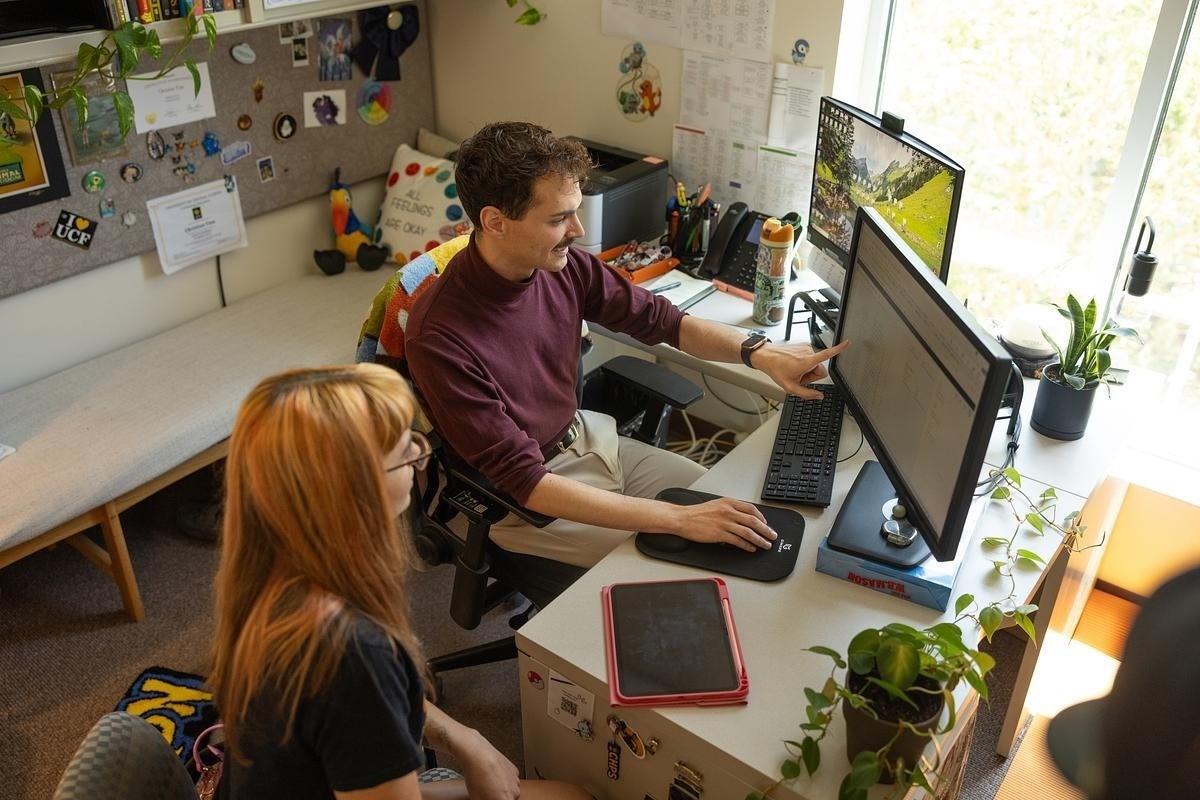
Academic Success Coaches combine BEAM-guided conversations with student-level analytics to identify needs — including academic planning, graduation requirements, registration issues and personal challenges — initiate outreach and connect students with support. Rather than waiting for students to ask for help, coaches use data to identify where support may be needed and reach out.
“Our Academic Success Coaches are aligned with students as both advisors and coaches,” says Jennifer Sumner, assistant vice president of Academic Success Coaching at UCF. “We’ve positioned [them] to be active and dynamic, and we expect students to do the same — to take an active role in their journey and work with us [to determine] how they can be successful at UCF.”
Behind that work is UCF’s Student Success Analytics platform, which brings real-time visibility into progression risk, retention patterns, graduation forecasts and intervention activity into one environment.
Every student in the graduating cohort is automatically evaluated nightly for indicators of completion status and progression risk. Those insights allow coaches, colleges and administrators to act while there is still time to make a difference.
The university’s Student Success Tiger Team takes that proactive approach further. Launched in 2024, the cross-functional team brings together analytics, coaching, enrollment management, academic affairs and college partners to resolve issues that individual advising can’t solve alone. Using data to pinpoint hindrances to graduation, the team helped prioritize graduating students for required courses, expand course capacity and improve graduation-related paperwork processes.
And this work now reaches students earlier in their academic journey, not just those nearing graduation. Progression checks for students in their first three years help identify challenges sooner, creating a continuum of support from entry to degree completion.
“[I can’t] express my gratitude enough for [my Academic Success Coach’s] support during my time at UCF, says psychology alum Jasmine Washington ’25. “I graduated with my bachelor’s degree, and I couldn’t have reached that milestone without [his] guidance. Navigating the requirements and staying on track wasn’t always easy, but [his] encouragement and insight truly made a difference in my journey.”
Advancing Timely Degree Completion
The impact is undeniable.
UCF’s four-year graduation rate has climbed to 63.8%, surpassing Florida’s 60% preeminence benchmark, with another increase projected for the 2022–26 cohort.
But the bigger accomplishment is what UCF built to get there.
Rather than layering temporary programs onto existing structures, UCF embedded student success into how it operates — from leadership priorities and analytics to coaching, academic planning and institutional decision-making. The sustained progress isn’t a result of a single program or initiative. It comes from making student success a shared responsibility.
Students helped define what thriving looks like. Faculty and staff bring that vision to life. Analytics reveal where action is needed. Coaches provide personalized support. UCF’s 12 colleges and administrative teams remove barriers. And university leaders keep student success at the center of decision-making.
Together, those efforts create an environment where more students can belong, move forward, overcome obstacles and graduate on time — prepared to thrive long after they leave campus.
That’s the difference between supporting student success and building a university around it.