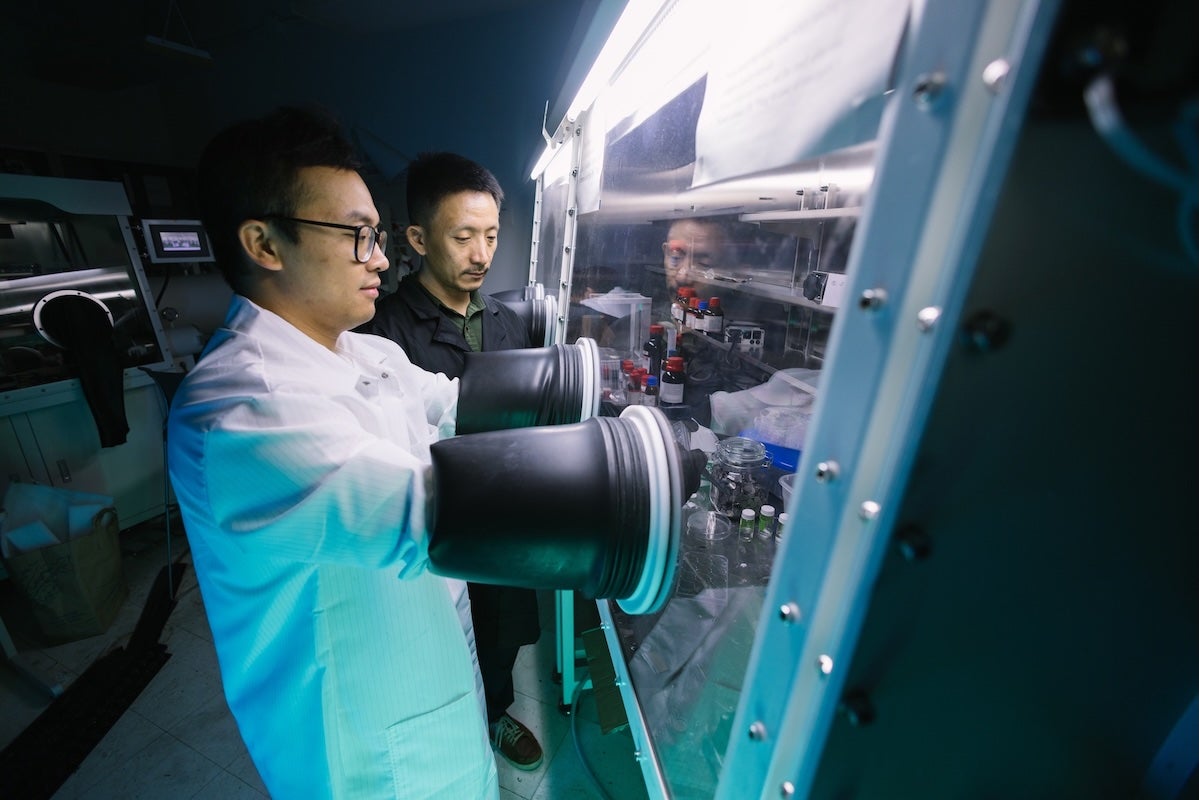
A decade of rigorous research led by Associate Professor of Material Science and Engineering Yang Yang produced an impactful patent.
The focus of the research behind the patent is to create a cost-effective, high-efficiency and sustainable method for manufacturing nano-materials to enhance energy and chemical production. Yang says he hopes that this will in turn address the current limitations of traditional, expensive fabrication techniques.
“The idea stemmed from the challenge of making solar hydrogen production more efficient and affordable,” says Yang, a member of the NanoScience Technology Center. According to Yang, the materials were tested and validated for their application as catalysts. The recent findings were also published in the Royal Society for Chemistry.
A Catalyst for Innovation
The technology uses particles designed to optimize the generation and production of hydrogen and oxygen that serve as catalysts for energy production. Traditional catalysts only respond to ultraviolet light, however this new development can harness a broader spectrum of sunlight.
To achieve this, Yang engineered particles within precise nanoscale structures that were grown inside titanium oxide (TiO₂) cavities, or light traps. These cavities can capture and control a wider spectrum of light, including sunlight, ultraviolet and near-infrared.
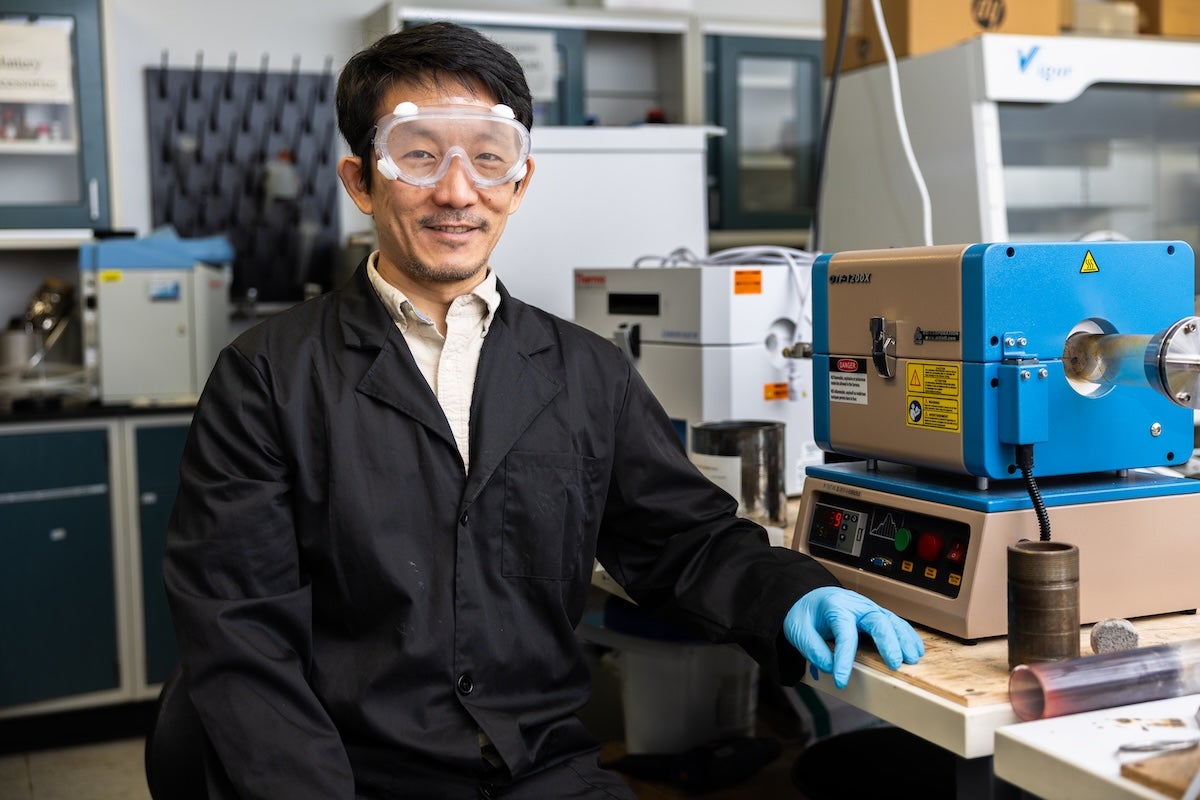
With this method, the particles can efficiently harvest solar energy through a process known as localized surface plasmon resonance. In simple terms, when light interacts with specialized nanomaterials it creates a synchronized ripple of mobile electrons — thus creating usable energy.
“In daily life, this could be implemented in solar-powered hydrogen generators for clean fuel in homes, cars or industrial settings, helping reduce reliance on fossil fuels and carbon emissions,” Yang says.
Shaping the Future of Energy
The research and industrial applications of this patent could expand as the technology develops, Yang says. By tailoring the composition of Yang’s particles, the catalysts can be integrated into technologies like electrolyzers used in seawater splitting, which is a process that aims to produce green hydrogen. Because the catalyst can be produced using renewable materials, it may reduce the environmental footprint of research and industry by limiting the need for freshwater use.
“There’s a strong potential to optimize plasmonic tunability, [or how metallic nanostructures interact with light], by engineering the composition of our engineered particles,” says Yang, “This platform also inspires new designs for full-spectrum solar utilization and could be adapted for CO₂ reduction or nitrogen fixation.”
This technology is fully available for licensing. Interested parties can contact the UCF Office of Technology Transfer or reach out directly to Yang Yang at Yang.Yang@ucf.edu for more information.
Funding for the research was provided by UCF through a startup grant No. 20080741. STEM, EELS, and XPS data analysis was supported by the U.S. Department of Energy, Office of Science, Office of Basic Energy Sciences, Early Career Research Program under award No. 68278. The technology was developed by faculty and students from the UCF College of Engineering and Computer Science and Engineering, and NanoScience Technology Center.