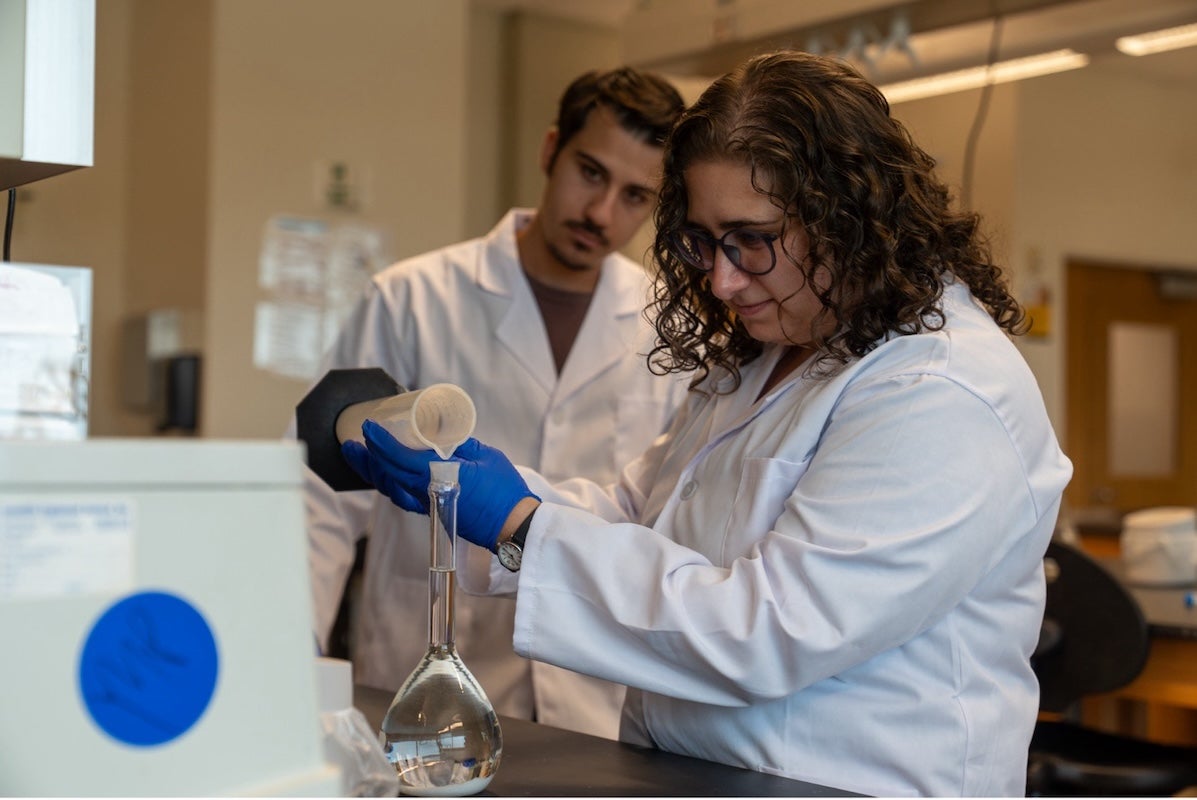
UCF assistant professor and researcher Cali Calarco, with the College of Medicine‘s Burnett School of Biomedical Sciences, is exploring how nicotine affects brain cells, providing insights that could ultimately help improve treatments for addiction.
Through a nearly five-year, $943,000-plus grant from the National Institutes of Health, Calarco’s lab is examining how neurons — nerve cells in the brain — and their molecules change when exposed to nicotine and other drugs. The goal is to understand how microscopic changes in the brain eventually influence behavioral decisions, including those associated with addiction.
“We want to understand what’s really influencing the neuron,” says Calarco, who began work on this project in 2024 as a postdoctoral scholar at the University of Maryland, Baltimore, before joining UCF in January as an assistant professor. “Which component is critical for the neuron function that leads to drug-seeking behavior?”
For this research, Calarco’s lab is focused on the nucleus accumbens, an area of the brain involved in reward, learning and behavior.
“I call it a little computer that integrates a lot of signals that come in relationship to reward learning from a lot of other parts of the brain to guide behavioral choices,” she says.
“We want to understand what’s really influencing the neuron. Which component is critical for the neuron function that leads to drug-seeking behavior?” — Cali Calarco, assistant professor
The nucleus accumbens contains multiple types of brain cells, and Calarco’s research examines how individual cell types respond to nicotine and other drugs. Her lab is particularly interested in mitochondria, the structures within cells that produce the energy they need to function. Recent studies suggest mitochondria may also play an important role in drug-seeking behavior.
“Mitochondria have been underappreciated in neurons previously,” she says. “Neurons are incredibly complex cells that do incredibly complex tasks, both electrically and chemically that require a ton of energy, so we knew they were really important. But mitochondria also influence how neurons communicate with each other. They’re super important for gene transcription and translation and for steroid hormone production.”
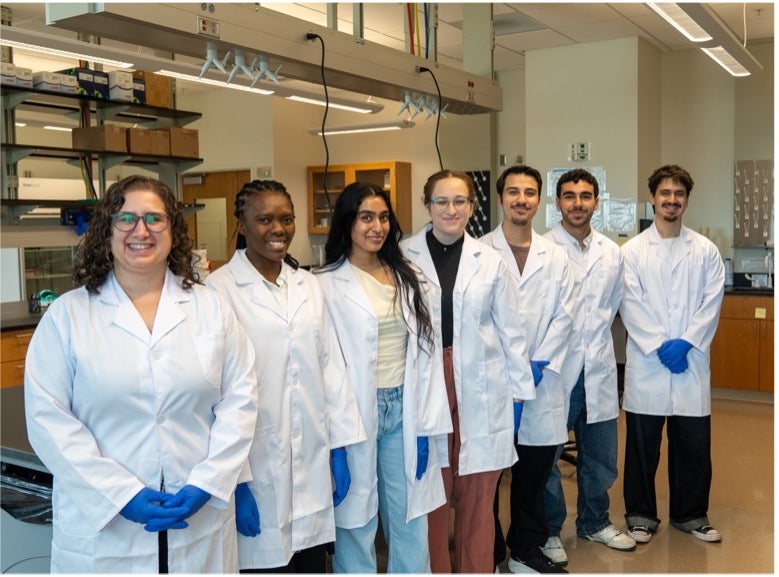
By understanding addiction at the molecular level, researchers may ultimately be able to develop better treatments for substance use disorder.
“There aren’t that many substance use disorder treatments, and the ones available only work for a subset of people,” she says. “There is room for improvement in nicotine use disorder therapies, and new pathway targets may provide more effective treatments with fewer side effects.”
Nicotine use has persisted even as the products used to consume it have changed. Calarco compares the trend to a game of whack-a-mole, with new nicotine products gaining popularity as older ones decline. While cigarette smoking has declined, consumers now have access to products such as e-cigarettes and nicotine pouches placed between the lips and gum. According to data from the FDA and CDC’s 2025 National Youth Tobacco Survey, nicotine pouch use nearly quadrupled among U.S. youth and young adults between 2022 and 2025.
While her research is focused on nicotine, Calarco says her findings could have implications for other substances and even social media addiction.
Calarco earned her doctorate in neuroscience from Yale University before conducting postdoctoral research at the University of Maryland, Baltimore, where she studied mitochondria and cocaine-seeking behavior. She joined the UCF College of Medicine’s Burnett School of Biomedical Sciences in January 2026.
Research reported in this publication was supported by the National Institute on Drug Abuse of the National Institutes of Health under award number K01DA061048. The content is solely the responsibility of the authors and does not necessarily represent the official views of the National Institutes of Health.