Landing humans on the moon was just a dream when UCF was founded in 1963. But we dared to believe — developing the talent and inventing the technologies to make it reality. That same spirit still drives us today.
We are America’s Space University. And we celebrate UCF Space Week to honor our origin as we dare to build what’s next.


Where Global Leaders Unite to Forge the Future of Space
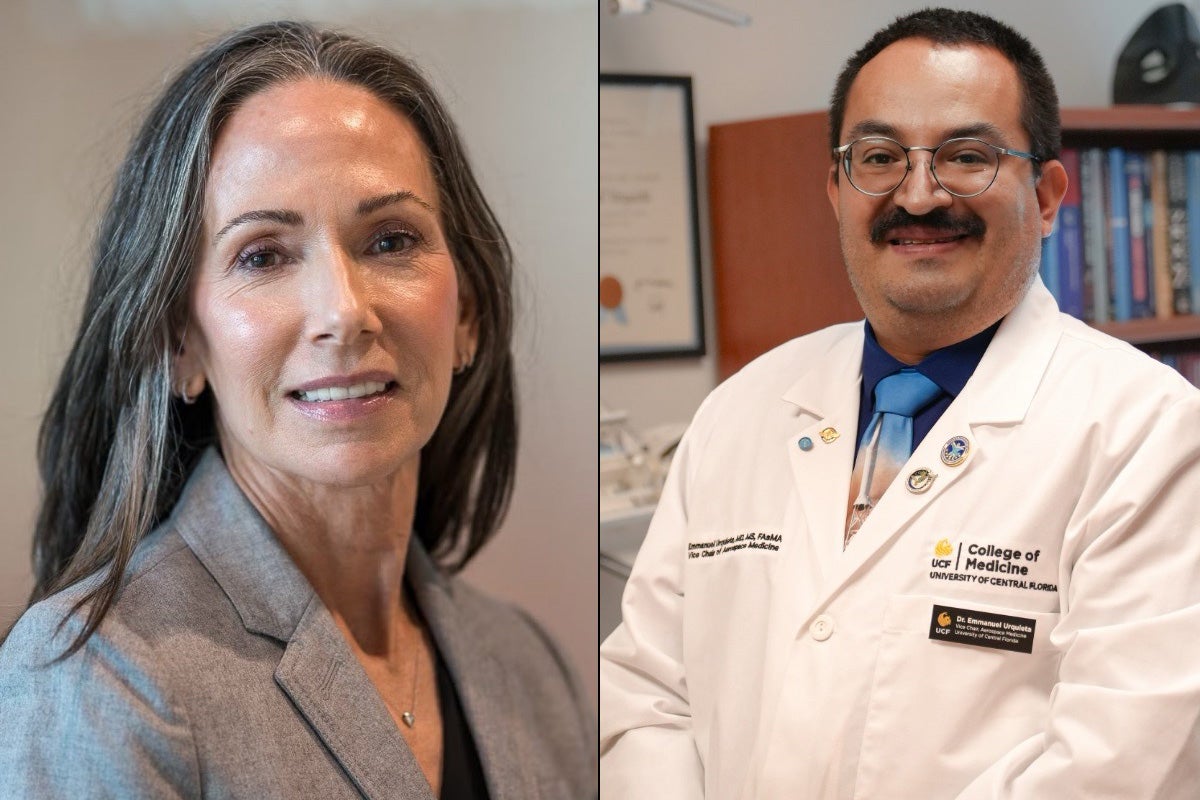
Two UCF College of Medicine faculty have been elected Academicians of the International Academy of Astronautics (IAA) — a lifetime distinction recognizing worldwide leaders in space travel.
UCF Associate Professors Emmanuel Urquieta and Jennifer Fogarty were honored at the IAA’s 79th annual International Astronautical Congress in Antalya, Turkey. The academy includes 1,200 fellows worldwide who are committed to collaborative research and education that advance space exploration to serve humanity.
Urquieta and Fogarty are leaders in the College of Medicine’s emerging aerospace medicine program that is creating a new frontier in healthcare as humans prepare for longer missions to the moon, Mars and beyond.
The program’s goal: explore how factors such as microgravity, radiation and isolation impact the human body in space and how that knowledge can drive innovation into diagnostics, treatment and disease prevention for patients on Earth.
As part of that effort, UCF has created a new Center for Aerospace and Extreme Environments Medicine (CASEEM). Urquieta leads the center; Fogarty is its chief scientist.
The multidisciplinary center includes UCF faculty experts in medicine, engineering, computer science, psychology, arts and educational leadership who collectively research and develop new technologies for keeping space travelers healthy. The work is applicable here on Earth, as well, to soldiers on military missions, deep sea explorers and mountain climbers.
From Flight Surgeon to Aerospace Leader
Urquieta began his career in aerospace medicine as a flight surgeon, serving on the Mexico City Police Department’s emergency medical services helicopter team before being selected for NASA’s HERA XI program. There he spent 30 days isolated with three crewmates in a simulated mission to the asteroid Geographos to understand how the isolation of a space mission affects the crew medically and psychologically.
In 2016, Urquieta joined the Translational Research Institute for Space Health at Baylor College of Medicine (TRISH), eventually becoming chief medical officer, where he managed medical research for missions to the moon and Mars as well as the institute’s commercial spaceflight programs.
He joined the College of Medicine in 2024.
Urquieta says this recognition inspires him to continue striving to make UCF an international leader in aerospace medicine.
“I look forward to contributing to the work of the academy,” he says. “And to helping advance the science and medicine that will support the next era of human space exploration.”
Leading Innovation in Spaceflight Safety
Fogarty’s honor recognizes her nearly 20-year career in aerospace medicine, beginning as chief scientist of NASA’s human research program. There, she examined the risks humans face while exploring space and developed research and programs to keep astronauts safe and healthy.
Following nearly 14 years at NASA, Fogarty brought her expertise to TRISH, where she provided strategic leadership in developing innovations to maintain human performance and wellness during space travel.
She joined UCF in 2025.
Fogarty says she was honored because she and Urquieta were nominated by a mentor, Jeffrey Davis, who has served as branch chief of medical operations at NASA.
“We were honored to be nominated by Dr. Davis and to have other people who agreed that we have made significant contributions to the field at an international level,” said Fogarty. “It’s very special to be recognized in this way.”
Fogarty says her role is not only to improve the health of space travelers, but to use that knowledge to create more innovative medical treatments for patients on Earth.
“There’s a lot of responsibility when you’re in an industry that’s relatively small and young,” she says. “I think it’s our role with the positions we have here to engage students and educate the public about what’s happening in space medicine and why.”