Highlights
-
Faculty and students from the Department of Legal Studies and Nicholson School of Communication and Media worked together to produce a podcast called The Dead Speak, blending entertainment law and audio reporting knowledge to accurately “bring the dead to life” in a podcast format.
-
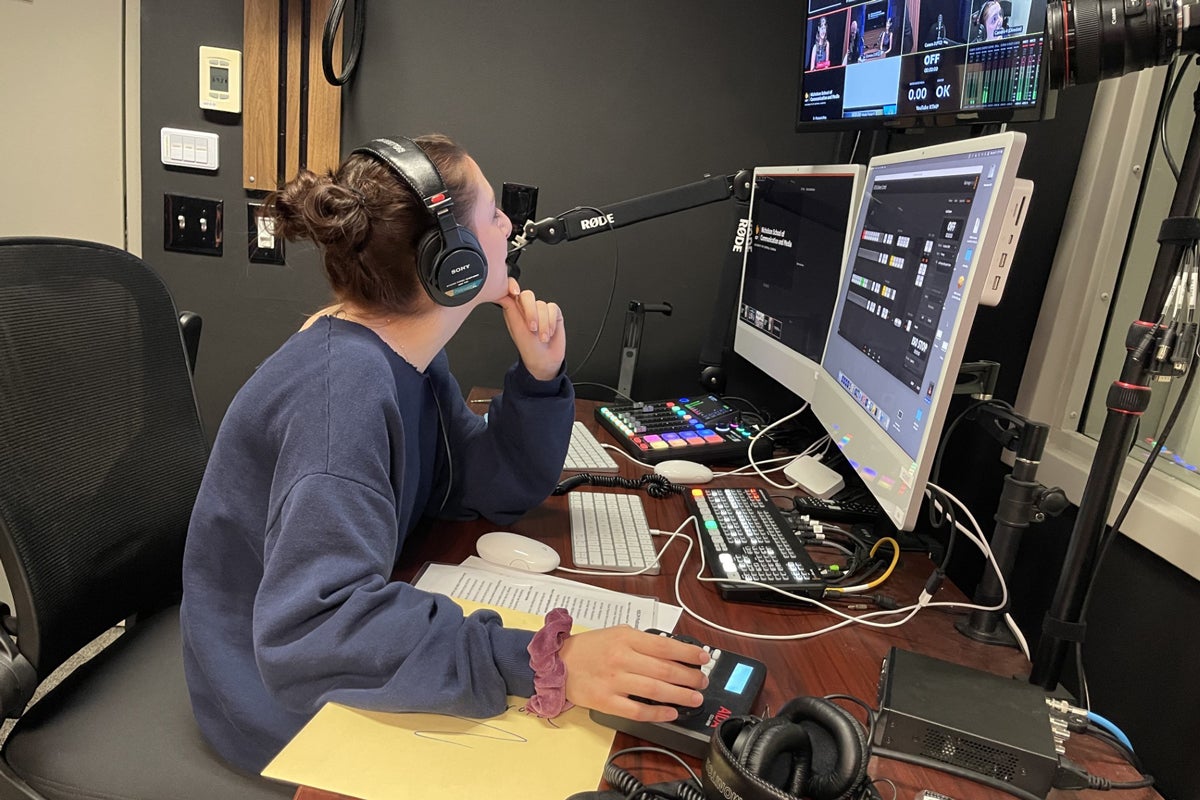
Legal studies students provided the legal foundation and research, while journalism students captured audio and created historically accurate recordings in Nicholson’s state-of-the-art podcasting studio.
-
The 12-episode podcast is available on SoundCloud.
What happens when students from an entertainment law class and a podcasting class walk into a graveyard together? At UCF, they bring to life an Emmy-winning faculty duo’s most ambitious cross-college collaboration yet.
Legal studies senior lecturer Irene Pons ’00 was inspired one day when she came across a video of someone wandering through cemeteries, reading headstones and telling the stories of the people buried beneath them. The videos were pulling millions of views. Pons, who teaches both entertainment law and funeral law at UCF, saw a learning opportunity for her legal studies students.
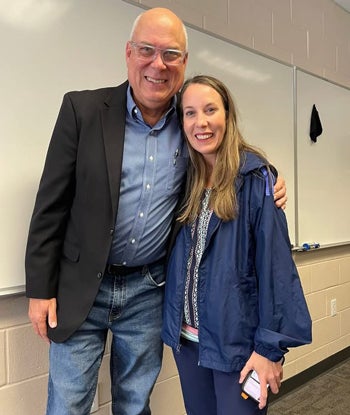
She reached out to Rick Brunson ’84, a senior instructor in UCF’s Nicholson School of Communication and Media (NCSM) and veteran broadcast journalist, as the first step to what would go on to become a student-produced podcast, The Dead Speak.
Pons’ entertainment law students paired with Brunson’s audio reporting and podcasting students during the Spring 2026 semester — creating a cross-disciplinary collaboration unlike anything either department had attempted before.
The two faculty members are repeat collaborators. Their prior work legal studies-related documentaries that have earned five regional Emmy awards.
But this project presented a whole new challenge. It required bringing together nearly 100 students of very different skill sets to deliver a finished product that would both accurately and legally “bringing the dead back to life.”
Bringing the Dead to Life in Sound
Each class took on a distinct role in the production. Pons’ legal studies students were the researchers. Using legal databases, death records, obituaries and cemetery records — while exercising the entertainment law and copyright skills they were developing in class — they identified deceased Floridians or people with strong Florida ties whose stories were compelling, historically verifiable and legally safe to tell.
A few students even ventured into cemeteries to find their subjects, while others utilized websites for virtual tours of burial grounds.
“Law comes into play because a lot of research goes into databases where death records are kept,” Pons says. “The entertainment law aspect comes in because we have ethical considerations, like copyright, public domain and how to verify the veracity of a record. ‘Did that person really die in 1867?’ Those are the kinds of questions that sharpened our legal research skills.”
“The entertainment law aspect comes in because we have ethical considerations, like copyright, public domain and how to verify the veracity of a record.” — Irene Pons ’00, senior lecturer
Once initial research was completed, the classes met together in person, divided into groups, in NCSM’s state-of-the-art podcasting studio. They pitched their research and determined which subjects would make the strongest episodes.
“My students were coming at this from what I call ‘seeing with your ears,’” Brunson says. “Does this subject and the time period they’re in present rich audio and sound opportunities? Does their story present rich opportunities to tell it in a sonic way?”
From there, Brunson’s students took over, writing scripts that would be narrated in first person and finding voice actors to give an accurate voice to the deceased.
Some students reached out to professional voice-acting collectives, and several professionals were so intrigued that they volunteered their voices. Other students recruited friends, family members or peers who matched the voice characterization they needed.
They further enhanced the production by recording real-world ambient sounds like crickets chirping, musical instruments or an audience cheering to create the backtracks that bring each episode to life.
In total, the collaboration produced 12 publicly accessible episodes that can be streamed on SoundCloud.
Everlasting Benefits
The response from students on both sides was immediate and enthusiastic. Pons’ law students were so enamored by the experience that many asked if they could come into the studio themselves to see their research brought to life.
“They were so invested in what they were doing,” Pons says. “At the end of class, they were like, ‘Do we have to leave?’ That was their favorite part of the whole semester.”
For Brunson’s podcasting students, the project offered an avenue for creativity while still adhering to journalism’s standards of accuracy and reporting and will ultimately serve them well on their resumes.
“The benefits are two-way. You get smarter by working with really smart and creative people, and you push understanding of ourselves as humans and as a community forward.” — Rick Brunson ’84, senior instructor
“We have dead-set rules against making things up over here,” Brunson says. “They really enjoyed this opportunity to go out, get sound, create a period of time and make it immersive in a listener’s mind. It stretched their muscles as audio storytellers. Students can say, ‘This is something I built. This is something that went out and is public-facing.’ I think that is so much more valuable to students than just getting an A on a test.”
He adds that the experience reaffirmed what he’s always believed about project-based learning.
“It’s cross-pollination,” he says. “The benefits are two-way. You get smarter by working with really smart and creative people, and you push understanding of ourselves as humans and as a community forward.”
Pons hopes to continue The Dead Speak podcast and partnership with Brunson’s class with her Entertainment Law course in Spring 2027 and her Death, Dying and the Law course in Fall 2027.
“When faculty have the opportunity, they should take advantage of collaborating like this,” she says. “It was so rewarding for the students and for us as professors just to see the smiles on their faces. That says it all.”