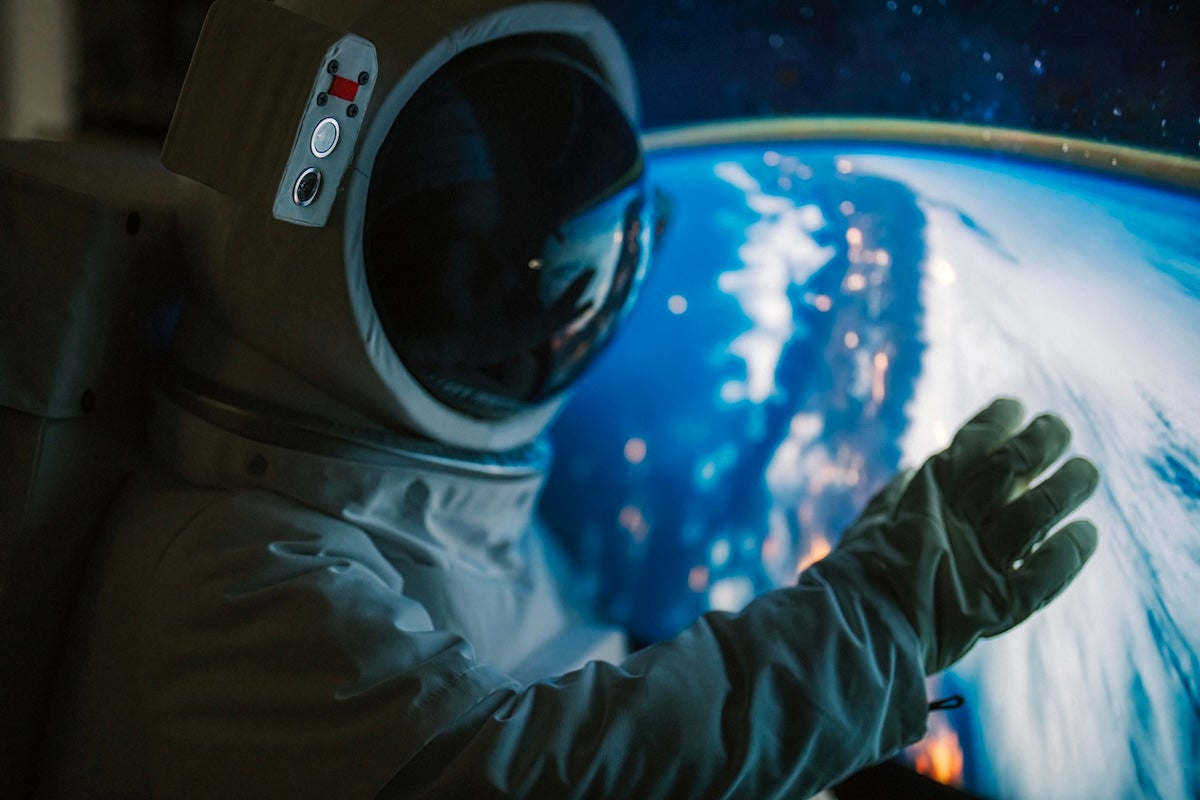
As spacecrafts venture farther and operate longer in orbit, one of the biggest threats they face is invisible: bursts of radiation that can disrupt or damage the electronics that keep them running. Testing those effects on Earth, however, has required massive particle accelerators with limited availability, creating a bottleneck for researchers and industry.
At UCF, researchers working in space and semiconductor reliability, including those affiliated with the university’s Center for Reliability Evaluation of Space and Semiconductor Technologies (CRESST), are helping address the challenge. Through a new collaboration with TAU Systems, they will evaluate and benchmark an emerging approach to radiation testing designed to make the process faster, more accessible and easier to scale.
“Academic partnerships are central to how we move this technology forward,” TAU Systems CEO Jerome Paye says. “Universities like UCF bring deep scientific expertise, world-class facilities and a culture of rigorous validation that complements everything we are doing on the commercial side. That is the real value of working closely with academia, it accelerates the path from breakthrough science to deployable technology.”
“Universities like UCF bring deep scientific expertise, world-class facilities and a culture of rigorous validation that complements everything we are doing on the commercial side. That is the real value of working closely with academia, it accelerates the path from breakthrough science to deployable technology.”—Jerome Paye, CEO of TAU Systems
UCF’s established strengths in microelectronics and radiation effects, combined with its legacy as America’s Space University, make it a natural partner as TAU Systems works to validate and scale accelerator technologies designed to reduce the size and cost of radiation testing systems.
Making Room for Beamtime
When a high-energy particle from space radiation strikes a microchip, it can cause it to malfunction, a phenomenon known as a single-event effect (SEE). These events are a major concern for satellites, spacecraft and defensive systems, where even small disruptions can have significant consequences.
Studying these effects requires access to specialized particle accelerator facilities. This access, known as “beamtime,” is limited and in high demand, often booked months in advance and creating delays that can slow research and development.
“Access to heavy-ion beam facilities is one of the major bottlenecks in radiation effects research today,” says Enxia Zhang, assistant professor in UCF’s Department of Electrical and Computer Engineering and lead of the Radiation Effects Exploration Laboratory (REEL). “These facilities are limited in number, heavily oversubscribed and often require long scheduling timelines. That makes it difficult to rapidly evaluate modern microelectronics technologies that are increasingly being deployed in space and defense systems.”
Researchers typically study these effects using heavy-ion accelerators, specialized facilities capable of simulating the radiation conditions electronics experience in space. While effective, these facilities are expensive to operate, limited in number and often booked months in advance creating delays for researchers and industry seeking access to beamtime.
An Alternative to Heavy Ion Testing
A collaboration between UCF and TAU Systems aims to change that by testing a new approach known as electron-based single-event effects, or eSEE. Instead of relying on heavy ions, the method uses laser-driven electron beams to reproduce similar radiation-induced effects observed in space electronics.
“Electron-based SEE approaches could significantly expand access to radiation testing by enabling more flexible and scalable experimental platforms,” Zhang says. “Our role is to rigorously evaluate how these electron-driven methods compare with established heavy-ion testing and determine where they can provide reliable and meaningful insight for real-world applications,” Zhang says.
The approach has the potential to reduce systems that traditionally span kilometers to setups that could fit within a laboratory, lowering barriers to entry and expanding access to radiation testing.
Through the partnership, researchers will work to validate the new method by comparing its results against established heavy-ion testing data to determine when and how reliably it can replicate real-world radiation effects. The collaboration will also support test execution, data analysis and the refinement of validation techniques.
“A key part of this collaboration is establishing confidence in the methodology through direct benchmarking against conventional heavy-ion data,” Zhang says. “If successful, these approaches could help accelerate qualification workflows for advanced semiconductor technologies used in space, aerospace and national security applications.
Forging a Future in Space
UCF’s work in space and semiconductor research, including efforts led through CRESST, positions the university as a contributor to advancing radiation testing capabilities. Located near Florida’s Space Coast and long connected to the nation’s aerospace industry, UCF supports research and workforce development tied to emerging space technologies.
If successful, the collaboration could lead to the deployment of a compact testing system at UCF, expanding access to radiation testing and helping train the next generation of engineers and researchers. By expanding access to radiation testing infrastructure, the effort could help accelerate the development of more resilient electronics for space, defense and commercial applications.