Highlights
-
UCF’s graduate program, FIEA, is once again named the No. 2 program in the world and the undergraduate gaming program, GaIM, rose to No. 3 — its highest placement yet — for 2026.
-
UCF graduates are meeting demand for the gaming sector as well as some of Orlando’s top industries, including the modeling, simulation and training fields.
-
Many of GaIM’s 250 annual graduates enter industry directly after graduation or they level up their education at FIEA before doing so — with an average starting salary of $83,000 for FIEAns.
Tomorrow’s leading video game developers are being built today at UCF.
The university’s graduate video gaming program, Florida Interactive Entertainment Academy (FIEA), and games and interactive media (GaIM) undergraduate program continue to develop a pipeline of talent to fuel Florida’s economy at a standard of excellence few can match, affirmed by The Princeton Review and PC Gamer’s Top Video Game Design Schools 2026 rankings.
The Princeton Review and PC Gamer has recognized FIEA as one of the top two programs of its kind in the world six of the past seven years.
GaIM improved two spots from last year to its highest ranking, rising to No. 3 in the world. Both programs continue to hold the title of No. 1 in the South.
Strategy for Success
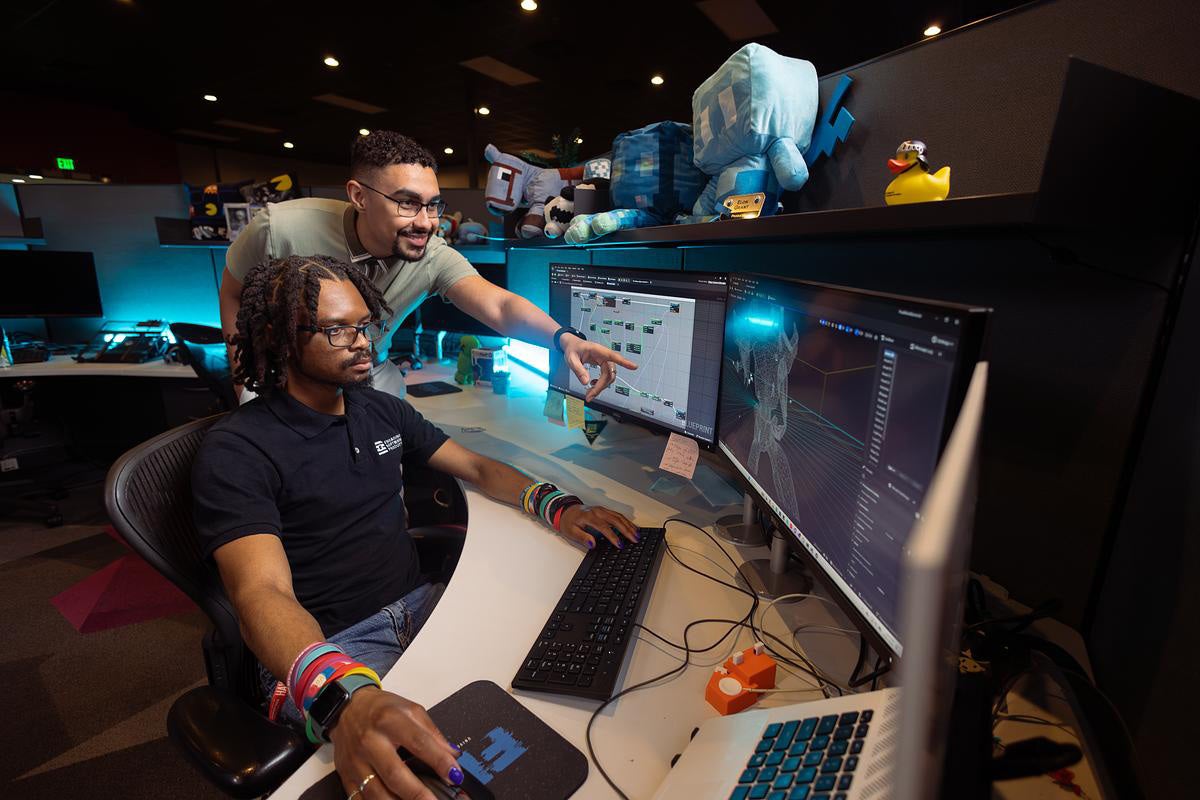
Since their inception, FIEA and GaIM have modeled their classrooms as close to a real-world, studio-like environment as possible, led by faculty with industry experience. That real-world perspective shapes every course, every project and every student who graduates.
“Our program intentionally emulates a collaborative ecosystem with a range of diverse talent in artists, designers and programmers, which is crucial to developing products and intellectual property,” says Nicholas Zuccarello, a 3D art instructor at FIEA who has previously worked for Sony Online Entertainment and Electronic Arts Tiburon. “We even structure projects to emulate real-world development pipelines as closely as possible within an educational setting.”

Orlando: A Leading Tech Hub
With Electronic Arts (EA) and Iron Galaxy Studios located less than a mile from the programs’ home base in downtown’s Creative Village, Orlando is the perfect setting to transition from college to career and now mentioned in the same breath alongside traditional tech-giant territories San Francisco, Seattle and Los Angeles.
Many alums go directly into the game industry including Epic, Microsoft, Nintendo, Sony and more.
FIEA has graduated 1,160 students since its first class in 2006 — about 100 of whom worked on several of the most popular games sold in the U.S. in 2025, including EA SPORTS College Football 26, EA SPORTS Madden NFL 26 and Call of Duty: Black Ops 7.

But it’s not just the gaming companies that eagerly hire FIEA and GaIM graduates. The skills taught in the two programs align perfectly with some of Orlando’s top industries.
Graduates land roles in the modeling, simulation and training sector. Others find their footing in medical technology, where interactive systems and game-based design are transforming how clinicians train and how patients heal. Knights can be found at many of the region’s big-name employers, including Disney, EA, Lockheed Martin, and Universal Destinations & Experiences, among others.
“Our students don’t just make games, they develop the creative and technical fluency to work wherever those skills are needed.” — Associate Professor Peter Smith ’05MS ’12PhD
“Our students don’t just make games, they develop the creative and technical fluency to work wherever those skills are needed,” says Associate Professor Peter Smith ’05MS ’12PhD, who serves as the associate director of GaIM. “That’s what makes GaIM graduates competitive across industries. It is a true honor to see The Princeton Review recognizing this accomplishment of our students and faculty.”
Nitin Bakshi ’21, who joined FIEA’s faculty as a technical art instructor after graduating with his master’s in interactive entertainment, says the program takes great pride that many of our alumni continue to live and work in Florida, contributing directly to the local economy.
“These companies rely on artists, designers and programmers who understand real-time production,” he says. “That is exactly the kind of training our program is built around.”
Serious Business
Interest in the program has risen in the past year. FIEA recently drew its largest applicant pool with more than 200 applicants resulting in 90 new enrollees, the largest cohort to date.
For good reason.
The average starting salary for a FIEA graduate is $83,000, and 80% of graduates are in their desired fields at over 400 companies around the world.
The global market size for gaming, hardware and software sales is more than $189 billion (NewZoo’s 2025 Global Games Market Report), overshadowing music and movie industries combined.
“Adapting to the needs of the industry has always been one of our strengths,” Bakshi says. “Whether it is new real-time technologies, new platforms, or new ways of collaboration, we work hard to make sure the program grows along with the field. Seeing the program attract more talented students each year, while continuing to evolve with the industry, is what makes me most excited about the future and about the impact these programs will continue to have.”
Climbing the Leaderboard
UCF’s GaIM improved two spots from last year to its highest ranking, rising to No. 3 in the world and continues to hold the title of the No. 1 program in the South.
The bachelor’s in digital media with a track in game degree design blends theory and practice with a sharp focus on industry readiness. The program stands out as one of the few programs that combine a strong emphasis on both art and technology.
Students develop skills in programming, game design, game programming, as well as 2D and 3D art and visual effects.
The GaIM Maker Space lab, located on the UCF Downtown campus, reflects that commitment in concrete terms: nearly $500,000 in mixed-reality technology including augmented and virtual reality, motion capture, physical computing, 3D printing, and web and mobile development equipment, alongside dedicated research space for applied work.
The impact on the quality of the students’ education and training is undeniable.
“The tools the maker space provides are integrated deeply into virtually every class in GaIM,” Smith says. “Students in early classes are printing board games and 3D printing game pieces, seniors are recording audio and motion capture sequences that are integrated directly into their capstone projects.”
The Rankings’ Methodology
The Princeton Review and PC Gamer’s game design school rankings are based on more than 40 data points derived from the company’s survey of administrators at 150 schools offering game design courses and/or degrees. Most of the institutions are in the U.S., with two in Canada and four abroad. The 50-question survey covered four areas: academics, faculty, technology and career topics.