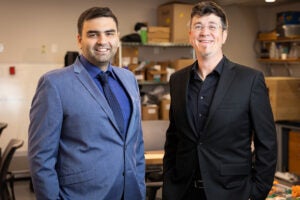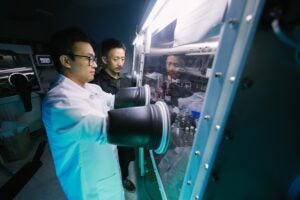
Founding Director of RISES Research Center (Resilient, Intelligent and Sustainable Energy Systems) Dr. Zhihua Qu explains the impact of a microgrid and the differences between a backup generator.
Video Highlights
00:05 – 01:28
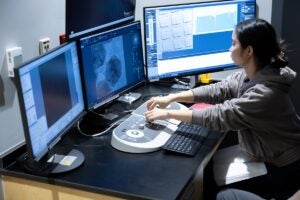
Zhihua Qu, Ph.D.: So microgrid is mainly to ensure reliability and resilience for critical infrastructure such as research one building. And for infrastructures like this, we typically have a so-called backup generator. In the event that there is a loss of power, oftentimes just a few seconds, it could have a major impact on ongoing scientific experiments. So the backup generator is to ensure there is a continuous supply of energy in the event of unpredicted interruptions. You can think of microgrid as power generation locally, just like a backup generator would provide, but the backup generator is only temporary. It's for a short period of time. And it does not cover all the loads. It only covers so-called emergency critical functions such as lighting in the building, whereas microgrid is to maintain normal operation for extended period of time in the event of unpredicted interruptions. What's behind me is the so-called Research One microgrid control center.
01:28 – 03:08
This particular center is for our students and faculty to conduct research, conduct the tests of various equipment that involved in this research one microgrid. So as part of this microgrid controller, we also conduct cybersecurity research. And that's very important because of critical infrastructure and the foundation of reliable power supply for our research, for our education activities. And for research as well, we wanted to develop new technologies that will fend off any potential cyber attack or inside attack for that matter, so that our infrastructure is not only resilient against the natural disasters, but also man-made attacks or disasters. So the microgrid is essentially a smaller grid designed specifically for certain installations such as UCF campus, and it's going to be proven not only enhance the reliability and resilience, but also reduce cost. As renewable generation becomes more and more popular, you have now opportunities to create onsite microgrids that are capable of supplying power without the main grid. And that brings the benefit of not only the sustainability, but also the resilience.
UCF Department of Electrical and Computer Engineering
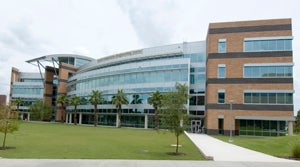
With the help of a $3 million donation from the L3Harris Corporation to the College of Engineering & Computer Science, the L3Harris Corporation Engineering Center (HCEC) now serves as the home of the Department of Electrical Engineering & Computer Science. The HCEC occupies 75,000 square feet and includes 30 research labs for faculty and graduate students. It also features two specialized research computer-aided virtual environments (CAVEs) for virtual and augmented reality.
Research Faculty
Thomas J. Riordan and Herbert C. Towle Chair & Pegasus Professor
Search Degrees
There are many benefits to taking a more proactive approach to choosing a career. The College of Engineering and Computer Science has curriculum and programs to help you land your next opportunity.
OR BROWSE BY:
Engineering and Computer Science News