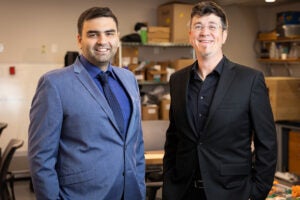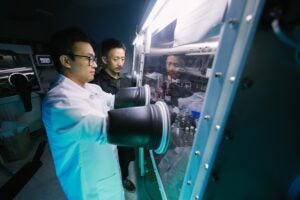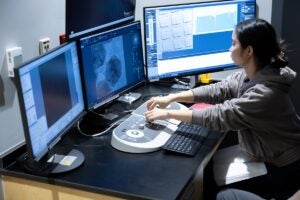
UCF researcher Sudipta Seal joined the fight by collaborating with Johns Hopkins Kimmel Cancer Center to provide a key component for a targeted medicine that combats the most common kind of pediatric brain tumor.
Video Highlights
00:07 – 01:21
Sudipta Seal Ph.D. (00:07): So what you're seeing here is a functional materials laboratory where we do a lot of work on materials at nanoscale. And this nanoscale materials finds their application in biomedical, energy, space, and many other applications. So one such application is we make very fine structure oxide molecules, namely rare earth oxide molecules, and then we put on various drugs on them so that it can effectively deliver to the site. And this molecule by itself has some aspects of pharmaceutical applications as well. So we make these nanoparticles in waters. And then of course they're so tiny, you cannot see them. And then when you attach these different drugs, they're quite soluble in nature. I think that is very important. This is one of our invention. And this is actually these two type of micro RNA and narrow particles that can be ... It's so small. We cannot say it's just like water, like it's all on water.
01:21 – 02:02
Sudipta Seal Ph.D. (01:21): So it's very easy to get to these cells. And it doesn't complicate other cell lines, so it's quite non-toxic.
Elayaraja Kolanthai Ph.D. (01:30): This particle size, we are engineer less than a ten nanometer size of particles. Okay. So that is the main important for when you are going to target in a brain. The other articles, if you have a bigger size, it's fine. But basically for the brain, you need a size of particles less than a 10 nanometer size of particles only is going to be work. So we already synthesized that engineered the particles less than five nanometer of this particles.
02:02 – 03:09
Sudipta Seal Ph.D. (02:02): It's just like a GPS system we may call it. So you program it. I'm going to only go to this address, but at the same time, I can add a stop to it. Suppose it goes before it goes to brain, maybe I'll just go to throat first. So it's just like GPS system, add a stop, subtract a stop. So this type of thing that we can really do that with nanotechlogy. Think about a Lego. So in a Lego, you have little tools that they've been done with a Lego so you can make a bus or if we can make a train, right? Same thing in this nanoparticle, think about it's a Lego block. And in Lego block, I have a lot of these anchors that I can attach to, and I can create these anchors as well. I think the unique part is that we can modulate our nanovector in a way that can sense and intervene in many types of disease.
03:09 – 03:54
Sudipta Seal Ph.D. (03:09): And not only that, many drugs when it goes inside the body, it doesn't get to its full potential because it can get [inaudible]. So this nanovector helps to protect not only product the drug, but combining with them, it becomes a wonder therapeutics, if you may call it. So I think that was pretty unique for this particular composite drug.
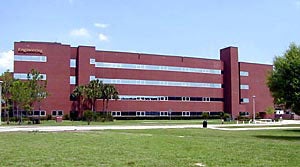
Engineering I
The UCF Materials Science and Engineering Department has a diverse and growing faculty that’s been recognized locally, nationally and internationally for its discovery, creation and characterization of nanomaterials used in additive manufacturing, photovoltaic cells, photonic devices, biomedical applications and more.
Research Faculty
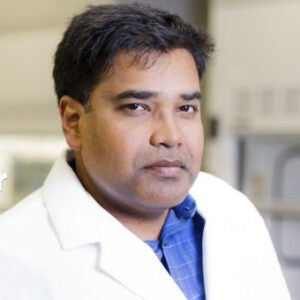

Postdoctoral Research Fellow Department of Materials Science and Engineering
Search Degrees
There are many benefits to taking a more proactive approach to choosing a career. The College of Engineering and Computer Science has curriculum and programs to help you land your next opportunity.
OR BROWSE BY:
Engineering and Computer Science News