Highlights
-
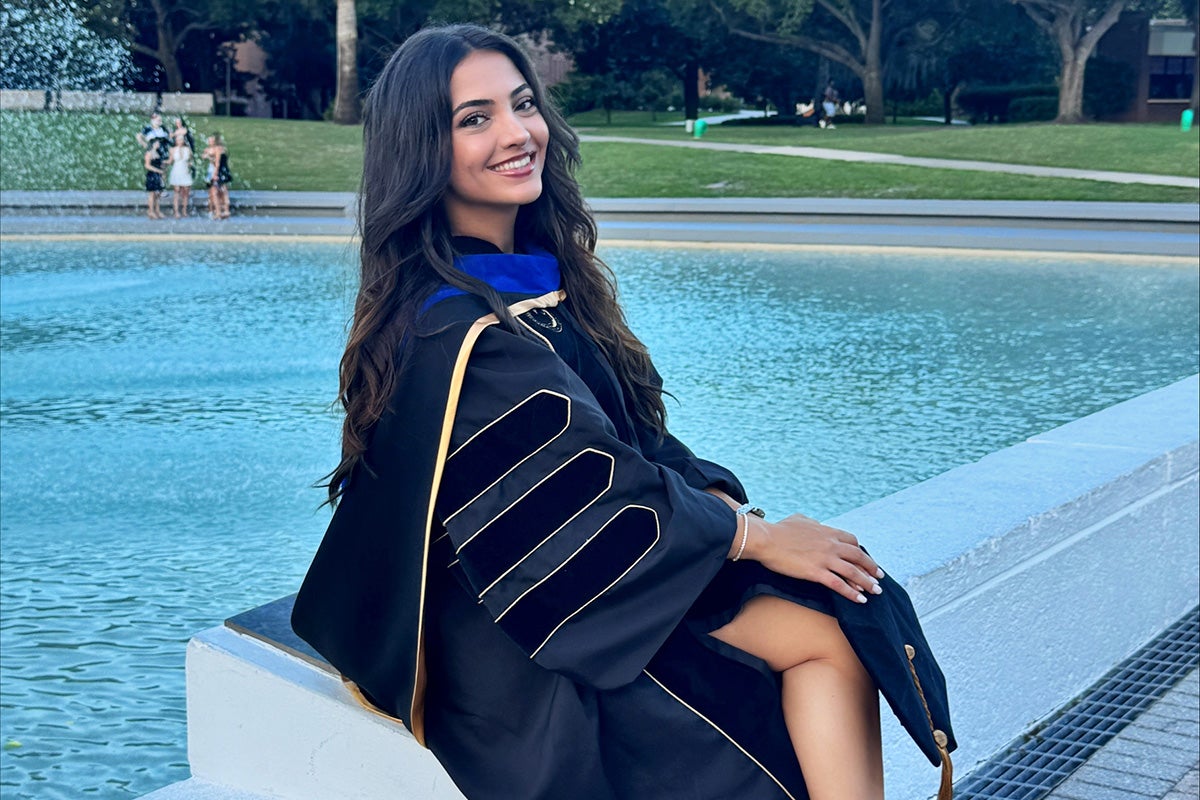
Computer science alum and competitive powerlifter Ilkin Isler ’22MS ’25PhD often chooses growth over comfort, pushing herself to be and do. This mentality led her to leave her home country, Turkey, to pursue AI studies at UCF.
-
While a student, Isler worked with doctors and other researchers to help improve imaging analysis for cancer.
-
Now a senior AI engineer at Universal Creative, she helps improve safety for park guests.
Nothing motivates Ilkin Isler ’22MS ’25PhD quite like this phrase: “It can’t be done.”
When Isler says candidly, “Working on my Ph.D. is the most difficult thing I’ve ever faced,” there’s a montage of difficult things in her life to consider — physical and mental, past and present.
For example, in August 2025, the recent computer science doctoral graduate began work as a senior artificial intelligence (AI) engineer at Universal Creative. Her role involved analyzing complex white papers and developing state-of-the-art AI systems from scratch — all for the purpose of improving the safety of park guests.
“I find solutions for high-risk applications,” Isler says, “which is a good description for what I love to do.”
“… when I hear something can’t be done, it motivates me to make it happen.” — Ilkin Isler ’22MS ’25PhD
The fact that her work requires fortitude also fits Isler well. In high school in Turkey, she once walked into a gym “just for something to do.” A trainer immediately suggested she head to the cardio area, where she’d blend in easily. Isler, however, saw the powerlifting space and thought, “That’s what I want to do.”
“I had to teach myself how to do [powerlifting],” she says. “People probably thought I’d give up, but when I hear something can’t be done, it motivates me to make it happen.”
Self-taught and competing despite her small frame, Isler went on to become a European powerlifting champion.
All of this is important for understanding the person who, while studying at UCF, helped develop an AI model to assess cancerous tumors.
Using Computer Imaging to Enhance Patient Care
Guided by a team of advisors, Isler came up with a way to feed medical imaging into an algorithm that measures shapes and textures with more speed, precision and consistency than is currently possible. Given such accurate information, an oncologist could make quicker, more confident decisions — improving overall patient care.
“… [Ilkin’s] work helps push the field forward in an important and timely way.” — David Mohaisen, UCF computer science professor
“The problem she chose to work on is inherently difficult for several reasons,” says David Mohaisen, UCF computer science professor and one of her advisors. “Medical imaging is a high-stakes domain where errors have serious clinical consequences.”
“It’s also a mature and crowded research area, with competitive works focusing on incremental benchmark gains rather than addressing deeper issues, such as reliability, uncertainty and clinical integration,” Mohaisen continues. “Instead of chasing marginal improvements, Ilkin focused on meaningful outcomes. Her work helps push the field forward in an important and timely way.”
Yet the breakthrough alone, and the work that went into it, does not fully capture what Isler faced at the dizzying start of her doctorate journey.
Taking a Chance to Change Her Life and Others
Isler arrived from Turkey with two suitcases and a hotel reservation near UCF.
“My mom filled one of the suitcases with Turkish food,” Isler says. She can laugh now, but at the time, she had no clear path beyond the airport. “I had to figure everything out.”
A few years earlier, she traveled across the globe to UCF as an undergraduate, having earned a competitive internship in the Synthetic Reality Lab, where she worked with Pegasus Professor Charles Hughes and then computer engineering doctoral student Kamran Ali ’21PhD on facial expression recognition.
“She committed herself to the research,” Hughes says, “and even contributed to writing and editing the resulting report after she returned to Turkey.”
Days away from starting doctorate-level research, with all her belongings in a single piece of luggage, Isler would do what she does best: find a way. She moved from the hotel to an unfurnished apartment.
But with her, Isler brought two specific interests to her postgraduate research at UCF. Her mother, a dentist in Turkey, inspired an interest in medical advancement. Her father, a computer science professor, recognized in his daughter the curiosity and determination required for the field.
“If I know an idea can be impactful, I’ll do whatever is necessary to make it a reality,” she says. “The higher the stakes, the more driven I become.”
Those stakes led her to focus on medical imaging solutions for cancer care worldwide. Without a medical background, she collaborated with doctors. It helped that she never looked at her research as an academic exercise. She wanted only to deliver something trustworthy that clinicians everywhere could use to eliminate gray areas in image analysis.
“I’ve been fortunate to work with many doctoral students over the years, and Ilkin stands out on multiple levels,” says Mohaisen, pointing out her motivation, energy and curiosity, before adding: “I’d say she is among the most driven.”
Fueled by Challenge and Service
By now, the source of Isler’s uncommon drive is clear. Every time someone showed skepticism about her powerlifting, she responded by breaking a national record. Although she could have attended a private college in Turkey, where she would have been surrounded by familiar language and culture, she instead chose to move across the world to study AI.
There’s one more motivation that consistently guides her: others.
Isler considers her greatest accomplishment in powerlifting to be the doors she helped open for others in Turkey to try any form of fitness they choose. And she says she would gladly move to another continent again, with just a suitcase and her AI skills, if it meant helping improve the lives of others.
“When I look back, I can see that I’ve often traded comfort for growth,” she says, “and I will not hesitate to do it again.”