Highlights
-
UCF was selected among the U.S. Department of Education’s historic number of applications for grant funding from the department’s Fund for the Improvement of Postsecondary Education (FIPSE).
-
UCF’s priority with this $3.4 million grant is to intentionally embed civil discourse and constructive communication skills into the everyday experience at the university through four main strategies involving faculty learning communities, student-centric initiatives and co-curricular activities.
-
At the end of the four years, UCF will take everything we have learned and implemented and host two symposiums. The symposiums will invite Florida’s State University System institutions and state colleges to learn strategies on institutionalizing civil discourse in curricular and co-curricular student experiences.
UCF is the only institution in the state of Florida selected to address the U.S. Department of Education’s civil discourse priority as part of its Fund for Improvement of Postsecondary Education initiative.
The department announced this month that it awarded $169 million in grants from the Fund for the Improvement of Postsecondary Education (FIPSE). Following a record number of applicants, UCF was among the honorees with a four-year $3.4 million grant for our proposal — Civil Interactions and Viewpoints for Interpersonal Competence (CIVIC): A Campuswide Model — which seeks to protect and promote civil discourse on campuses.
“The future demands graduates who can collaborate effectively, navigate complex conversations and lead with integrity within varied professional environments, even when they don’t always agree.” — Andrea Guzmán, UCF vice president for access and community engagement
“The future demands graduates who can collaborate effectively, navigate complex conversations and lead with integrity within varied professional environments, even when they don’t always agree,” says Andrea Guzmán, UCF vice president for access and community engagement and CIVIC principal investigator. “This grant allows us to prepare students not just academically, but to be thoughtful citizens and professionals. By integrating civil discourse skills throughout curricular and co-curricular experiences, we are helping students develop the communication and critical thinking skills that employers, communities and our democracy depend on.”
What is the Fund for Improvement of Postsecondary Education (FIPSE)?
FIPSE is a discretionary grant initiative that supports innovative projects to address urgent national needs in postsecondary education. The funds awarded from this specific program competition empower institutions to develop and scale solutions that improve educational outcomes, strengthen institutional capacity and align education with workforce demands.
In November, the Department of Education announced four FY 2025 competition priorities focused on expanding innovative teaching and student success initiatives, promoting civil discourse on campuses, advancing accreditation reform, and building capacity for high‑quality, workforce‑aligned short‑term academic programs eligible for Workforce Pell Grants.
While UCF was Florida’s lone representative selected for the civil discourse priority, the state saw Florida A&M, Florida Atlantic University, and its Commission for Public Higher Education, Inc. earn grants in accreditation. Hillsborough Community College earned funding for AI.
What is civil discourse?
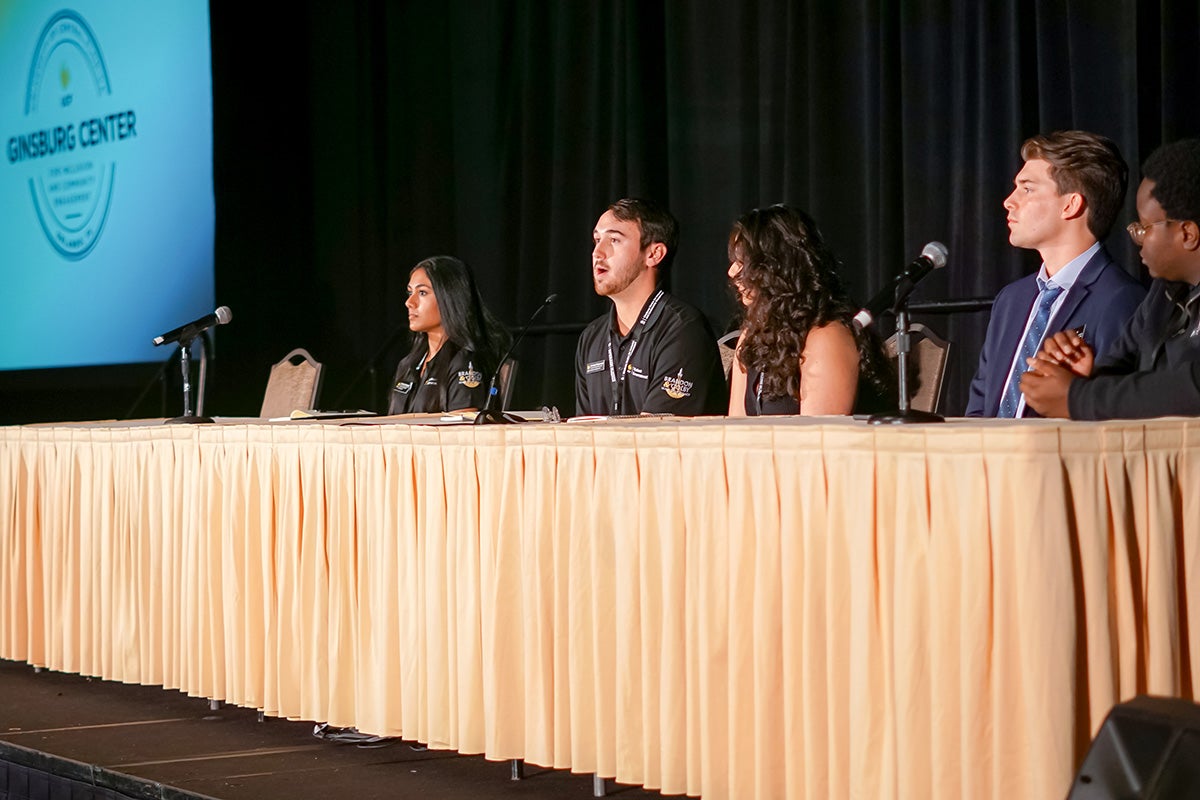
UCF’s Office of Civil Discourse and Engagement defines civil discourse as constructive conversation or dialogue which intends to enhance understanding, be productive and requires taking responsibility for truly listening and talking about important local, national and global topics/issues.
“Civil discourse is about understanding the other person’s viewpoint so you can come together to make thoughtful decisions in spite of having different viewpoints,” Guzmán says.
Guzmán says she often hears students today are hesitant to share their own perspectives. She hopes that through this intentional framework, students will begin to feel more confident engaging civilly with those around them.
“Whether students are in the classroom or just having a conversation with a peer, we want them to have the skillset and emotional intelligence needed for constructive conversations,” Guzmán says. “They should still be able to walk away and respectfully say, ‘I still don’t agree with you, but let’s go get a burger and fries afterward.’ Too often, we’ve seen relationships fracture because the skill of civil discourse has been lost.”
How will UCF use these funds?
UCF’s priority with this $3.4 million grant is to intentionally embed civil discourse and constructive communication skills into the everyday experience at the university through four main strategies.

Strategy 1: Faculty Learning Communities
The first strategy is geared toward faculty. UCF Director of Civil Discourse and Engagement Haley Winston ’17EdD and a faculty fellow, yet to be named, will partner to create a curriculum to offer paid learning experiences via faculty learning communities each semester and a track at the Summer Faculty Development Institute. This curriculum will inform faculty on strategies and methodologies for building civil discourse opportunities into their classes. There are also plans to develop and implement civil discourse modules in new faculty orientation.
Eventually, UCF’s course catalogue will recognize classes — much like it does now with service-learning courses — with a civil discourse designation.
Strategies 2 and 3: Student Orientation and Training
Two additional strategies are student-focused. One will collaborate with UCF’s Division of Student Success and Well-Being to include civil discourse modules at orientation.
“From the very start of a student’s journey at UCF, we set the expectation that we are an institution where people can express their views freely and constructively, in a respectful way,” Guzmán says.
The other will partner with UCF Career Services to offer civil discourse training for both student employee onboarding training as well as a supervisor-specific training via its Work+ Supervisor Hub, preparing students to carry on these skills into the workforce after graduation.
Strategy 4: Mini-grants for Learning Opportunities
The fourth strategy is geared toward expanding co-curricular opportunities through the UCF Ginsburg Center – Office of Civil Discourse and Engagement. Mini-grants will be offered to units and colleges who want to offer learning opportunities within their department or classrooms.
“This grant builds on work already underway at UCF and allows us to scale it intentionally.”
— Andrea Guzmán
“This grant builds on work already underway at UCF and allows us to scale it intentionally. It also enables the development of a pilot program designed to be replicated across the state university system,” Guzmán says. “The reason we are choosing to bolster programs like orientation and faculty learning communities are because these are existing infrastructures that almost every institution will have and can seamlessly incorporate.”
What happens next?
The funding takes effect immediately. UCF will invite faculty applications for the faculty fellow position during the Spring 2026 semester, with the appointment beginning in August.
UCF’s Office for Grant Initiatives and Partnerships will also organize an internal implementation team to confirm year-one priorities, which includes aligning timelines, refining deliverables and establishing the infrastructure needed to support the work.
“With every project we implement, we think about scale and long-term impact. The goal is always for meaningful, transformative work to live on beyond the grant,” says Cyndia Morales Muñiz ’13EdD, senior director of grant initiatives and partnerships, and CIVIC project director.
In addition to Muñiz, Guzmán and Winston, the project includes activity coordinators Joel Cramer, interim vice provost for Faculty Excellence; Chanda Torres ’98 ’00MA ’08EdD, assistant vice president of the Dixon Career Development Center; and Ryan Goodwin, assistant vice president for Strategic Initiatives.
In years three and four of the grant, UCF will develop and host two symposiums for Florida’s State University System institutions and state colleges to share implementation strategies and lessons learned, providing a model that can be replicated at their own campuses.
“This is yet another example of UCF leading the way to best serve our students and faculty and we look forward to getting started,” Muñiz says.
Note: 100% of UCF’s Civil Interactions and Viewpoints for Interpersonal Competence (CIVIC): A Campuswide Model is being financed with this federal funding and 0% of the program is being financed with non-federal funding.