Highlights
-
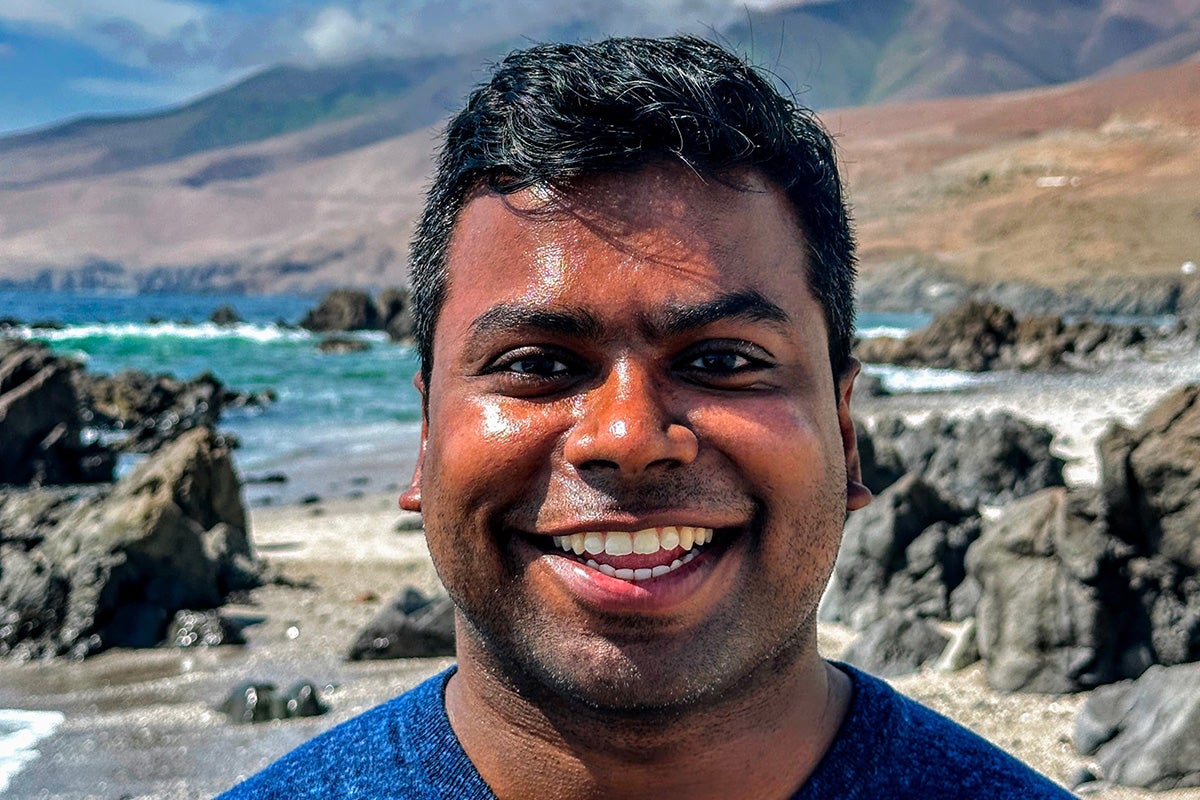
UCF computer engineering graduate Kamalakkannan Ravi is advancing trustworthy AI for healthcare through a research fellowship at Harvard Medical School and Boston Children’s Hospital.
-
At UCF, Ravi combined strong engineering fundamentals with interdisciplinary, human-centered research to develop transparent AI systems with real-world impact in healthcare and public safety.
-
A first-generation scholar and campus leader, Ravi found mentorship, community and purpose at UCF — experiences that continue to shape his commitment to ethical innovation.
For computer engineering major Kamalakkannan Ravi ’20MSCpE ’25PhD, the goal was never to just earn a doctorate — it was to build artificial intelligence (AI) systems people could trust in the moments that matter most.
That bold vision found its momentum at UCF. As a student, Ravi was drawn to a university that encouraged big questions and interdisciplinary thinking, along with strong engineering fundamentals — the kind UCF is rapidly becoming known for as a rising force in engineering and technology. The university’s dynamic research environment gave him the freedom to explore where machine learning, biomedical applications and human-centered AI converge, while mentorship in the Department of Electrical and Computer Engineering helped sharpen his purpose.
Now, he’s carrying that UCF-driven determination to Harvard Medical School and Boston Children’s Hospital, where he’ll begin a research fellowship with the Division of Genetics and Genomics to advance trustworthy AI for clinical decision-making in healthcare.
At Harvard, Ravi will work on a project that aims to help physicians identify rare diseases earlier and respond more quickly. His research focuses on developing and evaluating clinical decision support tools that analyze electronic health record data and natural language processing to detect patterns that may signal a rare condition. These tools are designed to support clinicians in identifying patients who may benefit from further genetic evaluation, testing or a specialist referral. Ravi’s role centers on creating trustworthy, transparent AI methods that align with clinical systems, helping ensure these technologies are used responsibly in real-world healthcare.
Overcoming Obstacles Without a Blueprint
Ravi’s path to this opportunity was shaped by his persistence and commitment to making an impact long before he arrived at UCF.
Originally from Chennai, India, he’s a first-generation college student who entered higher education without a family blueprint to guide him. That experience influenced how he navigated graduate school and advanced research environments, reinforcing the importance of mentorship, community and resilience.
After earning a bachelor’s degree in biomedical engineering from Anna University, Ravi worked as a research assistant at the Indian Institute of Technology Madras. There, he gained early exposure to data-driven modeling and applied systems research at the intersection of engineering and medicine — experiences that shaped his interest in applying computational methods to biomedical and societal challenges. He’d take this interest on his pursuit of graduate education abroad.
Finding Interdisciplinary Opportunity at UCF
Ravi chose UCF specifically for its strength in engineering combined with opportunities for interdisciplinary, human-centered research.
Within the Department of Electrical and Computer Engineering, he found an environment that encouraged him to explore machine learning, biomedical applications and ethical AI.
Under the mentorship of Pegasus Professor Jiann-Shiun Yuan, who oversees the NSF-sponsored Multi-functional Integrated System Technology Center and specializes in developing the next generation of smart systems, Ravi refined his research, which bridges technical innovation with societal impact.
At UCF, Ravi’s research focused on trustworthy and comprehensible AI in critical settings, including healthcare and public safety. His dissertation, “Artificial Intelligence for Social Wellness: Threats and Ideology Detection in Online Texts,” examined how scalable and ethically grounded AI systems can be designed for real-world applications. His work emphasized interpretability, reliability and evaluation with human decision-makers in mind.
His doctoral work led to the development of several datasets and frameworks, including:
- RICo, a large-scale dataset analyzing ideological discourse in online communities
- ALERT, a threat detection framework that combines active learning with AI to support transparency and reduce labeling burden
- TRuST-M, a human-subject study exploring how explanation quality affects user trust in AI-assisted moderation systems.
Portions of this work were supported by the U.S. Department of Homeland Security — a testament to its national relevance and real-world value.
Growing Through Leadership, Mentorship and Community
Beyond his studies, Ravi immersed himself in the UCF graduate community, taking on leadership roles that reflected his commitment to service and mentorship.
He served as senator for the College of Graduate Studies in student government, director of professional development for the Graduate Student Association and president of the Scholastic Association of Graduates in Engineering. He also led Alpha Alpha Alpha, the national honor society for first-generation college students, advocating for the success of first-generation graduate students.
Mentorship remained central to his experience through his involvement in the NSF-funded L.E.A.R.N. (Learning Environment and Academic Research Network) program, a STEM-focused living-learning community for first-year and transfer college students, and his service as a senior design project judge.
Ravi’s academic excellence, leadership and mentorship at UCF were recognized through multiple awards, including the ORCGS Doctoral Fellowship, the Graduate Presentation Fellowship, the Graduate Research Mentor Award, the UCF Alumni Fellows Leadership Scholarship and the Reuel Buchanan Aspire to Inspire Scholarship. These honors provided valuable support and enabled him to focus on research throughout his doctoral studies.
Advancing Impact Beyond UCF
As Ravi prepares to begin his fellowship at Harvard Medical School, he credits UCF with shaping both his research approach and his sense of responsibility as a scholar. He hopes his journey encourages other students, especially first-generation scholars, to pursue ambitious, interdisciplinary work while remaining grounded in mentorship, ethics and service to the broader community.