Additive manufacturing, better known as 3D printing, is a technique that can be used to create complex, lightweight components for medical devices, vehicles and even spacecraft. However, the healthcare, automotive and aerospace industries haven’t widely adopted the practice due to the high cost and lengthy process of testing and inspecting the parts.
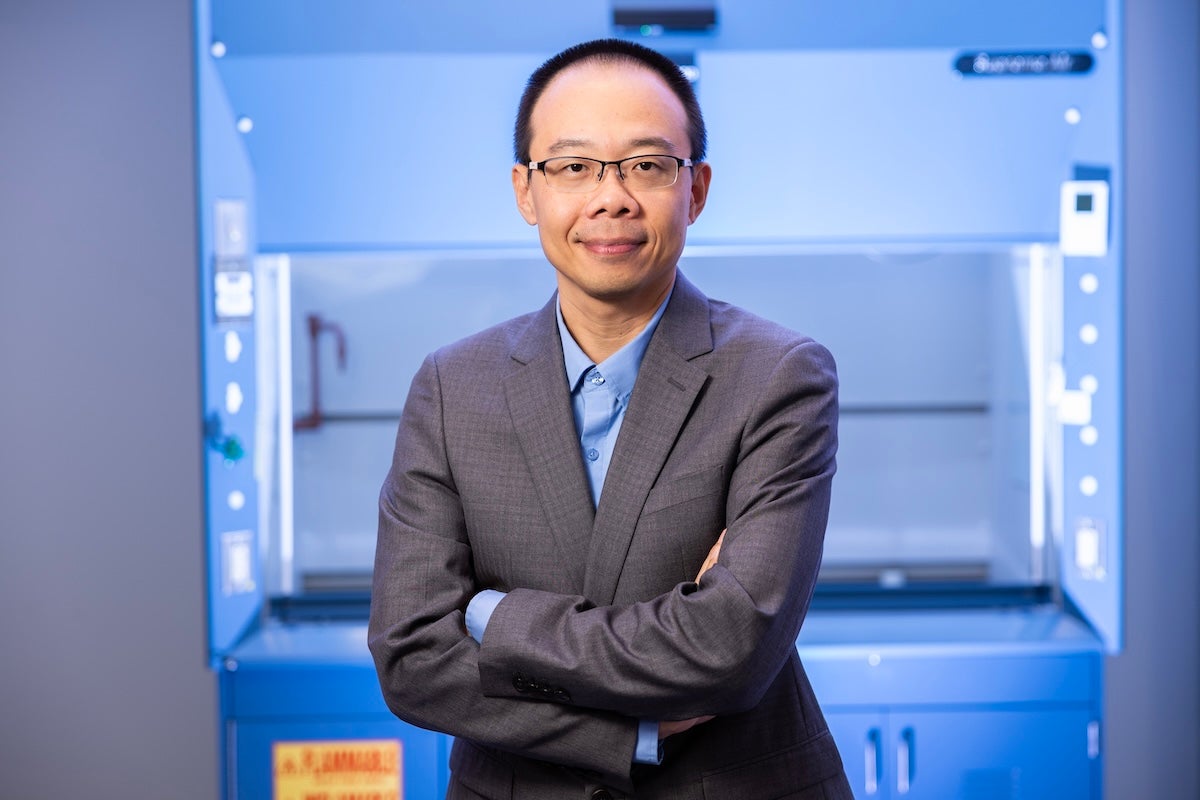
But that may change in the future through the efforts of a UCF researcher. Dazhong Wu, an associate professor of mechanical and aerospace engineering, has received a Young Faculty Award from the Defense Advanced Research Projects Agency (DARPA) for his project titled “Artificial Intelligence-Enabled Affordable and Scalable Additive Manufacturing Part Qualification.” The award will include nearly $500,000 of funding for the two-year project with an optional $500,000 for a third year of work, depending on how the research progresses.
The goal of the project is to develop an efficient and cost-effective machine learning model that can predict the defects and mechanical performance of 3D printed materials. Current metal additive manufacturing processes use expensive materials, such as titanium alloys, to build complex, high-performance parts layer-by-layer from digital models. Those parts undergo lengthy trial-and-error testing cycles that result in the destruction of parts and an overall loss of money.
With Wu’s novel method that mixes AI with additive manufacturing, the industry can move away from destructive testing and reduce inspection costs.
“Using AI we can predict the mechanical performance of 3D printed parts with small amounts of destructive and non-destructive testing data. With this, we can ensure every part is consistent, reliable and less costly.”
Once Wu’s AI model is built, he hopes it can be implemented in various industries to transform how they manufacture critical components.
“I’m hopeful this AI-enabled additive manufacturing qualification framework will be used across many industries, including aerospace and, many more,” Wu says. “Bringing costs down is crucial to the additive manufacturing industry. To do that, we need to make sure every part consistently meets performance requirements.”
About the Researcher
Wu joined UCFin 2017 after serving as a senior research associate at Penn State University’s Department of Industrial and Manufacturing Engineering. In 2021, the Society of Manufacturing Engineers ranked him among the 20 most influential academics in additive manufacturing. In the College of Engineering and Computer Science, he manages the Additive Manufacturing and Intelligent Systems Lab, where he and his team develop smart manufacturing techniques.
The project depicted is sponsored by the Defense Advanced Research Projects Agency. The content of this article does not necessarily reflect the position or policy of the government and no official endorsement should be inferred.