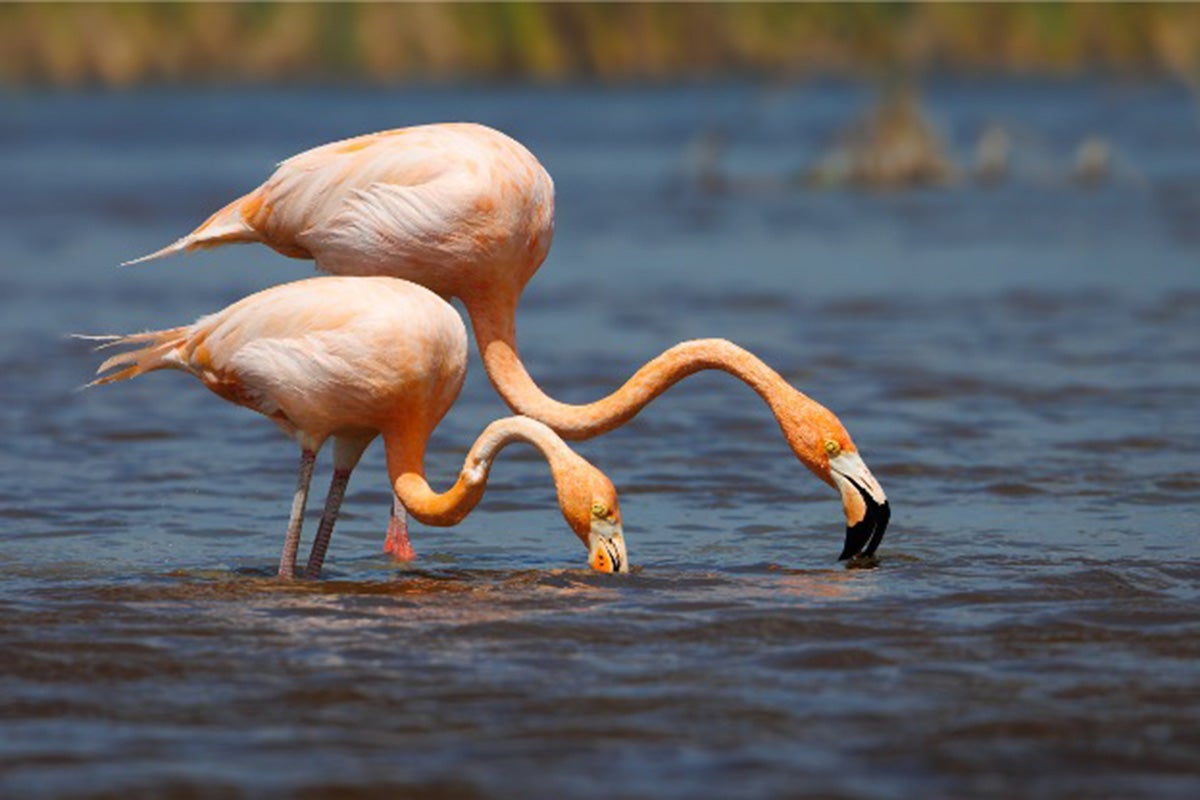
For all its presence on postcards and popular tourist attractions, the American flamingo (Phoenicopterus ruber) has been largely absent from Florida itself. Nearly wiped out from the state in the early 1900s, the species has shown only faint signs of a true comeback.
Now, a new study published in the American Ornithological Society’s Ornithological Applications journal details how researchers from UCF’s Department of Biology and colleagues analyzed the genetic variability, population structure and viable conservation strategies for Florida’s American flamingo.
“As a native Floridian who grew up in Tallahassee, Florida, I was fascinated and a little surprised to see the flamingo as a prominent state icon, yet I had never seen one in the wild,” says Jessica Folsom ’23MS, who led the study while earning her master’s degree in biology at UCF.
The Flamingo’s Lost History
Flamingos were nearly extirpated in Florida due to hunting and habitat loss. While later sightings suggested possible natural recolonization, many of the birds were thought to be escapees from zoos or other captive populations rather than signs of a true restoration.
Eric Hoffman, professor and chair of UCF’s Department of Biology and a co-author of the study, says the project revealed the depth of what was lost.
“Before this project, I wasn’t aware of the historical distribution or how common these birds were in Florida 100 to 150 years ago,” Hoffman says.
An Unlikely Founding Population
Although flamingo populations remain large in regions near Florida, including The Bahamas, Cuba and Mexico, Florida’s first wave of birds originated in an unconventional setting.
“In the 1920s, the owner of a horse racetrack in Hialeah released roughly 20 flamingos, likely sourced from The Bahamas, as a marketing strategy to boost attendance and betting,” Hoffman says. “The birds thrived in the wetland habitat at the track’s center, forming the founding population for many Florida zoo-held flocks, including Zoo Miami’s.”
Signs Florida Can Still Support Flamingos
In recent years, researchers say that flamingos generally fly into Florida from neighboring regions or arrive after hurricanes. Some flocks remain for months — evidence that Florida’s wetlands can support them — however, establishing a long-term breeding population remains a primary challenge.
“These returning flocks have given us an opportunity to collect contemporary and historical samples to address questions about their genetics and population structure — a central focus of my lab,” Hoffman says.
What the Genetics Reveal
Folsom, who conducted the research in Hoffman’s lab as a graduate student and now works as a biologist for the Florida Fish and Wildlife Conservation Commission, says populations that undergo extirpation or steep decline often face consequences such as reduced genetic variability, loss of unique local adaptations or alleles, and, in severe cases, a greater risk of inbreeding.
“In Florida, hunting for feathers could have created those conditions,” Folsom says. “However, in our study, we found insignificant levels of inbreeding, little loss of genetic variability and minimal differentiation between Florida birds, the birds in Florida zoos, and other populations in the Caribbean and parts of South America.”
The study included 188 flamingos spanning seven contemporary wild populations — from Cuba, The Bahamas, Bonaire, the Yucatán Peninsula, Mississippi, the Galápagos Islands and Florida — as well as managed flocks, or ex-situ, housed in Zoo Miami and Hialeah Park. It also included five historical populations from Cuba, The Bahamas, Mexico, Florida and the Galápagos Islands.
Because wild Florida specimens are limited, the team used other Caribbean wild populations as genetic proxies. Using whole genome sequencing across more than two million loci — the fixed positions of genes on a chromosome — the team analyzed data using bioinformatics software on UCF’s high-performance computing cluster, Stokes.
“One of our most surprising findings was that modern flamingos showed significant genetic variability compared to historical populations,” Folsom says. “Captive populations showed the greatest genetic variability and minimal inbreeding, meaning they could be strong candidates for reintroduction. Genetic similarities also indicate flamingos from other regions could adapt well to Florida, with limited risk of outbreeding depression.”
Researchers emphasize that reintroduction must be paired with policy change.
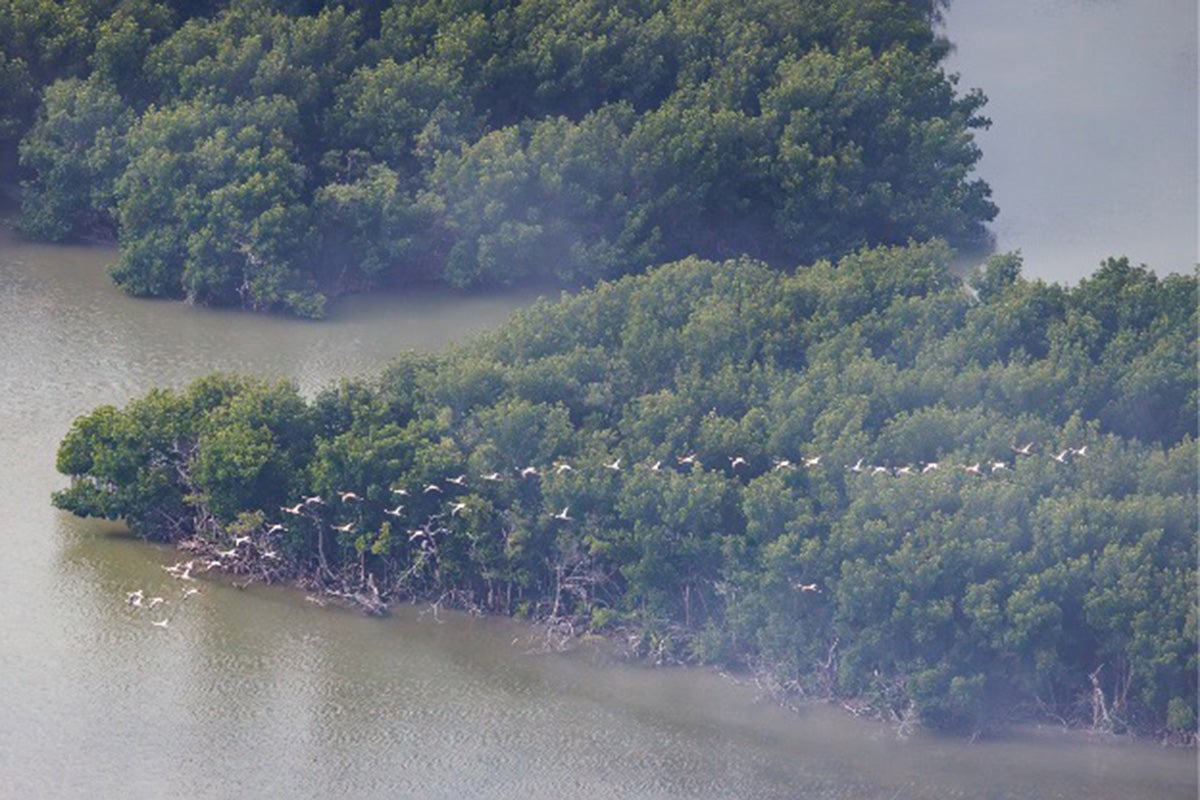
“For more than a century, there were almost no conservation measures for flamingos in the U.S.,” says Steven Whitfield, director of Terrestrial and Wetlands Conservation at the Audubon Nature Institute and a co-author of the study. “That’s partly because flamingos were long considered a non-native species to Florida. With our work, we want to show they have always belonged here and there’s a scientific basis to support their recovery.”
Why Policy Matters as Much as Habitat
A petition to classify the birds as threatened was filed with the state, Whitfield says, but the proposal did not advance, stating that flamingos don’t warrant inclusion on the threatened species list. Some officials have cited existing protections, such as Everglades National Park, as sufficient. Researchers disagree, saying habitat protections alone cannot ensure the species’ survival or population restoration.
“This study provides the evidence needed to prove that birds raised by zoos are a viable genetic match, opening the opportunity for reintroduction from zoo populations,” Whitfield says.
Meanwhile, public momentum is strengthening legislative interest.
“There is sustained statewide support for naming the flamingo Florida’s official state bird, and bills are now under review in both the Florida House and Senate,” Folsom says. “They’re often the first image that comes to mind when you think of Florida, and that recognition drives ecotourism and public enthusiasm, which also supports broader wetland conservation efforts.”
Successful recovery efforts in other regions point to promising intervention strategies.
“Artificial nest mounds can encourage breeding, and decoy flamingos have been used to signal an established flock, helping attract passing birds,” Folsom says. “Both tactics have shown success in human care and select wild settings.”
A Path Forward for Restoration
While the long-term outlook for flamingos is good, the small numbers in Florida are not enough for the species to recover. Moreover, habitat destruction, pollution and warming temperatures add to the challenges they face.
“Natural recovery of the flamingo is unlikely in Florida without intervention,” Whitfield says. “But our study shifts that conversation. We can now confidently say ex-situ flamingos are genetically compatible with wild populations, which opens possibilities for a future release program, even though logistical hurdles remain.”
For the researchers, the study has not only demonstrated how genetics can inform conservation but also provided an opportunity to raise awareness about an iconic species that has always been native to Florida.
“Growing up in Florida, it’s impossible not to appreciate its biodiversity,” Folsom says. “Working on this project with passionate colleagues like Eric and Steven has been incredibly rewarding, helping clarify the flamingos’ history in Florida and the value of protecting and reintroducing them.”