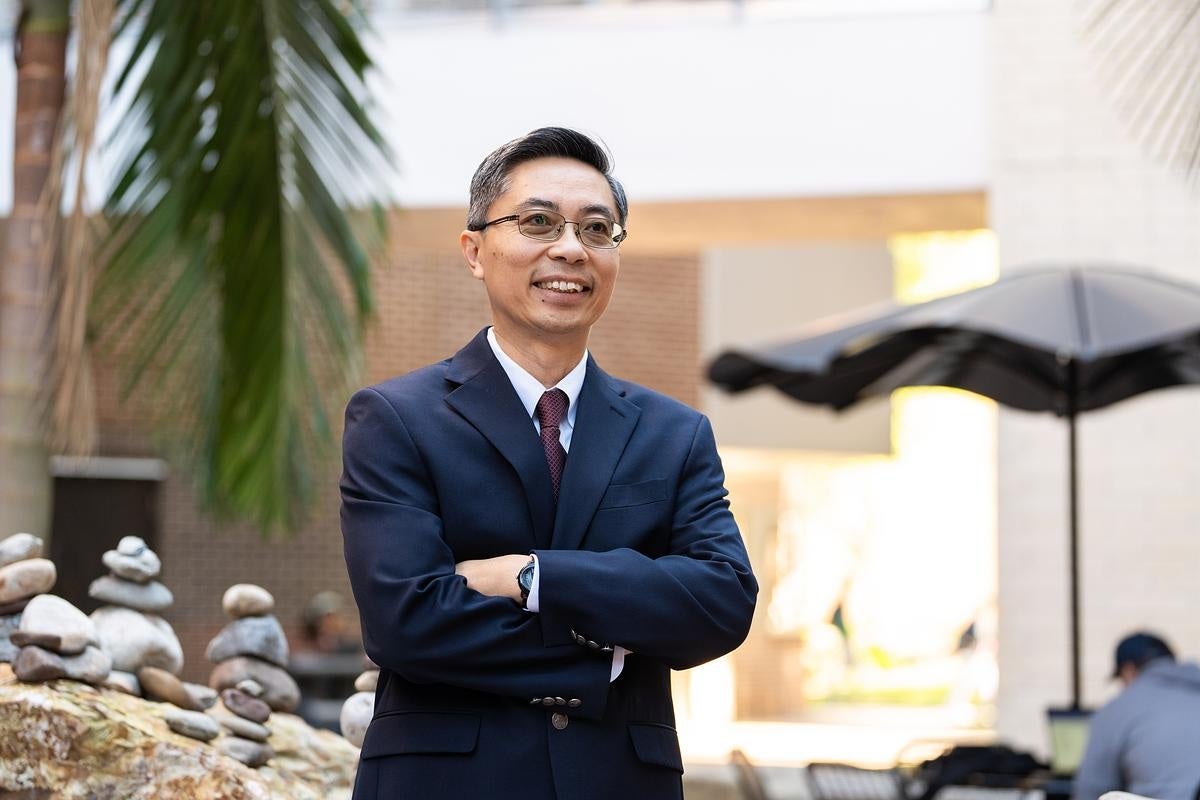
UCF researcher and cybersecurity expert Yan Solihin has been named a senior member of the National Academy of Inventors (NAI), an honor that recognizes innovators whose work has made a tangible impact beyond the laboratory.
Globally, a total of 230 emerging inventors were named to the list this year, making it the largest cohort in NAI history. The inductees will be honored during the NAI 15th annual conference in Los Angeles in June. Solihin says he feels honored to join this distinguished group of researchers.
“What sets the NAI senior member designation apart is that it focuses on innovations with real-world impact.”
“This induction means a lot to me,” he says. “What sets the NAI senior member designation apart is that it focuses on innovations with real-world impact.”
Solihin’s work has significantly impacted society and the way that our technology works. The Pegasus Professor and director of the UCF Cyber Security and Privacy faculty cluster initiative has made computing systems faster, more reliable and more secure.
Among his most influential inventios are a security mechanism known as the Bonsai Merkle Tree and a system called Cache Quality of Service. The former protects computer memory from unauthorized modifications at significantly lower cost than previous methods, while the latter addresses performance slowdowns that occur when multiple applications share processor resources.
Both innovations have influenced processors that are now widely used in data centers.
“My journey of making real-world impact from my research spanned many years ago, starting in 2012,” he says. “Since that time, my work has garnered 57 U.S. patents in the area of chip design.”
Solihin, who is also an Institute of Electrical and Electronics Engineers, Association for Computing Machinery and Japan Society for Promotion of Science fellow, says his process for taking an invention from an idea to a tangible product starts with identifying a problem that is worth solving. From there, he analyzes literature and technical documents for solutions, identifies the key technical challenges to overcome and then works to refine the solution. He encourages young inventors to just start by “brainspilling,” or getting the idea out on paper.
“When I have an idea in my head, it is typically not very clear,” Solihin says. “It appears vague, like seeing it through fog. Translating this into an invention requires working the brain to conceptualize the solution, to visualize it in much deeper details, to enumerate all the cases in which it shows benefits and drawbacks and solves key technical challenges. This process, brainspilling, requires long hours with pencil and paper to remove the fog.”
Ultimately, he says, the motivation to continue innovating comes from the satisfaction of solving complex problems.
“It’s the good feeling of gaining clarity on something that was once unclear,” he says. “It’s similar to solving a puzzle but with open-ended problems and unpredictable timelines.”