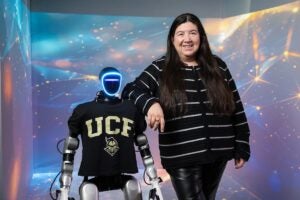
Qiushi Fu’s foundational research on bimanual coordination may help victims of stroke, limb loss or other conditions limiting limb usage improve their quality of life.
Video Highlights
00:05 – 01:26
My name is Qiushi Fu I'm assistant professor in mechanical and aerospace engineering. And also I'm part of the faculty cluster initiative. And I'm the member of the Bionics cluster, which stands for Bionic Implants Materials and Nerve Interfaces. So the objective of the research is quite simple. We want to understand how the brain controls our two hands to work on a task that has a common objective. For example, tying your shoes, buttoning. So this test typically requires two hands to work together. And if one hand makes a mistake, the other hand can compensate for it. As we all know, in people with neurological disorders such as stroke survivors and cerebral palsy patients, they typically would have a impaired motor function of one hand. It's called epilateral impairment. But when they work on tasks that require two hands to coordinate, the impairment are typically worse than the unilateral impairment because of these disruption in coordination.
01:26 – 02:39
So hopefully our research will provide biomarkers and baseline data to perform rehabilitation interventions to help them regain or recover from impaired motor control. We ask the participants to perform certain motor tasks, and we observe how the brain signals are correlated with the movement. And typically this gives several things. One is when you observe a signature of brain signals that make a good representation of the coordination behavior between limbs, we can use this as biomarkers to assess the progress of rehabilitation, or we can identify patients who may benefit more from a particular rehabilitation protocol. So this one device is the most relevant to this research project. It's a bunch of electrodes that measures the electrical activity of the brain when it functions.
02:39 – 03:30
Currently, this was designed to have 64 electrodes over the entire scale. And the way we use it, we can either look at the activities within individual channels or patrol or patch of areas, but more importantly, mathematical modeling allows us to compute where or estimate where the origin of the activity is from in which region of the brain.
03:30 – 04:15
he cameras here is a motion captures system. So what we can do is we can put these reflective markers on the human body and then the camera sees these markers and track their movement. Therefore, we can track the movement of the limbs. And then through the motion camera system, we could measure the exact movement pattern during this test. And then also these can be used to correlate with brain activity.
Research Faculty
Associate Professor | Department of Mechanical and Aerospace Engineering
World-class Academic Programs
UCF’s College of Sciences has curriculum and programs to help you land your next opportunity.
OR BROWSE BY:
Engineering and Computer Science News