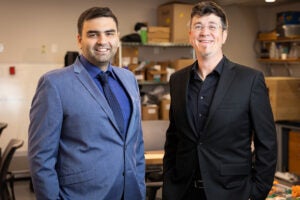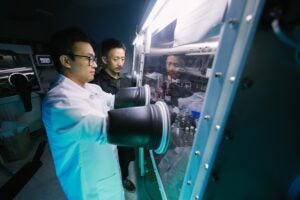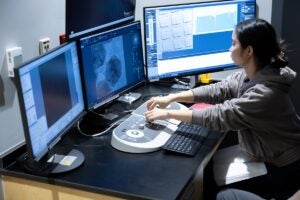
The research teams of Laurene Tetard, professor of physics at UCF, and Richard Blair, researcher professor at UCF’s Florida Space Institute, have discovered how to produce strong micro and nanofibers of carbon at room temperature, which can be implemented in a unique 3D printing process they have developed.
Video Highlights
00:06 – 01:05
So what was being studied is how we have catalyst materials that when exposed to light can break hydrocarbons like methane down into their component elements. So it breaks the methane down into carbon and hydrogen. And so as we broke it down into the carbon and we say, okay, carbon's all over the place. It's soot, it's charcoal briquettes, but the carbon was being produced in very set structures. So we could actually make carbon structures of arbitrary shape. So it's kind of like 3D printing, but for carbon. Now this has been done by people, but at very high temperatures. We are doing it at room temperature. We've managed to do it on fabric and we can produce quite flexible and small structures. Right now, we're most excited about the fact that these carbon structures are electrically conductive and they can interface with biological systems without killing the systems.
01:05 – 01:50
So a lot of people, you want to interface electrically potentially with cells or with nerves. And those electrodes need to be very compatible with biological systems. So we've seen that these carbon materials can be poked into living cells that don't kill them. So you can measure electrical contact out of them and you can put things into the cells. So everyday people might see applications in bioelectronics, and so we're kind of excited about that part. This project started as a serendipitous discovery.
01:50 – 02:06
So before the pandemic, we had a graduate student. We were looking at catalysts that would convert propylene, which is like the precursor for polypropylene, your pullovers. You're looking for catalysts that can convert that could just cause reactions with that. And in order to study that catalyst, we had to do some spectrotical Raman spectroscopy. So that requires a laser. And when the student focused the laser down on the surface of the catalyst under the gas that we're interested in, the propylene, he started seeing black spots.
02:06 – 02:54
And he came back to me and said, oh, it's burning, it's burning, it's burning. But there was nothing to burn. There's nothing that would make those black spots like that. And so we quickly realized that what was happening as we were breaking the gas down into its component part, hydrogen and carbon. So that was interesting. We were looking at the hydrogen component and Dr. Tatard, she noticed that as she focused the laser on, she started getting interesting shapes, and then she could slowly move the laser up from the surface and the shapes would grow following the laser. And then she's very patient. So she managed to, if you look at the article, she grew these very beautiful rays and uniform structures, and she even showed that you can rotate the structure and start growing again. And so if you think about that, that's 3D printing.
02:54 – 03:05
So all we need now are platforms to start making structures. We found that with very little energy, we can produce very small, useful carbon structures that have applications in electronics and potentially energy harvesting and actually could have some impact in the world.
Partnership Building 1
The Florida Space Institute (FSI) serves as a key component of the University of Central Florida (UCF), representing the university’s tradition and determined future in space research and education. FSI’s mission is to catalyze space-related research, development, and education; extending its influence beyond UCF to encompass a network of member institutions throughout Florida.
Research Faculty

World-class Academic Programs
UCF’s College of Sciences has curriculum and programs to help you land your next opportunity.
OR BROWSE BY:
Engineering and Computer Science News