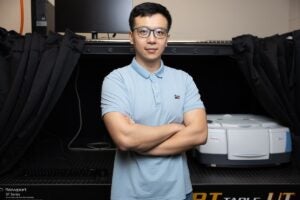
Interdisciplinary research, led by Associate Professor Matthieu Baudelet and chemistry doctoral students, fosters new global standards for forensic science work.
Video Highlights
00:09 – 01:20
Matthew Baudelet:
My background is in chemical analysis using laser ablation. So that means using lasers for sampling little amounts of matter. And one of the main aspects of it is to create standards. And those standards are some of the most complex ones to make. And so that was a very nice challenge and I wanted to try to solve it. This aspect of research is about anthropology and toxicology. And so in forensic anthropology, there's a lot of work that is about solving crimes, of course. But also there's a lot of work that we are doing also in parallel that is about repatriating soldiers fallen from previous wars. And so we just have bones and we need to be able to analyze them. And in toxicology, maybe that's something that's more understandable, but like drug addiction, also there is any poisoning. So those are big, big topics in forensics that we try to help with those standards.
01:20 – 02:25
We call those standards those fantastic four because there are four hard biomaterials. There is nails, hairs, bones, and teeth. The creation of those standards is very important because every aspect, especially in toxicology, you do chemical analysis every day, but you need to be able to quantify the amount of either poison that you found or drugs that was used and you need standards for that. You cannot do it without those standards. Really two people right now that are in the group is like Caitlin Bonilla and Kristen Livingston. And I'm very thankful for having them the past five years, even a little bit more for Caitlin because she's from UCF. She's an undergrad from forensic program. But they really right away understood the need for how we needed those standards. So I'm really thankful for that.
02:25 – 03:22
Kaitlyn Bonilla:
Our standard is composed of a keratin film. It's really small little material here. So what it is is we extract the keratin from human hairs. Previously, there are other methods where they try to develop standards such as they would soak hairs in solution of drugs or the metals. However, those materials, they don't have as good of a yield. They don't have as much surface area as these films do. So when you're using a laser, you want to be able to sample directly from the material, but you need room to do that. So that the surface area is going to matter. So these enhance that. They provide a controlled material that you can controllably dope with your analytes of interest, such as the metals or the metabolites. So it's really going to provide an accurate quantification of these analytes of interest. Hair does provide a lot of information within its growth.
03:22 – 03:34
So as it grows, the information is going to grow along the hair strand. So using these laser-based techniques, we are able to get information directly from the hair through its growth.
03:34 – 04:11
Kristen Livingston:
Bones are an important matrix to study because if you think about what tissues are left behind when individuals die, bones are the ones that last the longest. And so they can give you a lot of information about the individual. So as bones are formed, they are composed primarily of collagen and then a mineral matrix known as hydroxyapatite. And so these make up the bulk properties of the bone. However, trace elements can be incorporated into the bone matrix throughout an individual's life. So things like diet or environmental exposure or even maybe health deficiencies or disorders can impact what the composition of an individual's bones.
04:11 – 04:47
So what we are trying to study is how we can measure those elemental differences in bone. And so we do that using a technique called laser-induced breakdown spectroscopy. We actually have a portable instrument. So bones, a lot of times you find them out in the field. So at an excavation site or maybe in different laboratories. So it's important that we are able to travel with our instrument to help analyze those. So this is the example of that instrument that I use. And to analyze the bone, you can just hold it up to it and press a button and then you get your chemical information out of that.
04:47 – 05:05
Matthew Baudelet:
So what excites me about it is that, yeah, so now we get those four. They're like, we've put our name, we put the group's name on those four standards, but they just open ... It's like Pandora's box. Now there's so much more we can do.
Partnerships II
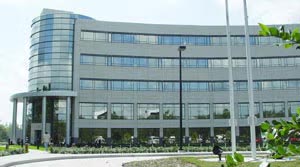
The National Center for Forensic Science (NCFS), a program of the National Institute of Justice (NIJ), is housed at the University of Central Florida. NCFS was formed in 1997 to serve the forensic science, investigative, and criminal justice communities and to enhance their capabilities. The NCFS has close working relationships with UCF’s Forensic Science, Computer Science, Engineering, and Criminal Justice Programs. It is also involved in partnerships with the FBI, BATF, the U.S. Secret Service, and various state and local agencies.
Research Faculty
World-class Academic Programs
UCF’s College of Sciences has curriculum and programs to help you land your next opportunity.
OR BROWSE BY:
Engineering and Computer Science News