Andres Käosaar is motivated in life by one simple truth: We are capable of doing more than we think we can.
That philosophy has landed the UCF industrial and organizational psychology doctoral candidate on a mountain in the middle of a blizzard during an Arctic ski trip. It’s what has encouraged him to complete 50-mile ultramarathons. And it’s a big part of what is pushing him into his next big endeavor: rowing across the Atlantic Ocean.
According to the Ocean Rowing Society, 1,736 rowers have successfully crossed an ocean as of November 2025. Exponentially more people (over 7,000) have summited Mount Everest.
Motivated by the pursuit of a life well lived, and for the betterment of his research into optimizing teamwork in isolated, confined and extreme environments like outer space, Käosaar has every intention of adding his name to that exclusive list despite what his team is up against.
They are not experienced sailors or fishermen. In fact, in their everyday lives they are a wood chemist, a geneticist, a psychologist and a banker who had never held an oar in their hands until three years ago when they committed to this goal.
“We just have one life. We have to allow ourselves to dream, even if they seem wild.” — Andres Käosaar, UCF student
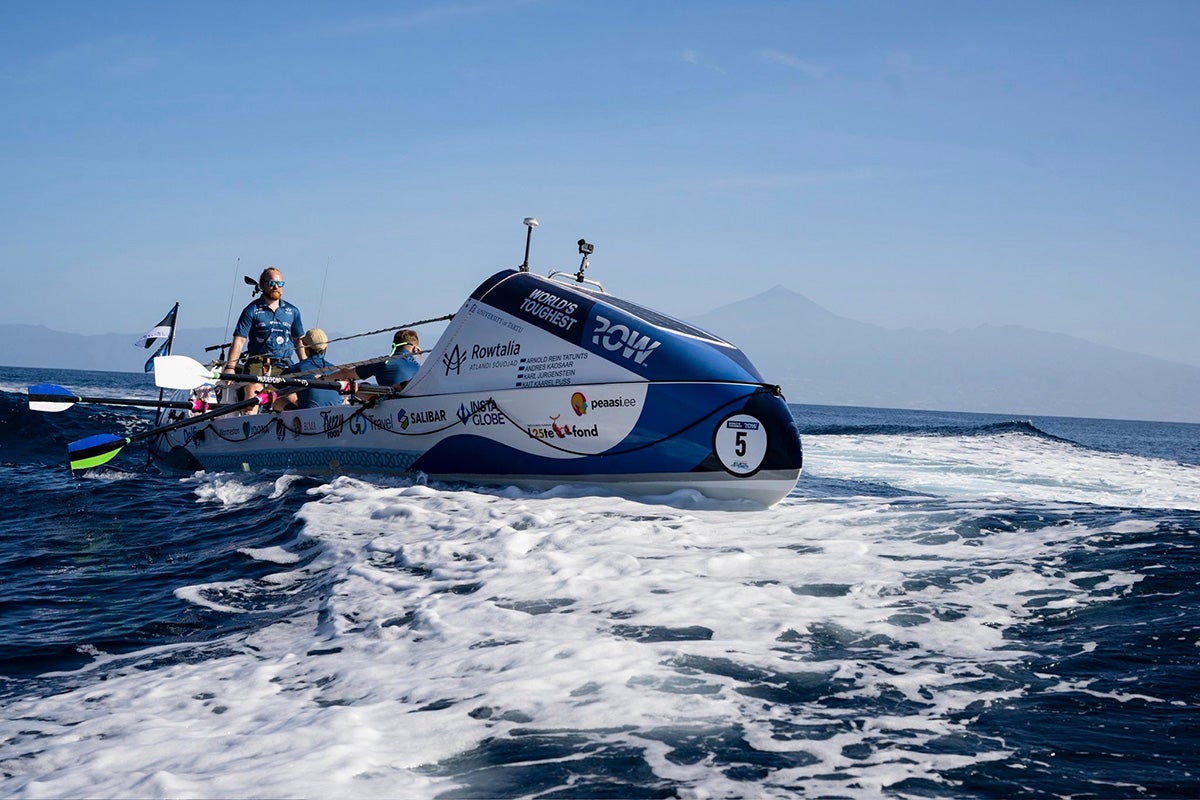
They had not attempted to actually row on the Atlantic, whose waves can measure up to 20 feet high, until a few days ago when they performed a test run ahead of their official embarkment Dec. 11.
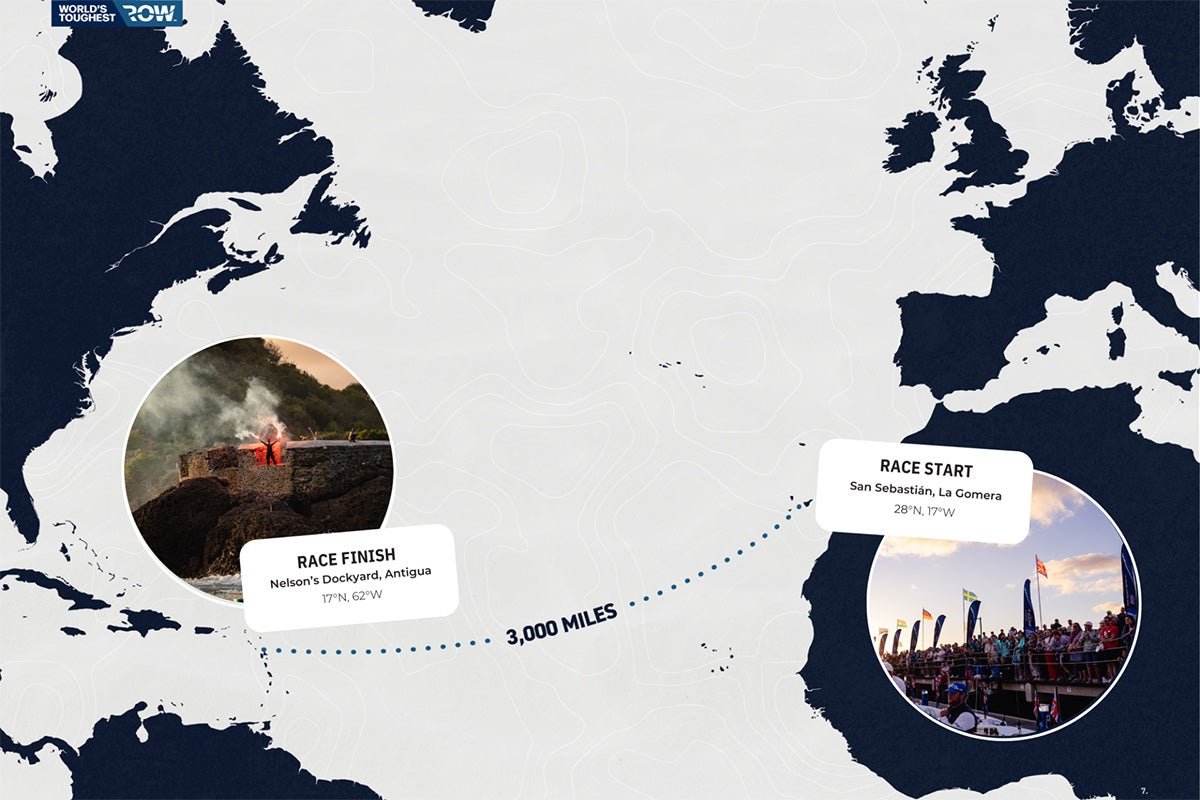
Their 30-foot-by-5-foot vessel must be self-sustaining with enough food and provisions to withstand a 5,000-calorie/day diet over their 3,000-mile voyage westward. There is no getting off the boat once the endeavor has started. If an emergency dictates otherwise, they will forfeit their journey.
They intend to row in pairs in two-hour time blocks. That’s 12 hours of rowing a day, with never more than a two-hour break in between shifts, for 40 days straight.
The challenges — and potential glory — ahead are as vast and wide as the ocean itself.
“We just have one life. We have to allow ourselves to dream, even if they seem wild,” Käosaar says. “If someone asks me if I would like to do something extraordinary, I can’t say no.”
What It Takes to Row the Ocean
Races across the Atlantic have been formally organized since 1997, and since 2015, the World’s Toughest Row Atlantic competition has been held annually every December.
In 2025, more than 30 teams and another 10 individuals in solo boats will participate in the challenge. Käosaar’s team, Team Rowtalia, will be on the starting line Dec. 11, in San Sebastian de la Gomera, Canary Islands, when they push off for English Harbour, Antigua and Barbuda.
“The race organizers actually say that 80% of the whole endeavor is getting to the starting line,” Käosaar says. “The rowing itself is the easy part. There is nothing else to do. There is nothing to think about anymore. You just have to cross the ocean.”
Käosaar learned about the World’s Toughest Row three years ago when a friend in his home country of Estonia approached him with the idea to enter the race. His now teammate prepared a 30-minute presentation to sell him on the idea.
Käosaar isn’t easily intimidated. He spent a month in Antarctica for research earlier this year. He was willing to say yes 60 seconds into his buddy’s presentation, but he politely sat through the full pitch before agreeing. They decided to recruit two of their former fraternity members “bold and naïve enough” to join their daring mission.
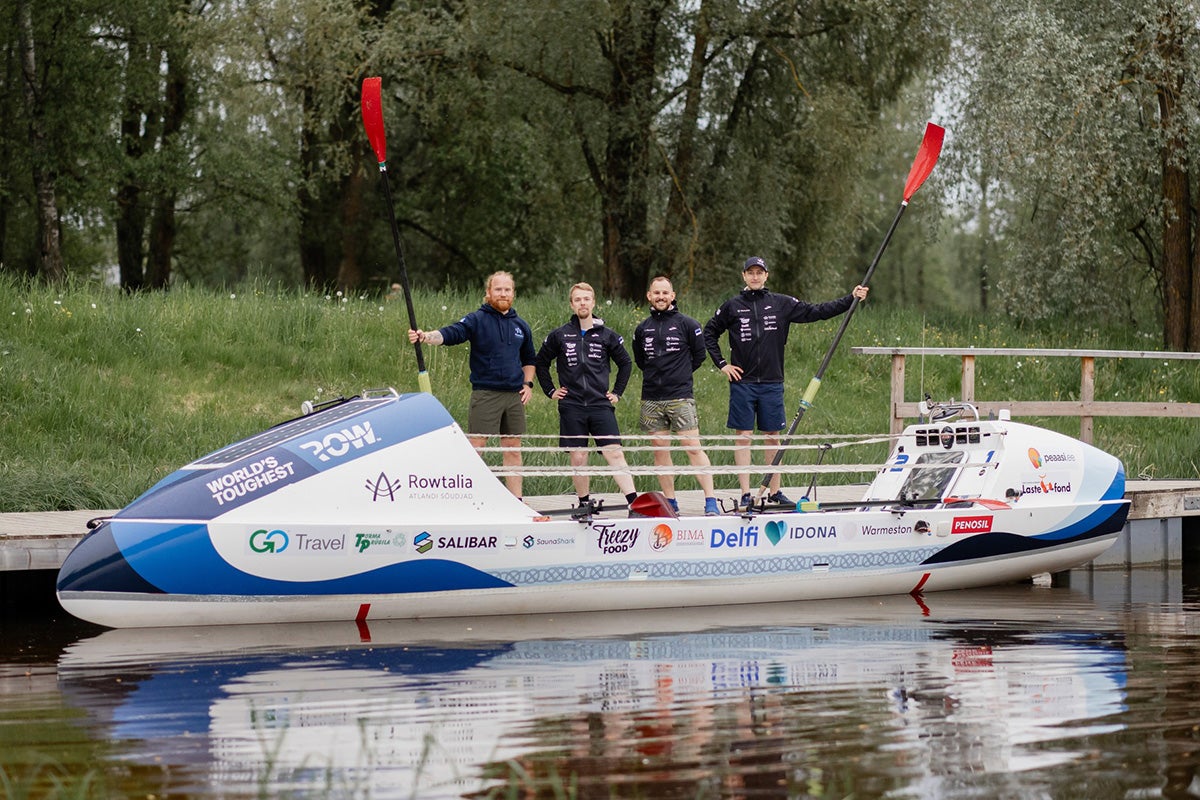
They found a coach to teach them the rowing technique since none of them had any experience. They raised $163,000 of their $184,000 goal, which includes the cost of the boat they purchased in May. They accumulated 200 hours of individual training time on the Baltic Sea, with more than half of those hours accumulated during a five-day practice session. Most of their training has been done on indoor rowing machines.
They have listened to podcasts of former ocean-crossers to get a sense of what to expect. Their biggest takeaway: “While it’s going to be hard, you’re there to get the experience. Just try to enjoy it.”
They also prepared with a team-building trip to the Finnish Arctic, camping in a tent in remote snowfields for six days to pressure test how they worked as a team in such a harsh environment.
Käosaar’s field of research and the expertise he has gained in his years studying at UCF make him uniquely suited to navigate how their team dynamic and effectiveness will be impacted by factors like emotions, personalities and situational behaviors that will inevitably reveal themselves under such environmental strain.
While they each have their individual motivations and aspirations for this endeavor, they have also discussed their shared vision as a unit. One definition of a successful mission, Käosaar points out, is solely focused on the optimization of the desired outcome. A team could despise each other and the experience throughout the entire process, never wanting to interact with their teammates again once the mission is complete, but still be considered successful if the goal is completed.
Käosaar likes to define a successful team more holistically.
“I think a better way of looking at it is to think about this concept of team viability; do we think that in the future we could work again successfully?” he says. “Our ultimate goal is that we hope to cross the ocean such that we are willing and able to do that again in the next few years with the same team.”
Ocean Tides to Outer Space
Part of what makes this journey so appealing to Käosaar is the insight and street cred he will gain in his field and research subjects.
The psychology behind teamwork in isolated, confined and extreme environments applies to fields with life-and-death stakes on the line: think submariners, certain military deployments, oil riggers and his specialties, astronauts and Antarctic-based researchers.
Käosaar first zeroed in on this specialized field as a clinical psychology graduate student in Estonia as he wrote a cover letter applying for a European Space Agency internship.
“I was thinking in space we have astronauts, we have people, so we need psychologists,” he says. “I realized that that’s me. That’s what I want to do. That’s my life. My eyes went big and I was like, ‘Wow, OK, let’s go.’ From that moment I started dedicating my life and time toward that.”
As he looked for research opportunities, he came across Research Professor Shawn Burke at UCF’s Institute of Simulation and Training, whose work in team leadership and resiliency has been funded by powerhouse names including the U.S. Army Research Institute, Air Force Office of Scientific Research, Office of Naval Research, the U.S. National Science Foundation, DARPA and NASA.
Since joining her lab in 2021, he has contributed to two NASA research grants, once an unfathomable dream that has now become his reality. He credits Burke for molding him into a confident researcher who has grown considerably from his immersive experiences.
“Without UCF being so big in its focus on the space field, seeing rockets launching in the evening when I’m driving home, just this widening of understanding what’s [achievable] — I think this has been something that wouldn’t be possible without being exactly here,” Käosaar says.
He hopes this rowing challenge will build upon the practical skills he has gained at UCF for his future research by providing him with firsthand knowledge of the isolation and extreme circumstances his astronaut subjects in space work through.
“I don’t think I would be able to fully understand the participants of the studies or the subjects we’re studying without putting myself in that situation and really being like, ‘OK, that’s what you guys feel,’ ” Käosaar says.
With his impending graduation in the spring, Käosaar is looking forward to continuing his work, making real contributions and impact to this next frontier of space exploration.
“I don’t want to use the cliche words of becoming interplanetary species, but that’s basically what we are thinking about. I think this could have huge implications for the sustainability of humans in space,” he says. “I think being able to support those endeavors and support this development of humanity, that’s a big part of why I do it, and I’m passionate about it.”
Andres Käosaar’s team, Team Rowtalia, will have solar-powered internet on board. You can follow their journey across the Atlantic on Instagram at @teamrowtalia.