Highlights
-
Damodaran is one of 18 researchers selected for Phase I of NASA’s 2026 NIAC program, receiving $175,000 to study the PHOENIX concept.
-
Damodaran collaborated with strategic partners from UCF’s College of Optics and Photonics (CREOL), Florida Space Institute (FSI), Department of Physics and NASA’s Jet Propulsion Laboratory on the project.
-
PHOENIX would use advanced photonic technologies developed in collaboration with researchers from CREOL to connect up to 25 spacecraft that could work together as a powerful virtual telescope.
-
The concept could allow scientists to observe structures involved in planet formation, star formation and the evolution of distant galaxies that existing observatories cannot directly resolve.
Landing humans on the moon was just a dream when UCF was founded in 1963. But we dared to believe — developing the talent and inventing the technologies to make it reality. That same spirit still drives us today.
We are America’s Space University. And we celebrate UCF Space Week to honor our origin as we dare to build what’s next.


Where Global Leaders Unite to Forge the Future of Space
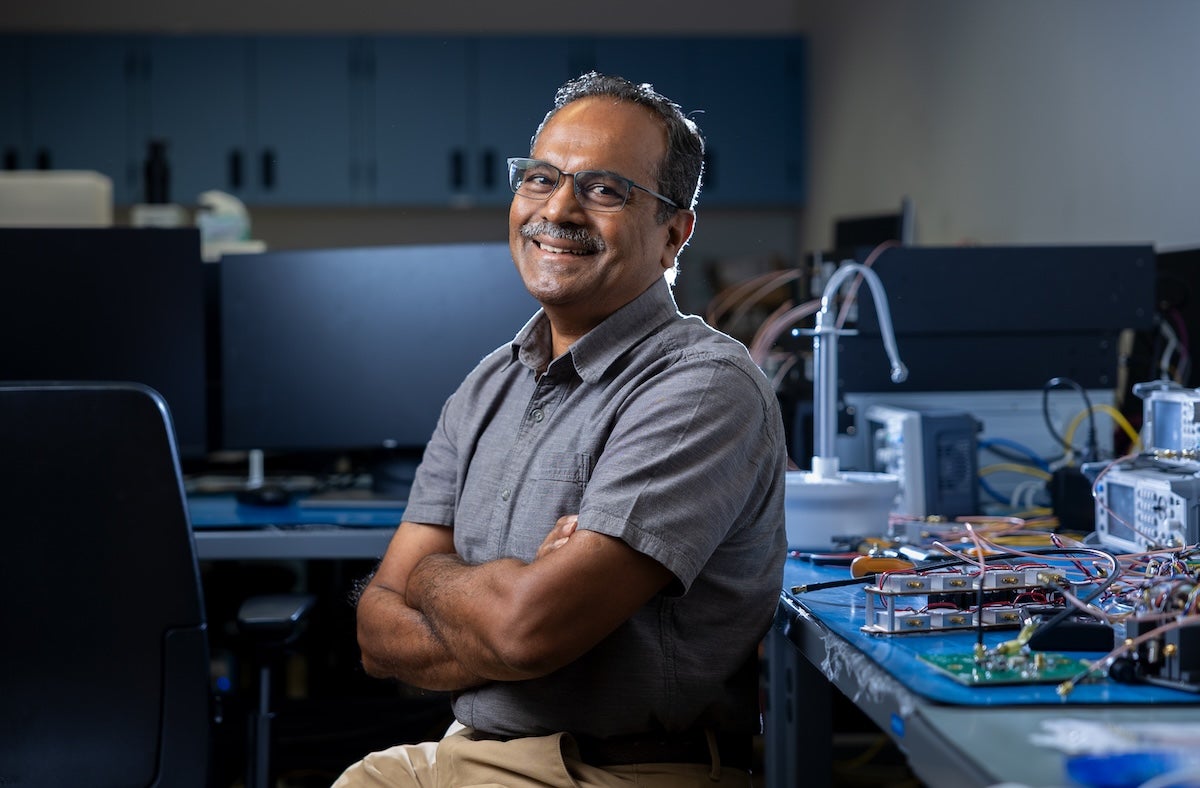
UCF Professor Anish Damodaran is investigating a new approach for a virtual super telescope that could allow scientists to observe planet formation and the early universe in unprecedented detail.
Damodaran previously led radio astronomy for the Arecibo Observatory, which UCF began co-managing in 2018 under an agreement with the U.S. National Science Foundation. Following the telescope’s structural collapse in 2020, he continued to advance his research activities at UCF.
Damodaran is now one of 18 researchers in the U.S. selected for Phase I of NASA’s 2026 Innovative Advanced Concepts (NIAC) program. The nine-month, $175,000 award funds early development of technologies that demonstrate transformative potential and possible feasibility for eventual implementation.
“Having the opportunity to explore such a bold idea at its earliest stage, and to do so with the support of NASA and the NIAC community, is both professionally and personally inspiring,” Damodaran says.
The concept is known as PHOENIX — short for Photonics-Enabled Heterodyne Submillimeter/Far-Infrared Interferometer.
PHOENIX proposes using advanced photonic technologies to connect up to 25 spacecraft into a powerful space-based interferometer. Working together, the spacecraft could effectively function as a much larger telescope, capable of producing ultra-high-resolution observations at submillimeter and far-infrared wavelengths.
The project also brings together expertise in astronomy, photonics and space instrumentation from UCF and NASA’s Jet Propulsion Laboratory (JPL). This includes CREOL Pegasus Professor Peter Delfyett; CREOL professors Guifang Li and Stephen Eikenberry; Florida Space Institute researcher Julie Brisset; College of Sciences Professor Yan Fernandez; and JPL researchers Jacob Kooi and Jonathan Kawamura.
Jumpstarting a New Wave of Space Technology
Some of the most important stages in the evolution of the universe are also among the most difficult to observe. Stars, planets and galaxies often form from cold gas and dust that are invisible to the human eye.
Falling between infrared and radio wavelengths on the electromagnetic spectrum, submillimeter astronomy gives scientists a window into this otherwise hidden universe.
But observing these phenomena at extremely high resolution requires capabilities that are difficult to achieve with a conventional space telescope. A single telescope with an aperture measuring tens or even hundreds of meters would face significant launch constraints. Dividing that observing power across multiple smaller satellites presents its own challenges, including precisely synchronizing the spacecraft, and processing and transmitting the enormous amounts of data they collect.

“While existing facilities can detect cold gas and dust associated with planet formation, star formation, and galaxy evolution, they cannot directly resolve many of the critical structures where these processes occur,” Damodaran says.
PHOENIX would use optical frequency combs and integrated photonic circuits to provide the precise timing, positioning and signal processing needed for the distributed telescopes to operate together as a single instrument.
Seeing the Universe in New Detail
PHOENIX could also provide new insights into how stars form within dense, dust-enshrouded environments. By combining high-resolution imaging with spectroscopy — an observation technique that uses light to analyze the chemical composition of matter — the observatory concept could allow astronomers to examine how turbulence, gravity and gas dynamics interact where stars form.
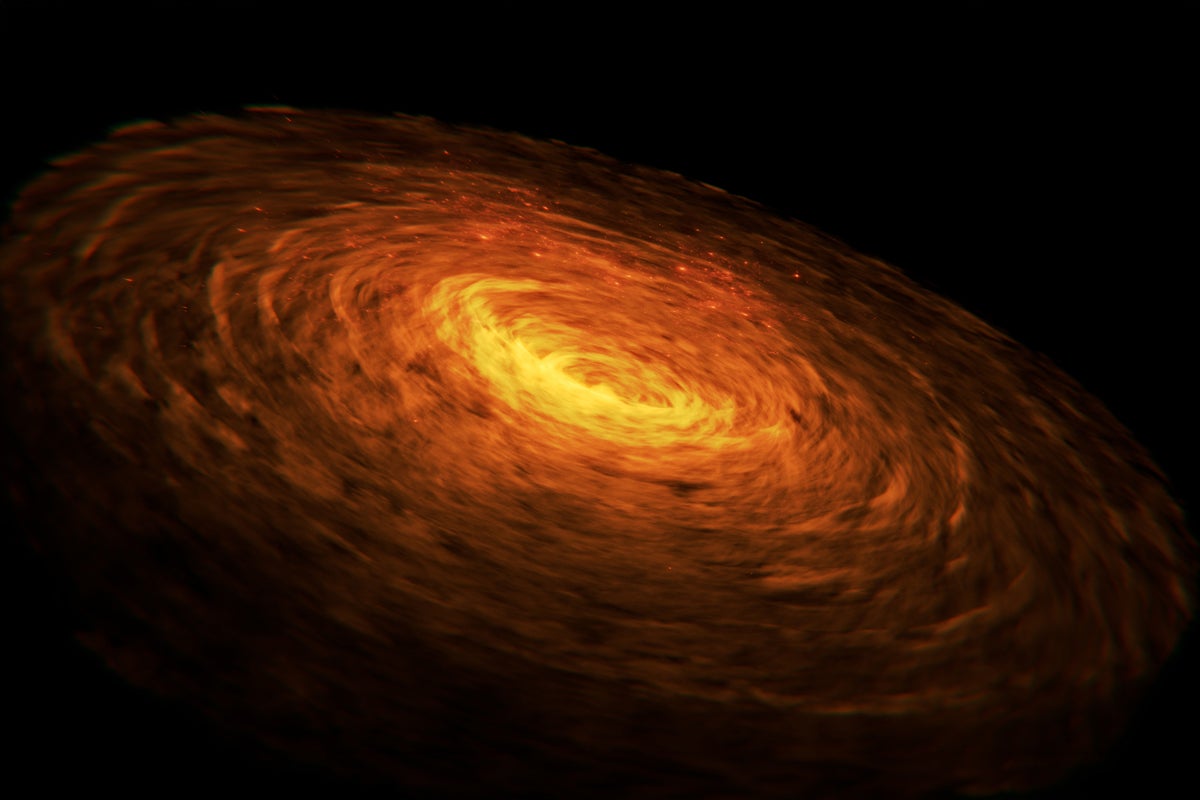
“One of the most exciting applications would be the direct observation of planet formation in protoplanetary disks around young stars,” Damodaran says, referring to the rotating disks of gas and dust which form planets. “PHOENIX could resolve structures on scales comparable to the size of the inner solar system — allowing scientists to observe how water, water ice, molecular gas and dust are assembled into planets, identify the signatures of newly forming worlds, and investigate the conditions that lead to potentially habitable planetary systems.”
On a larger scale, observations of gas and dust within distant galaxies could help researchers examine how star formation and supermassive black holes have influenced galaxy evolution over billions of years.
“One of the most exciting applications would be the direct observation of planet formation in protoplanetary disks around young stars.” — Anish Roshi, Florida Space Institute professor
Testing an Ambitious Idea
The nine-month Phase I study represents an early step toward determining whether that vision could eventually become technically achievable. Rather than building the observatory itself, Damodaran and his collaborators will use the NIAC award to develop a more detailed mission architecture, identify critical enabling technologies, evaluate performance requirements, assess technology readiness and further define the scientific capabilities PHOENIX could provide.
Following his selection, Damodaran attended the NIAC orientation and symposium, where he met other NIAC fellows and learned about the range of early-stage concepts being pursued through the NASA program.
“In many ways, the process feels like undertaking a second Ph.D. thesis,” Damodaran says. “It requires questioning assumptions, exploring alternative approaches, identifying critical technology gaps and developing a compelling scientific case. As a scientist and instrument developer, I find that immensely rewarding.”
Future Stages of NASA’s NIAC Program
NASA’s NIAC program supports visionary aerospace concepts through progressive phases of study. Eligible Phase I recipients can propose for Phase II, which provides up to $750,000 for two years of further concept development and requires researchers to prepare a roadmap for continued development.
Phase III provides up to $2 million for another two years of exploration and development, with the goal of strategically transitioning concepts with the highest potential impact for NASA, other government agencies or commercial partners. NASA plans to make six to eight Phase II awards and one Phase III award annually.
The PHOENIX project is supported by a $175,000 Phase I award through NASA’s Innovative Advanced Concepts program.