Highlights
-
Planetary sciences graduate students Daejhanae Smith and Rhiannon Hicks are applying the lessons from their coursework to the study of real astronomical objects.
-
The subject of their observations is an asteroid in the main asteroid belt between Mars and Jupiter known as 44 Nysa, providing an opportunity for the graduate astronomers to explore the physical properties of a small body in our solar system.
-
Through astronomical observations and analysis of reflected light, the students are examining 44 Nysa’s characteristics and gaining hands-on experience with techniques used in planetary science research.
A class project led graduate students Daejhanae Smith and Rhiannon Hicks to contribute data to “Unmasking (44) Nysa: Evidence for a Trilobate Structure,” a study published in the Journal of Astronomy & Astrophysics examining one of the solar system’s more unusual asteroids.
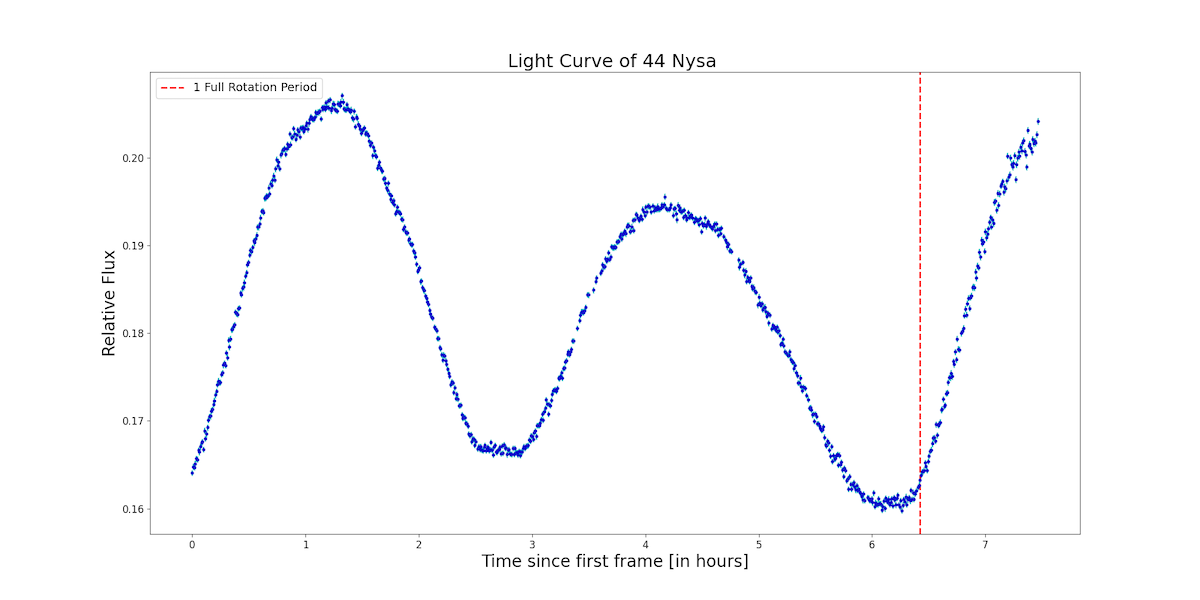
For their Advanced Observational Astronomy course, Smith and Hicks designed and carried out their own project to study 44 Nysa, a large, bright asteroid located in the main asteroid belt between Mars and Jupiter. By observing 44 Nysa for around eight hours, they collected more than 800 images and produced a light curve, a measurement of an object’s brightness as it rotates.
Their observations showed the same distinctive pattern seen in previous studies, with two unequal maximums and minimums in 44 Nysa’s brightness. Researchers later combined their data with high-resolution observations to develop a three-dimensional shape model, a digital blueprint, that revealed evidence that 44 Nysa may have a rare, trilobate shape, or three distinct lobes.
From a Class Assignment to a Research Project
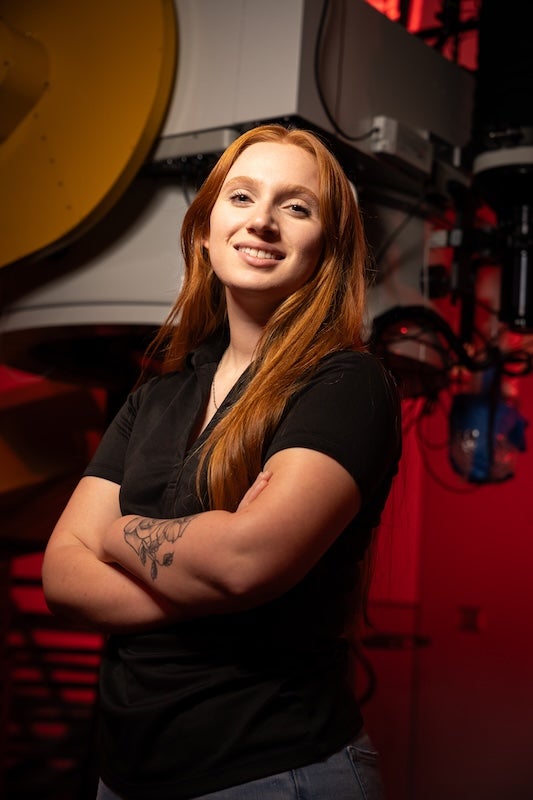
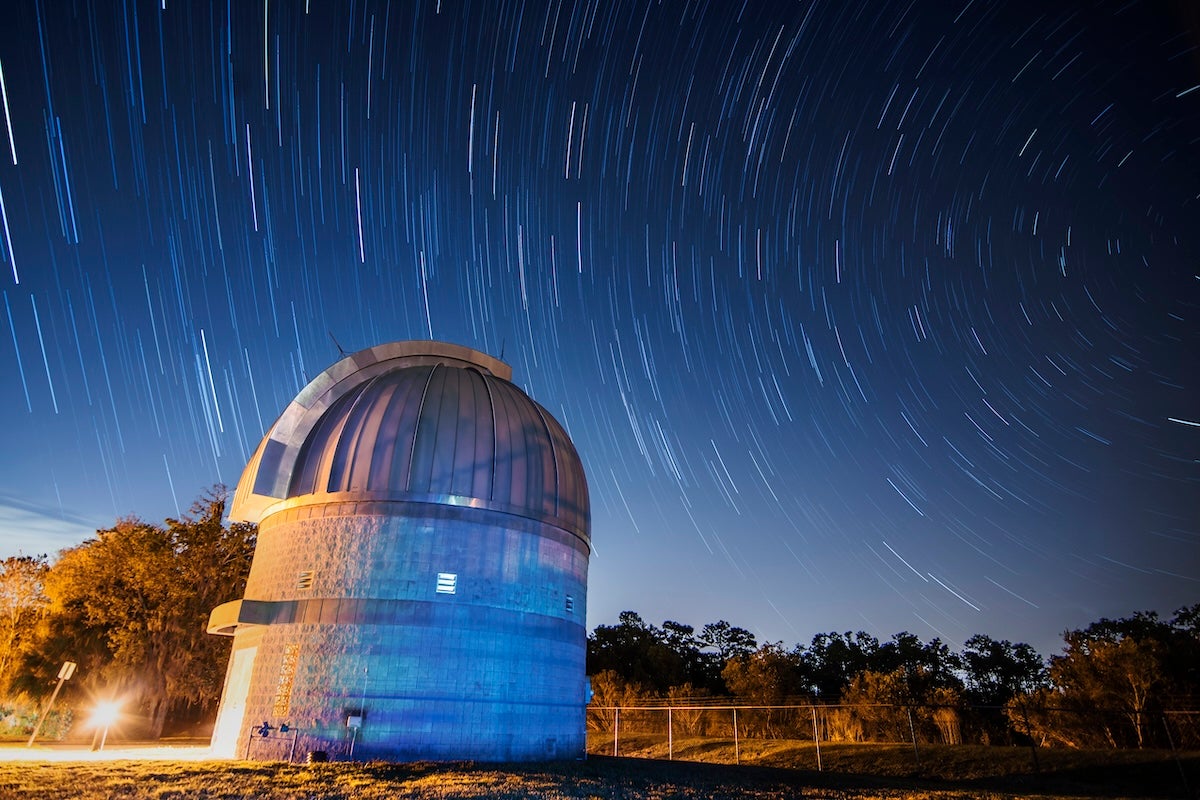
As part of the course, Smith and Hicks developed and carried out an observational project using the Robinson Observatory telescope.
“We decided on 44 Nysa as our target because it had very favorable viewing geometry when we wanted to observe it in February,” Hicks says. “It was in a position where it was bright enough for the Robinson telescope to see, and it was viewable long enough in the night sky for us to observe it.”
Observations dating to 1913 showed two unequal maximums and minimums during the asteroid’s rotation. Such patterns can indicate an elongated or multiple-lobed body, suggesting 44 Nysa’s shape may be unusually complex.
“We wanted to get a more recent and comprehensive data set and compare it to the results that have previously been published,” Smith says. “That meant we needed to observe 44 Nysa for its full rotation period, taking images consistently over the course of a number of hours.”
A Night at Robinson Observatory
On the night of Feb. 22, the pair spent about eight hours observing 44 Nysa at Robinson Observatory.
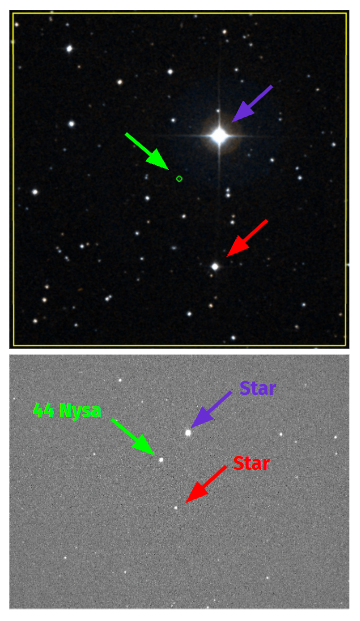
Their goal was to consistently photograph the asteroid as it moved through the sky and rotated. Because distant asteroids can resemble stars in telescope images, the students used a finder chart to verify they were observing the correct object.
They took 30-second exposures while monitoring the telescope and tracking the asteroid.
“It was quite the feat for us,” Smith says. “We knew it would require patience and meticulous work, but our data ended up being significant enough to be included in this larger study.”
Data That Helped Reveal 44 Nysa’s Shape
Coincidentally, the students completed their observations days after 44 Nysa was studied with a larger telescope capable of resolving its shape.
Researchers combined high-resolution images with light-curve data, including observations from Smith and Hicks, to develop a three-dimensional shape model.
The resulting model showed that 44 Nysa appears to have three distinct sections or lobes, a structure that could make it the first known asteroid with a trilobate shape.
Most asteroids and comets observed with current capabilities have been found to have elongated or two-lobed, or bilobate, shapes. The possible three-lobed structure raises new questions about asteroid formation and evolution through collisions.
“One main question still to be answered about 44 Nysa is what kind of mechanism helped create this apparent trilobate structure,” Hicks says. “Did three separate bodies coalesce into one? Is the irregular shape due to multiple catastrophic impacts?”
Students Leading the Way

UCF Associate Professor of Physics Ryan Ogliore says the project demonstrates the persistence required for scientific research. From the initial observation through the data analysis, the students encountered the kinds of challenges that are common in physics, astronomy and planetary science.
“They just kept at it, showing the type of resolve that is required for success in the sciences,” Ogliore says.
For Smith and Hicks, the experience reinforced the value of pursuing research even when the immediate results may seem familiar.
“This experience shows that you never know how your science can help others unless you share it,” Hicks says.
The students were unaware of the larger study when they selected 44 Nysa. Learning that their data contributed to the work was an unexpected outcome of what began as a class assignment.
“We are very humbled to be a part of something this big,” Smith says.
A Research Opportunity at Robinson Observatory
Richard Jerousek, associate lecturer of physics and Robinson Observatory director, says the facility has already supported several publications but using it for small-body light-curve analysis to contribute to shape modeling represents a new milestone.
Large observatories are often unable to dedicate extensive time to projects requiring repeated observations.
“There is still a lot of important and under-appreciated data that we can collect with modest-sized campus telescopes that simply isn’t being done at more advanced facilities,” Jerousek says.
Recent improvements to Robinson Observatory have also expanded its capabilities, with graduate students and postdoctoral researchers helping propose new instrumentation and work through the challenges of bringing new capabilities online.
For Jerousek, the project reflects the role students play in shaping the observatory’s future.
“Robinson Observatory truly is what our students make of it,” he says.
For Smith and Hicks, the project has already demonstrated how an opportunity that begins in the classroom can extend far beyond it.
“I think that experience goes to show that there are a lot of research opportunities available at UCF, and class projects can be a great steppingstone to published research,” Hicks says.
The research highlighted in this article was published in the August 2026 issue of the Journal of Astronomy & Astrophysics in the paper “Unmasking (44) Nysa: Evidence for a trilobate structure.”