Highlights
-
Debashis Chanda’s method mimics how animals like octopuses use nanoscale structures that manipulate light to display and change color, which differs from traditional pigment color.
-
The new method addresses former structural color commercial production challenges with customization, scalability and sustainability.
-
The development could improve a variety of industries and products, such as camouflage used for defense and textiles, thermal sensing, reconfigurable displays and more.
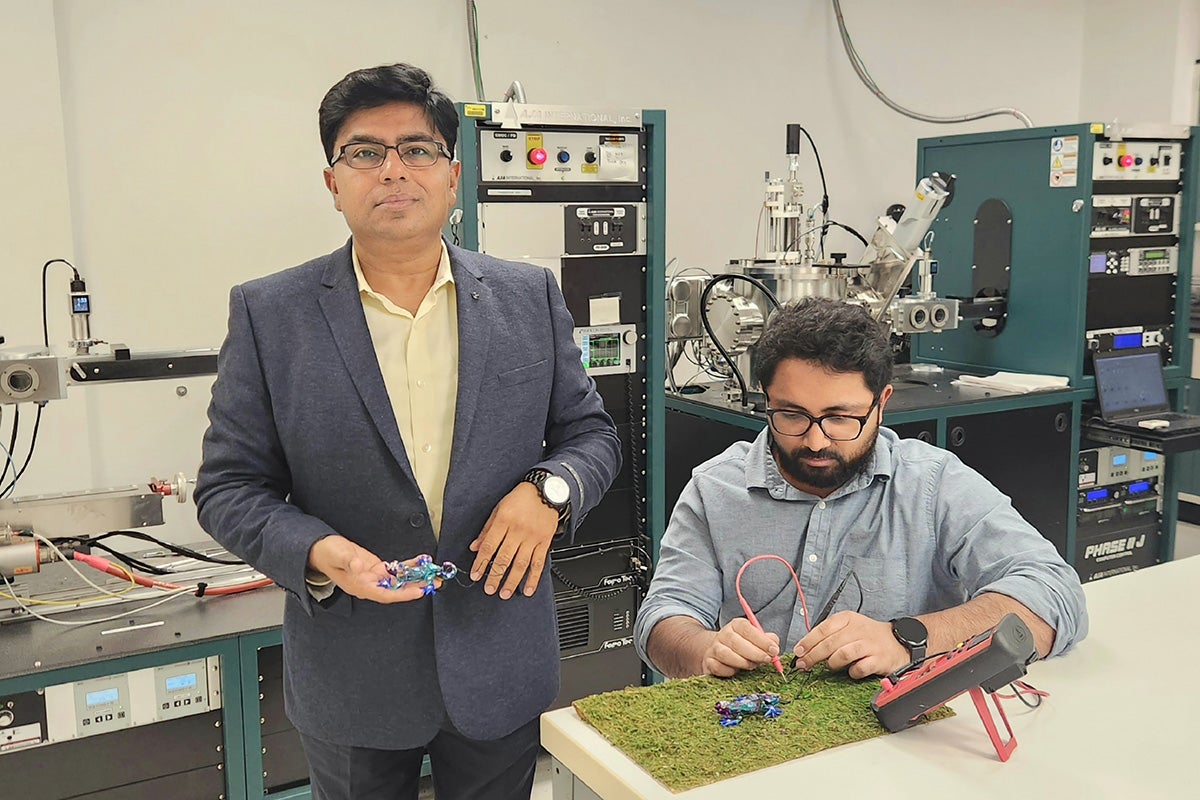
Color isn’t just about looks — it plays a vital role in how we communicate, protect ourselves and interact with the world. Debashis Chanda, a researcher and professor at UCF’s NanoScience Technology Center, has developed a new material that can change color dynamically in response to external stimuli like temperature, which creates a new possibilities for materials and devices to respond, adapt and be reconfigured in real time.
Most colors in commercial and industrial products come from pigments, which absorb, reflect light and fades over time. However, structural colors, which are found in animals like octopuses, use nanoscale structures to control how light reflects. Inspired by this efficient approach, Chanda has been researching how to create more vibrant, angle-independent colors without relying on chemical pigments for years.
His latest development addresses the challenges with dynamically tunable color, complex designs and manufacturing challenges of structural colors, which may make it easier to commercially manufacture these materials. The concept holds immense promise for applications in thermal sensing, advanced textile engineering, camouflage and reconfigurable displays.
The research was recently published in Proceedings of the National Academy of Sciences (PNAS), an esteemed scholarly journal by the National Academy of Sciences. It also includes contributions from researchers Aritra Biswas ’21MS ’24PhD, Pablo Cencillo-Abad, Souptik Mukherjee, Jay Patel ’25 and Mahdi Soudi ’25.
How it Works
Chanda’s approach uses phase modulation of a multilayer stack composed of a phase-changing material and a high-index material on a reflective surface. When the temperature shifts, the way light moves through the material changes, causing the surface color to change as well.
The technology combines several novel features:
- Large area fabrication without complex lithography, which is an expensive patterning method
- Reversible color change
- Precise control over dynamically customizable color
- Broad dynamic range that spans a large portion of visible color space
Earlier methods of developing structural color often relied on expensive electrochromic materials, mechanical actuation or photonic crystals, all of which are hindered by limited tunability, complex fabrication steps, lithographic patterning requirements and angular sensitivity. Achieving dynamic color switching in the visible range remains a significant challenge.
“The reliance on angle-dependent resonances or patterned nanostructures limits practical integration and scalability,” Chanda says. “Overcoming these barriers is critical for advancing tunable structural color platforms toward real-world applications in flexible electronics, displays and wearable systems.”
This new method can be used for creating large textiles, complex surfaces, and temperature-sensitive consumer product labeling.
Mimicking Nature for Dynamic Colors
The design draws inspiration from animals like octopuses, which change color by rearranging tiny structures in their skin rather than producing new pigments.
Chanda’s team created a layered design that can change color without being affected by viewing angle or direction of the incident light. It uses a very thin layer of VO₂, a material that changes phase from semiconductor to metal with temperature, placed on top of a thick aluminum layer to form a resonating cavity to trap and reflect light in a controlled way.
Pigment colorants control light absorption through a material’s electronic properties, which means each color needs a new molecule and isn’t affected by the surrounding environment. Structural colorants, like those found in octopuses, work differently: they control the way light is reflected, scattered or absorbed based on the geometrical arrangement of nanostructures, making them sensitive to changes in their surroundings.
“Harnessing the reversible phase transition, the platform offers precise control over dynamically tunable color, opening avenues for applications in temperature sensing, displays, tunable colored fabrics and many other consumer products,” Chanda says.
The bilayer structure is made using magnetron sputtering to deposit the phase-change material, a process that uses plasma to deposit thin film. It also uses electron-beam deposition to deposit the metal layer, which melts material with a focused electron beam to create precise coatings. This combination allows the structure to be applied to flexible substrates, making it suitable for large-scale production and wearable applications.
Looking Ahead
Chanda says the next steps of the project include further exploration of color space and roll-to-roll fabrication to improve its viability as a commercial and defense-related platform.
“This platform holds promise for a robust, scalable and dynamically tunable coloration platform with broad applicability, while demonstrating a proof-of-concept product that highlights its commercial and defense-related application potentials,” Chanda says.
Licensing Opportunity
For more information about licensing this technology, visit UCF’s Office of Technology Transfer.
Researcher Credentials
Chanda has joint appointments in UCF’s NanoScience Technology Center, the Department of Physics, and the College of Optics and Photonics. He received his doctoral degree in photonics from the University of Toronto and completed a postdoctoral fellowship at the University of Illinois at Urbana-Champaign. He joined UCF in Fall 2012.
This material is based upon work supported by the NSF Grant no. ECCS-1920840 and NGA Grant no. HM0476-20-1-0010. Any opinions, findings, and conclusions or recommendations expressed in this publication are those of the author(s) and do not necessarily reflect the views of the NSF/NGA.