Forensic science is a field that’s drawn more attention in recent years, thanks to the onset of true crime podcasts and the increase of television shows and films focused on the topic. A survey by Edison Research last year reported that 84% of the U.S. population ages 13 and up are “true crime consumers,” listening or watching these types of stories.
UCF’s College of Sciences and its National Center for Forensic Science (NCFS) are at the heart of the real science behind the real-life cases, along with the larger field that goes beyond criminal justice.
Why This Research Matters
Now, thanks to the work of UCF researchers, the field of forensic science around the world is receiving a massive boost of knowledge through the release of the “fantastic four” chemical standards; the four, hard biomaterials — nails, hair, bones and teeth — that provide a consistent and critical reference point for forensic anthropology and toxicology work.
“The creation of these standards is important because every aspect — especially in toxicology — is helpful to quantify data when looking at these biomaterials in the field,” says Matthieu Baudelet, an associate professor of chemistry at UCF affiliated with NCFS. “You have a sample you want to mimic and now there is a reference with these ‘fantastic four’ that you can use for analysis. We can help crime labs around the world to be more precise, avoiding wrong decisions when looking at evidence.”
Baudelet undertook the work of creating these standards in 2018 because he says it was a complex puzzle to solve and the work was necessary for improvements in forensic science.
“At the time, no one was working on this and we dared to find the answer and fill this scientific need in the field,” Baudelet says. “Forensic science is important today because there is always a need for answering questions on a number of topics. In our case, the research revolves around anthropology and toxicology. In forensic anthropology, work is often about solving crimes, but there’s also work in parallel to repatriate fallen soldiers from previous wars.”
Baudelet says that the new chemical standards will open doors to solve issues in toxicology or biomedical applications; for instance, the burgeoning market for hair analysis, which needs these standards.
How Laser Technology Is Shaping Forensic Science
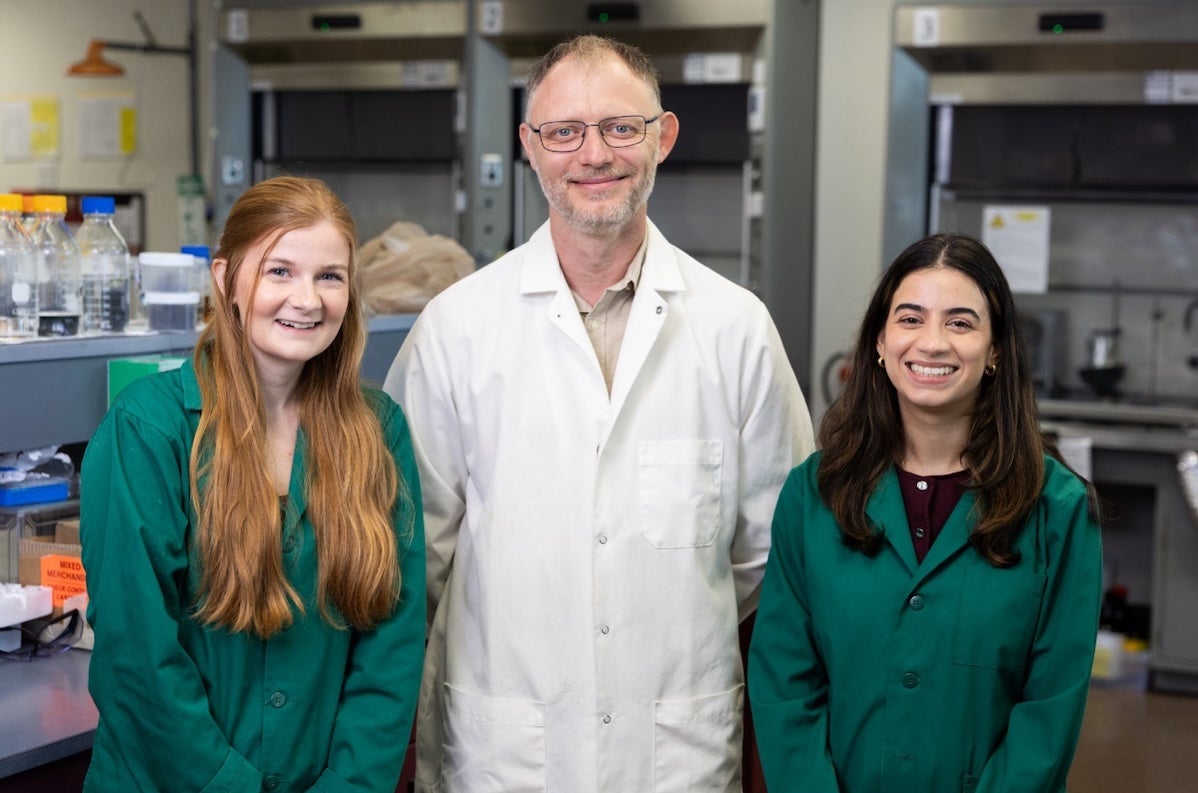
Baudelet has led the development of these new standards through his work at NCFS. His background is in physics, optics and spectroscopy, and he’s found that interdisciplinary collaboration has helped move the field forward.
“Laser ablation inductively coupled plasma mass spectrometry (LA-ICP-MS) and laser-induced breakdown spectroscopy (LIBS) are widely accepted techniques for direct sampling of biological materials for elemental analysis, with increasing applications being reported over the recent years,” according to a study by Baudelet and his former postdoctoral scholar, Mauro Martinez, that was published in Analytical and Bioanalytical Chemistry.
LIBS is an analytical and versatile technique that utilizes a high-energy laser pulse to generate a plasma, which emits light, on the surface of a sample to help identify the elemental composition of the material. These laser-based techniques have provided opportunities for two doctoral students working alongside Baudelet on these standards to see better results.
“The portability of LIBS makes it useful worldwide,” says Kristen Livingston, who graduates this fall with her doctoral degree in chemistry. “I’ve traveled with the portable laser instrument to Romania and Hawaii and had the opportunity to work with bones and other skeletal remains in a variety of environments. The new standards and technology have the potential to make a global impact.”
Details about the new references have been published in Spectrochimica Acta Part B: Atomic Spectroscopy and the Journal of Analytical Atomic Spectrometry.

“Having a reference material is important because you can compare new measurements to a known measurement, which facilitates a reliable outcome, especially in forensic science,” Livingston says. “You need trustworthy and reliable data to compare new measurements back to a known measurement.”
Applying Science to Justice
Kaitlyn Bonilla ’20 ’24MS, a chemistry alum and doctoral student graduating this fall, has worked on developing the chemical standard for hair samples. Her passion for forensic science began in high school watching one of her favorite television shows, Law & Order.
“A lot of people learn about forensics through TV shows and I was no different,” Bonilla says. “I wanted to be the next Olivia Benson [an NYPD officer from Law & Order: Special Victims Unit]. I initially wanted to be a detective. I was interested in science and math and after taking a forensics class in high school, I thought, why don’t I apply science to the law?”
As an undergraduate student at UCF, she took a course in microscopy and learned about hair as a biologic material in forensic science.
“Hair as a matrix is so interesting because it provides a chronological record with its growth,” Bonilla says. “As hair grows, information grows along a hair strand. Using lasers, we can see that record of information. It’s been exciting to learn more about it.”
Bonilla says she is the first scientist in her family, and her studies have been supported through a National Institute of Justice fellowship, one of only eight UCF students selected since the fellowship’s inception in 2000.
“Thanks to this NIJ fellowship, I have been able to attend conferences and share my work, as well as conduct my studies in toxicology analysis,” Bonilla says.
Decoding Bones Through Chemistry
Baudelet’s other graduate student working on the “fantastic four” chemical standards is Kristen Livingston, who was similarly interested in forensic science watching it on TV.
“I watched NCIS and admired Abby [a chief forensic scientist] on the show,” says Livingston. “I appreciated the work that happened on those shows and how it made an impact on the community and in the justice system.”
She says that her interest in forensic science intersected with her English class during her senior year in high school.
“We had to write a paper about a topic we were passionate about and I wrote about The Innocence Project and how DNA is used to exonerate innocent individuals from prison sentences,” Livingston says. “These sentences may have resulted from improper forensic practices, so I wanted to improve the field of forensic science.”
She says the work she’s doing is important because applying chemistry to forensic anthropology provides another level of information about bones.
“Typically, forensic anthropologists study the physical bone — the shape or morphology — and they can get answers from the bones themselves. But chemically, there’s another world of information,” says Livingston. “Bones are an important matrix to study; if you think about tissues left behind when individuals die, bones last the longest. They can give you a lot of information about the individual they belonged to.”
Livingston says she’s not the first chemist in my family; her father inspired her as well.
“My father worked in the field of nuclear chemistry and I grew up seeing his passion and love for this process,” says Livingston. “Being able to have these conversations with him about my research and being able to bond with him over his love for chemistry, has meant a lot to me.”
Funder Information
This project was supported by Award No. AWD00005982, awarded by the National Institute of Justice, Office of Justice Programs, U.S. Department of Justice. The opinions, findings, and conclusions or recommendations expressed in this publication/program/exhibition are those of the author(s) and do not necessarily reflect those of the Department of Justice.
Researcher Credentials
Matthieu Baudelet joined UCF’s Department of Chemistry and the National Center for Forensic Science in 2015. His work focuses on developing lased-based spectroscopic techniques for forensic applications, including the analysis of tire skid marks, pollen, and anthropological remains. He also leads efforts to create matrix-matched biomaterial standards for LIBS and LA-ICP-MS to improve quantitative analysis in forensic and biomedical research. Originally from France, Baudelet earned his Ph.D. in Laser and Spectroscopy from the University of Lyon.