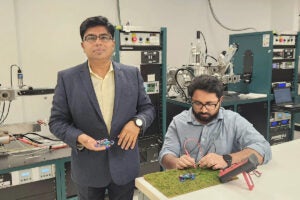
The world of Quantum Photonics is developing fast. Andrea Blanco Redondo sheds light on her research in Quantum Silicon Photonics. This research relates to Quantum Computing as well. Quantum computing benefits include enhancing physics simulations, creating robust machine learning algorithms and solving complex problems that even super computers may not be able to handle.
Video Highlights
00:04 – 00:55
Andrea Blanco-Redondo, Ph.D.: Well, my field of the study is generally quantum silicon photonics, right? So what I love about this build is that it lies kind of at the intersection between fundamental questions and real life applications. Just to give you an idea, we are trying to understand whether we can produce quantum states of light that are more robust to imperfection, fundamentally more robust, and in doing so, we are contributing to the scalability of quantum computing and quantum secure communications. In the long term, I hope that our research would truly contribute to the scalability of quantum information platforms. Quantum computing is a different paradigm of doing computation in which we exploit quantum properties of particles, right? In my case, of photons.
00:55 – 01:45
The reason quantum computing is interesting and is attracting a lot of attention in the last decade is that if we achieve quantum computing at a scale that is large enough, we can actually solve problems that are not solvable right now with our current technology.
Photons are really particles of light. So light can be understood as a wave or as a particle. When we think of light as a particle, we are thinking about basically the smallest quantity of light you could imagine. That's a quanta of light, that is a photon. And photonics is really the science that deals with the generation, manipulation, and detection of those photos, of those quantile of lights.
01:45 – 02:26
So solitons or solitary waves are waves that can propagate unchanged for very long distance. So for example, imagine casting a stone into a pond that's going to generate ripples. Now, as these ripples propagate away from the stones, they're going to decrease their height, increase their width, and eventually just dissipate and disappear. Now, solitons are nothing like that. To envision a solitun, envision one of those ripples that propagates with the same width and the same height forever, basically.
02:26 – 02:58
What's exciting is that we recently discovered that what we thought to be the only kind of optical solitons is actually just one member of an infinite family of optical solitons, right? That mix of really tackling very fundamental questions that really interests me a lot, like just feeling that can advance and scientific knowledge. But in combination with actually feeling that this can make an impact in real life applications, that's probably what has got me hooked into photonics research and in particular, the different areas of integrated photonics that we deal with.
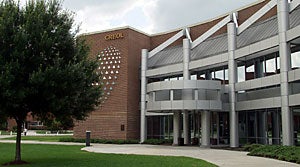
CREOL, The College of Optics and Photonics
CREOL, the College of Optics and Photonics, is one of the world’s foremost institutions for research and education in optical and photonic science and engineering. CREOL started in 1987 as the Center for Research and Education in Optics and Lasers, and became a College in 2004, the first US graduate college in this area, offering interdisciplinary graduate programs leading to an M.S. in Optics and Photonics and a Ph.D. in Optics and Photonics. An undergraduate program offering a BS degree in Photonic Science and Engineering began in 2013 in partnership with the College of Engineering and Computer Science.
Research Faculty
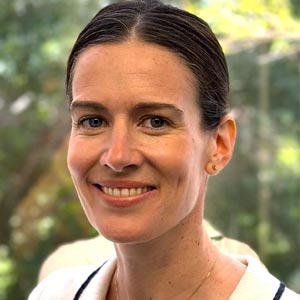
Florida Photonics Center of Excellence Endowed Professor of Optics and Photonics
Search Degrees
There are many benefits to taking a more proactive approach to choosing a career. The College of Optics & Photonics has curriculum and programs to help you land your next opportunity.
OR BROWSE BY:
Optics and Photonics News