
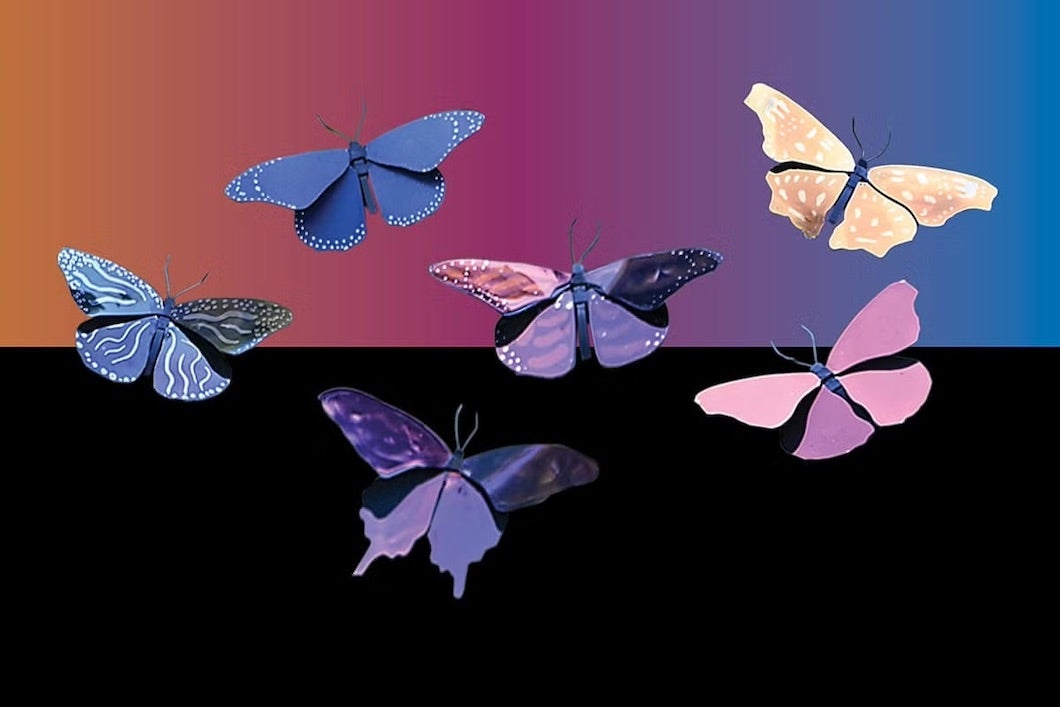
Color is the result of how light interacts with materials and how the human eye and brain interpret those interactions.
When light hits an object, some wavelengths are absorbed and others are reflected. The reflected wavelengths reach the eye, where specialized cells convert light into electrical signals. The brain processes those signals to create the experience of color.
Most colors come from pigments. But some of the most vivid and durable colors, both in nature and in emerging technologies, come from structure instead.
How Do Light Wavelengths Create Color?
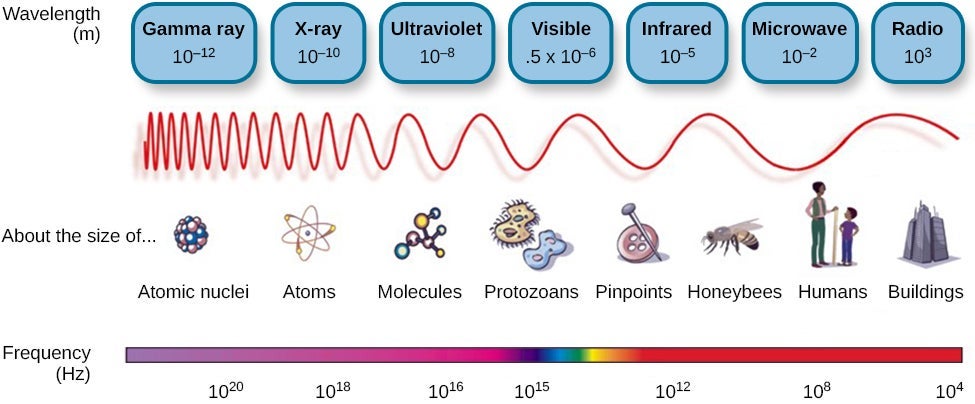
Light travels as electromagnetic waves and the distance between peaks is defined as the wavelength.
The human eye detects only a narrow band of the full electromagnetic spectrum, approximately 380 to 740 nanometers.
Within this range, wavelengths are perceived differently:
- Longer wavelengths as red
- Intermediate wavelengths as green
- Shorter wavelengths as blue or violet
Sunlight appears white because it contains a relatively uniform mix of all visible wavelengths.
When white light passes through materials like rain droplets or prisms, it separates into its component wavelengths through dispersion, revealing the familiar rainbow spectrum.
This interaction between light and materials is the foundation for everything that follows. It shapes both how the eye detects color and how scientists are now learning to engineer it.
How Does the Eye Focus Light Onto the Retina?
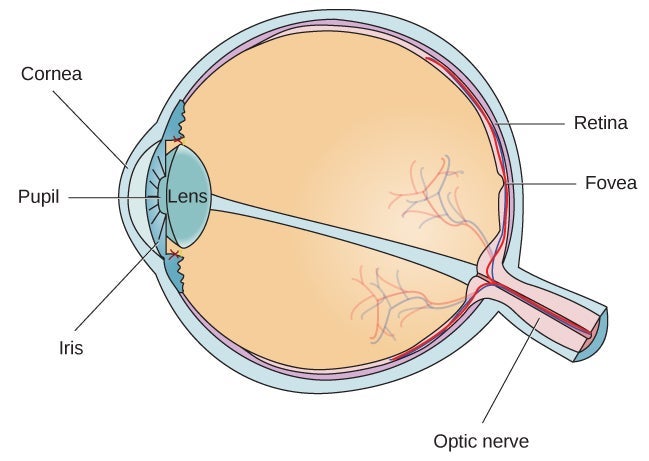
Light entering the eye is shaped by three structures working in sequence.
The cornea does most of the focusing as light first arrives. The pupil widens or narrows behind it, regulating how much light gets through based on how bright the surroundings are. The lens then makes the fine adjustments, physically changing shape to bring the image into focus.
The result is a sharp but upside-down image on the retina, which the brain quietly flips right-side up before you ever notice.
How Do Specialized Cells in the Eye Detect Different Colors?
The retina contains two main types of photoreceptors:
- Rods: Highly sensitive, optimized for low light and motion detection, but do not convey color.
- Cones: Function best in bright light and enable high-resolution color vision.
Cones are concentrated in the fovea, a small central region responsible for sharp vision.
Most humans possess three types of cones, each sensitive to overlapping wavelength ranges roughly aligned with red, green and blue.
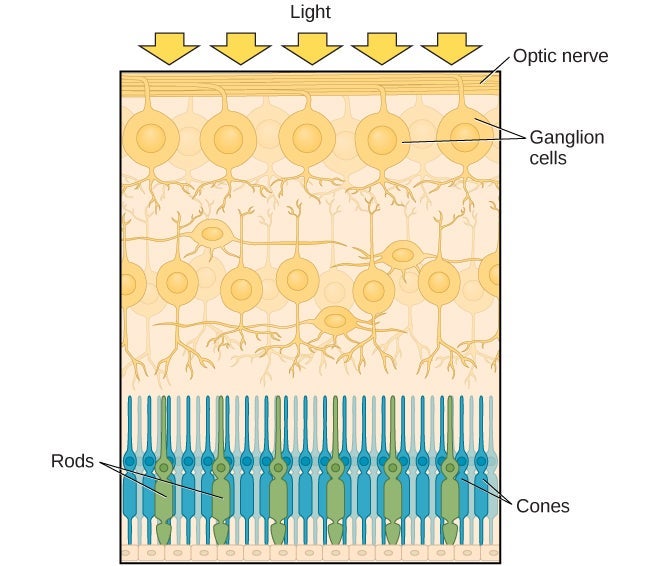
This forms the basis of trichromatic theory, which explains how combinations of three cone signals produce thousands of perceived hues.
At UCF’s NanoScience Technology Center, Professor Debashis Chanda and his research group study how nanoscale material structures control the absorption and reflection of specific wavelengths. The work of Dr. Chanda, including nanopatterned graphene detectors and tunable photonic materials, demonstrates how wavelength-dependent light interaction can be engineered for optical sensing and infrared detection.
How Does the Brain Turn Electrical Signals into a Full Spectrum of Hues?
Signals from the cones travel through retinal ganglion cells into the optic nerve.
At the optic chiasm, signals from each eye cross so the brain can combine information from both visual fields.
Processing occurs primarily in the occipital lobe at the back of the brain.
This process allows the brain to construct a full spectrum of color from just three types of cone cells.
Beyond trichromatic detection, the brain organizes color into opponent pairs:
- Black–white
- Yellow–blue
- Green–red
In this system, certain cells are activated by one color and inhibited by its pair.
Because a single cell cannot be both excited and inhibited simultaneously, humans cannot perceive combinations such as “greenish-red.”
This mechanism also explains negative afterimages, where prolonged exposure to one color temporarily shifts perception toward its opponent.
Why Can’t Humans See Greenish-Red?
Even though your retina uses three types of cones, your brain doesn’t keep color information in that form for long. As color signals move deeper into the visual system, they’re reorganized into “opponent pairs.”
In opponent processing, certain cells treat colors as opposites: red vs. green and blue vs. yellow (along with black vs. white for brightness). A given cell is pushed in one direction or the other. It can’t strongly signal “red” and “green” at the same time, so your brain never produces a single experience of greenish-red (or yellowish-blue).
This same system explains negative afterimages. If you stare at a strong color for long enough, the cells tuned to that color adapt. When you look away at a neutral surface, the opposing signal temporarily dominates and you “see” the opposite color even though it isn’t actually there.
These limits are not flaws. They are built into how the visual system processes contrast and difference.

How Does the Brain Keep Colors Consistent in Different Light?
A white tablecloth looks white at noon, under a fluorescent kitchen bulb and by candlelight, even though the wavelengths bouncing off it are wildly different in each case.
The brain pulls off this trick by comparing the object to its surroundings rather than reading wavelengths in isolation. The result, called color constancy, is what lets you recognize a friend’s red jacket whether you spot them outside at sunset or inside a dim restaurant.
From Human Vision to Engineered Color
Once we understand how humans detect and interpret color, we can begin to design materials that interact with light intentionally.
For example, researchers at UCF’s NanoScience Technology Center demonstrated that nanopatterned graphene can be engineered to absorb specific wavelengths more efficiently, enabling detection of infrared light beyond the range of human vision. This work shows how nanoscale geometry can control wavelength-dependent absorption in engineered sensing systems.
Complementary theoretical work by Professor Michael Leuenberger, who holds appointments in the center and UCF’s Department of Physics, helps explain how graphene’s electronic structure enables wavelength-dependent infrared detection. The modeling work of Dr. Leuenberger gives experimental groups the foundation they draw on when designing new detector materials.
Understanding how humans see color has led directly to new ways of creating it. Instead of relying on pigments, researchers are now designing materials that control how light behaves at the nanoscale.
What is Structural Color?
Structural color is color created by nanoscale physical structures rather than chemical pigments.
Instead of molecules absorbing specific wavelengths, microscopic surface patterns interact with light through reflection, scattering and interference. The resulting color depends on geometry and structure rather than dye.
Because structural color depends on structure, scientists can engineer it to control how specific wavelengths of light behave.
This is the same principle behind some of the most vivid colors in nature, such as butterfly wings, where nanoscale patterns shape how light is reflected.
Researchers are now applying this principle to engineered materials. At UCF, work led by Dr. Chanda focuses on plasmonic structures that use colorless materials to produce visible color through nanoscale design.
That allows scientists to design materials for specific optical effects, including:
- Reflective coatings that reduce heat absorption
- Ultra-lightweight color for aerospace applications
- High-resolution display technologies that rethink how pixels generate color
- Temperature-responsive materials that visibly signal environmental change
By linking foundational vision science with advanced optical engineering, this research shifts color from something we simply observe to something we can precisely control and design.
This approach builds directly on the same principles that shape human color perception, but shifts control from biology to engineered materials.
How are Researchers Engineering New Forms of Color?
Researchers are extending these principles to develop new materials that control light with greater precision and efficiency.
Instead of relying on molecules that absorb specific wavelengths, structural color uses precisely arranged materials, often aluminum and aluminum oxide, to reflect and manipulate light physically.
This approach mimics natural systems such as butterfly wings, which generate vivid hues through microscopic structure rather than dye.
Because structural color depends on physical geometry rather than chemical bonds, it can be more fade-resistant and may offer sustainability advantages over conventional pigments.
This research is supported by CREOL, the College of Optics and Photonics at UCF, where faculty such as Professor Shin-Tson Wu study optical materials, waveguide systems and display technologies that control how specific wavelengths propagate through engineered devices. The research of Dr. Wu has shaped how liquid crystal and emerging displays render color across consumer products and specialized scientific instruments.
These wavelength-dependent optical principles are studied in degree programs such as the Photonic Science and Engineering BSPE, the Optics and Photonics master’s programs and the Nanotechnology MS. Students in these programs work directly with optical materials, nanofabrication tools and photonic systems used in sensing, imaging and display technologies.
What Materials Make Structural Color Possible?
Structural color depends on getting ordinary materials to do extraordinary things. Most of the materials in this field aren’t exotic. What matters is how they’re arranged, layered and patterned at scales smaller than the wavelength of light itself.
The materials
- Aluminum and aluminum oxide form the core of most lightweight plasmonic coatings. Aluminum is colorless on its own, but patterned at the nanoscale it can produce vivid, fade-resistant color.
- Vanadium dioxide (VO2) is a phase-change material that behaves differently at different temperatures, which is what allows materials to shift color as the environment heats up or cools down.
- Graphene absorbs light in tunable ways across a wide range of wavelengths, making it useful for sensors that detect infrared and other wavelengths the human eye can’t see.
- Titanium dioxide (TiO2) bends light strongly, which makes it valuable in the layered stacks that produce structural color in displays and coatings.
How they work together
- Plasmonic resonance describes what happens when light hits a metal surface patterned at the nanoscale. The electrons on that surface oscillate in sync with the light, reflecting some wavelengths intensely and absorbing others. That’s how a colorless metal like aluminum can produce vivid color.
- Optical cavities trap light between thin layers of material, reinforcing certain wavelengths and canceling others. The result is a precisely controlled color that depends on the thickness and arrangement of the layers, not on any dye.
- Scalable patterning techniques make it possible to manufacture these nanoscale designs across surfaces large enough to be useful, from a sensor chip to the side of an aircraft.
What Real-World Applications are Emerging?
Structural color is no longer just a lab curiosity. UCF researchers are already turning it into technologies aimed at healthcare, defense, displays and the built environment.
Disease Detection in a Smartphone
Dr. Chanda’s lab has developed a low-cost biosensor that pairs with a regular smartphone to detect infectious disease. The sensor is a layer of aluminum nanoparticles on a thin optical cavity. When target molecules bind to its surface, the structural color shifts, and a smartphone camera reads the change. The platform is designed to bring fast, reliable diagnostics to areas that lack traditional lab equipment.
Camouflage, Smart Textiles and Reconfigurable Displays
A 2026 advance from the Chanda lab, published in the Proceedings of the National Academy of Sciences, produces materials that change color on demand in response to temperature. Inspired by how octopuses shift color by rearranging tiny structures in their skin rather than producing new pigments, the technology has potential uses in adaptive military camouflage, color-changing fabrics, thermal sensing and displays that can be reconfigured in real time.
Cooler Buildings and Lighter Aircraft
The same plasmonic paint behind the centuries-stable color described above also reflects nearly all incoming infrared radiation. Surfaces stay roughly 10 to 15 degrees Fahrenheit cooler than they would under conventional paint, which cuts air-conditioning demand on hot days. Its dramatic weight savings open the door to broader use in aerospace.
Next-Generation Displays
The same wavelength-control principles drive new display technologies. The work of Dr. Wu and colleagues shapes how color is rendered in liquid crystal screens, augmented reality headsets and other devices that have to deliver sharp, accurate color in compact form.
Across all of these areas, the underlying shift is the same. Color is moving away from chemical pigments and toward surfaces engineered to control light directly. That shift can reduce reliance on toxic dyes, support passive cooling and expand what’s possible in displays and sensing, especially when materials are designed to work with how human vision actually perceives color and contrast.
Why Does This Matter?
Color isn’t just what something looks like. It changes how a material behaves.
A structural-color coating doesn’t fade because there’s no dye to break down.

Normal color fades because pigment loses its ability to absorb photons. Here, we’re not limited by that phenomenon. Once we paint something with structural color, it should stay for centuries.”
Beyond fade resistance, structural color delivers two other measurable advantages over conventional paint:
- Weight savings. About 3 pounds of plasmonic paint can cover a Boeing 747, compared with the more than 1,000 pounds of conventional paint normally required.
- Passive cooling. Because the color comes from the geometry of the surface, it can be tuned to reflect infrared light and keep surfaces 10 to 15 degrees Fahrenheit cooler than conventional paint, easing demand on air conditioning.
The same physics that explains why a butterfly’s wing is iridescent is starting to show up in aerospace coatings, in the next generation of displays and in the way we think about cooling buildings without burning energy to do it.
Summary: How Humans See and Engineer Color
- Humans see color when cone cells in the retina detect different wavelengths of visible light and convert them into electrical signals that the brain interprets as color.
- Visible light spans wavelengths from about 380 to 740 nanometers. The eye detects these differences and the brain uses them to construct color perception.
- Human color vision has biological limits. In low light, cone activity decreases and color fades. Aging also affects how the eye focuses and processes visual detail.
- Structural color is created by nanoscale surface structures that control how light is reflected and scattered, rather than by chemical pigments.
- Professor Debashis Chanda develops structural color using colorless materials engineered at the nanoscale. These materials can produce durable color and reduce heat absorption.
- Researchers at UCF’s College of Optics and Photonics, including Professor Shin-Tson Wu, design optical materials that control how light moves through displays and imaging systems.
Common Questions About How Color Works
Butterfly wings create bright colors through a physical process called structural color, where microscopic surface structures control how light is reflected and scattered. Instead of chemical dyes, butterfly wings contain nanoscale patterns that interact with specific wavelengths of light. These structures reflect certain colors very strongly, producing vivid hues that often appear brighter and more durable than pigment-based colors.
Structural color is color created by nanoscale physical structures that control how light is reflected and scattered, rather than by chemical pigments.
Instead of absorbing specific wavelengths, these structures interact with light through reflection, interference and scattering. The resulting color depends on the geometry of the material rather than its chemical composition.
Pigment color comes from chemical substances that absorb certain wavelengths of light and reflect others. Structural color comes from physical structures that control how light behaves at very small scales.
Pigments can fade over time as their chemical properties change, while structural color is tied to the material’s structure and is typically more stable under the same conditions.
Color vision is primarily handled by cone cells in the retina.
There are three types of cones, each sensitive to different ranges of wavelengths. The brain compares signals from these cells to produce the perception of color.
Structural colors can be engineered to control how light behaves, which allows for more precise and durable color production.
Because they do not rely on chemical pigments, these materials can reduce fading, lower material use and, in some cases, reflect heat more effectively.
Color vision is reduced in dim lighting because cone cells require relatively bright light to function effectively.
In low-light conditions, rod cells become more active. Rods are more sensitive to light but do not detect color, which causes the visual system to shift toward grayscale perception.