
Hypersonic speed changes more than travel time. It compresses supply chains. It shortens emergency response windows. Systems that once operated across hours begin operating in minutes.
Reaching those speeds means solving several problems at once. Air compresses and heats to extreme levels. Materials must survive sustained thermal stress. Engines must operate where combustion becomes unstable.
Work on these challenges is already underway. Propulsion systems are being developed for Mach 6 through Mach 17, alongside materials testing and computational modeling that predict how these systems behave under extreme conditions.
What Hypersonic Speed Makes Physically Possible
Hypersonic speed begins at Mach 5 — five times the speed of sound — about 3,800 miles per hour at sea level. Depending on altitude and vehicle design, speeds can exceed 13,000 miles per hour.
At that scale, travel times collapse. A transcontinental flight becomes minutes instead of hours. Crossing the Atlantic could take less time than a daily commute.
The impact extends beyond passenger travel. Critical supplies could move across the world in near real time. Defense systems respond faster. Access to space becomes more frequent and more flexible.
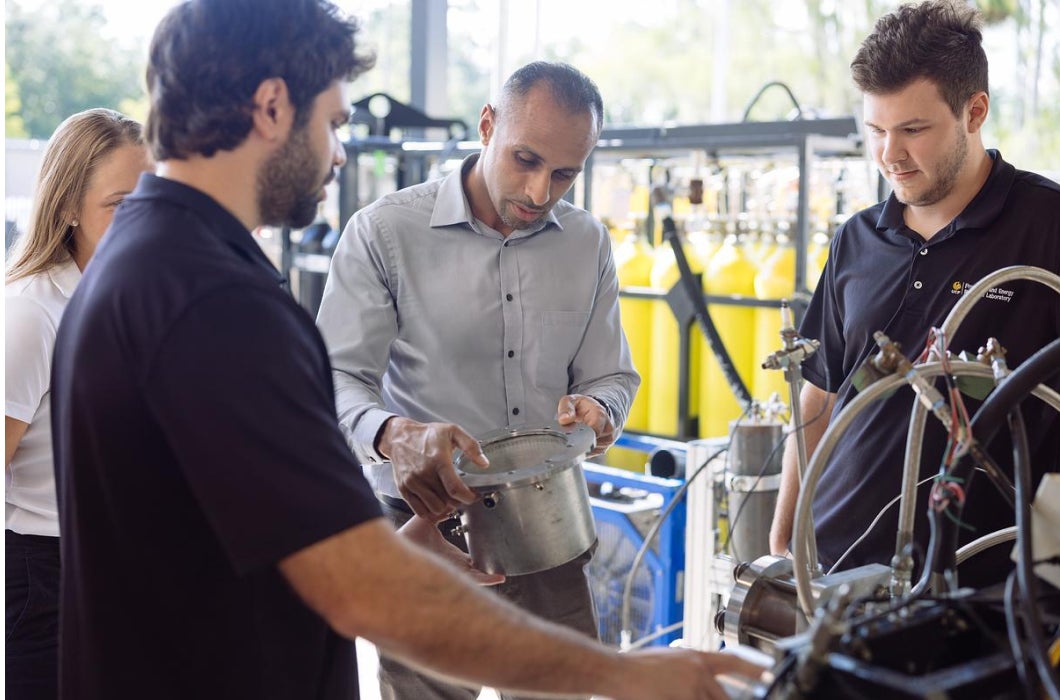
At UCF’s HyperSpace Center, propulsion systems are being developed for Mach 6 through Mach 17, pushing beyond incremental gains and into a different operating regime.
What Counts as Hypersonic Speed?
Mach Number and Speed Thresholds
Aircraft speed is measured using Mach number, a ratio between a vehicle’s speed and the speed of sound.
- Mach 1 marks the speed of sound or supersonic flight
- Mach 5 marks the beginning of hypersonic flight
Most modern aircraft operate far below this range. Fighter jets typically reach around Mach 2, which shows how large the gap is between current systems and hypersonic capability.
Why Hypersonic is a Distinct Physical Environment
At hypersonic speeds, air stops behaving like a simple fluid.
It compresses. It heats. It begins to chemically react. In some cases, it forms a plasma layer that interferes with communication.
Understanding this requires predicting how pressure, heat and chemistry interact at the same time. Researchers like Sung Min Jo, assistant professor at UCF specializing in computational hypersonics and plasma physics research and education, use computational models to study how high-energy airflow interacts with vehicle surfaces before systems are built.
What Happens to Air at Hypersonic Speed?
Shock Waves and Compression
Vehicles at hypersonic speeds generate intense shock waves. These are abrupt changes in pressure and temperature that shape both performance and risk.
Shock waves also create structural risks. Michael Kinzel, an associate professor of Mechanical and Aerospace Engineering, has shown that hitting a single raindrop at Mach 8 can generate forces comparable to the weight of an elephant. The impact creates pressure waves that can form cavitation bubbles, which damage surfaces over time.
What seems negligible at lower speeds becomes structurally meaningful at higher ones.

If you have a rain droplet with a tenth of an inch diameter and you hit it at Mach 8, it can create a load as heavy as the weight of an elephant.”
Boundary Layers and Airflow Behavior
The boundary layer, the thin layer of air touching the vehicle, becomes extremely hot and unstable at hypersonic speeds.
That instability affects propulsion. In engines, turbulent airflow can cause combustion to accelerate unpredictably or fail entirely.
Work in UCF’s Propulsion and Energy Research Laboratory focuses on how to control combustion under these conditions.
Why Hypersonic Flight Generates Extreme Heat
Aerodynamic Heating
At hypersonic speeds, heat does not come from the engine. It comes from the air.
As a vehicle compresses air in front of it, temperatures at leading edges can exceed 3,500 to 5,000 degrees Fahrenheit. At those temperatures, most conventional materials begin to weaken or fail.
That turns flight into a materials problem as much as an aerodynamic one. Speed alone is not the barrier. Surviving what that speed creates is.
Materials and Thermal Protection
Handling that heat requires materials that can maintain strength under sustained thermal stress.
At UCF’s Composite Materials and Structures Laboratory, Professor Jihua “Jan” Gou studies ceramic matrix composites and carbon-based materials designed to withstand extreme temperatures while remaining lightweight.
These materials are tested under controlled conditions that simulate the thermal loads experienced during hypersonic flight, where repeated exposure matters as much as peak temperature.
Cooling systems carry equal weight in the problem. Professor Jayanta Kapat’s work focuses on using supercritical carbon dioxide to remove heat from the most vulnerable regions of a vehicle, especially along the leading edge where temperatures concentrate.
The constraint is not just heat resistance. It is balance. Materials must survive temperature, carry load and remain light enough for flight.
Why Propulsion Becomes Difficult at Hypersonic Speed
Combustion in Extreme Conditions
Traditional engines slow incoming air before combustion. At hypersonic speeds, that approach creates too much heat and drag.
Scramjets avoid this by allowing air to remain supersonic inside the engine. That introduces a different constraint. Fuel must ignite and release energy in milliseconds inside unstable airflow.
That timing window is where most systems fail.
Detonation-Based Propulsion
One approach replaces steady combustion with controlled detonations.
Trustee Chair Professor Kareem Ahmed’s work at UCF’s HyperSpace Center focuses on stabilizing these detonations so they can produce consistent thrust. His team developed a hypersonic detonation rocket engine and continues studying how to sustain these reactions long enough for practical use.
Experiments at facilities like HyperREACT have extended these reactions beyond the millisecond range, moving propulsion closer to sustained operation.
The challenge is not generating energy. The challenge is maintaining control in a system that naturally becomes unstable at high speed.
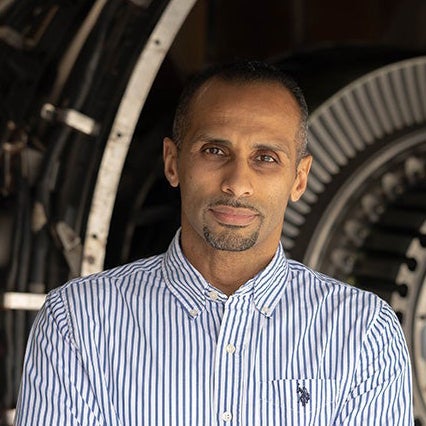
You’re flying at 10 times the speed of sound… this has to be a vehicle that has its own propulsion system, which provides that energy for that vehicle.”
Why Hypersonic Vehicles are Difficult to Control and Operate
Coupled Systems
At hypersonic speeds, systems stop operating independently. Airflow affects heat. Heat affects materials. Materials affect structure. Structure feeds back into propulsion.
A small disruption in one part of the system can cascade through the rest. That coupling is why hypersonic vehicles are difficult to predict and harder to control in real time.
Structural Stress and Fatigue
Materials are not only exposed to extreme heat. They are also exposed to repeated stress.
Associate Professor and Associate Chair Jeffrey Kauffman studies how high-cycle fatigue develops under sustained vibration, where small stresses accumulate over time until failure occurs.
At the same time, reducing weight remains essential. Associate Professor Ranajay Ghosh’s work on origami-inspired structures explores how geometry can improve strength while minimizing mass.
The tradeoff is constant. Stronger structures add weight. Lighter structures reduce durability. Hypersonic design sits inside that tension.
Why Hypersonic Flight is Difficult to Test
Wind Tunnel and Experimental Limitations
Hypersonic conditions are difficult to reproduce.
Standard wind tunnels cannot reach the temperatures, pressures and velocities required. Specialized facilities are needed to simulate those environments for short durations.
At UCF, the High-Hypersonic Enthalpy Facility (HiHYPER) allows researchers to study how materials and airflow behave under those conditions.
These tests provide snapshots, not full flight conditions, which limits how much can be observed directly.
Simulation and Validation Challenges
Because experiments are expensive and limited, researchers rely on computer simulations known as Computational Fluid Dynamics.
Assistant Professor Patrick Meagher develops computational fluid dynamics models that simulate detonation behavior and airflow interaction at hypersonic speeds. Graduate students in Aerospace Engineering and Mechanical Engineering Ph.D. programs contribute to this modeling work.
These models allow researchers to test scenarios that cannot be fully recreated in physical systems, but they still depend on experimental data for validation.
Progress comes from using both together. Simulation expands what can be explored. Testing anchors it in reality.
How Hypersonic Challenges Come Together
Hypersonic flight is not solved one problem at a time. At the HyperSpace Center, propulsion work led by Dr. Ahmed runs alongside materials testing and airflow modeling. Combustion systems are developed while materials are tested under heat and simulations predict how those systems will behave in flight.
That overlap is where progress happens.
Faster propulsion changes how quickly systems can move. Materials determine whether they survive. Modeling reduces the time between concept and testing.
Each piece only matters if it works with the others.
What Determines How Fast Humans Can Travel?
Hypersonic speed is limited by physics and engineering constraints. It is shaped by how much heat materials can handle, how stable propulsion can remain and how much stress structures can absorb.
Each improvement shifts that boundary. What changes is not only speed. It is what becomes possible within that speed.
Summary: The Mechanics of Hypersonic Flight
- Hypersonic speed begins at Mach 5, or five times the speed of sound. At these speeds, air becomes highly compressed and extremely hot, creating conditions that do not occur in conventional flight.
- Propulsion systems must operate inside that environment. Detonation-based engines use shock-driven reactions to generate thrust, and Dr. Kareem Ahmed’s work focuses on stabilizing these reactions for sustained operation.
- Extreme heat is one of the primary constraints. Air compression and friction can raise surface temperatures above 3,500°F, which requires materials that can maintain strength under sustained thermal stress.
- Dr. Jihua “Jan” Gou studies ceramic matrix composites and carbon-based materials designed to withstand these temperatures while remaining lightweight.
- Cooling systems are required to prevent structural damage. Dr. Jayanta Kapat studies methods that circulate supercritical carbon dioxide through vehicle structures to manage heat during flight.
- Even small environmental impacts can create significant stress. Dr. Michael Kinzel’s work shows that raindrop impacts at hypersonic speeds generate shock forces capable of damaging vehicle surfaces.
- Structural stress accumulates over time. Dr. Jeffrey Kauffman studies how repeated vibration leads to material fatigue, while structural design approaches aim to balance durability with reduced mass.
- Hypersonic flight depends on solving these challenges together. Propulsion must remain stable. Materials must survive extreme heat. Structures must withstand continuous stress.
- Progress comes from integrating these systems under the same conditions, allowing high-speed flight to move from theoretical possibility toward practical use.
Frequently Asked Questions About Hypersonics
A scramjet allows air to move through the engine at supersonic speeds while fuel burns, producing thrust without slowing the airflow.
At hypersonic speeds, small raindrops can create large impact forces that damage surfaces.
CMCs are lightweight materials designed to withstand extreme heat without melting or degrading.
A detonation engine uses controlled shock-driven explosions to generate thrust more efficiently.
At extreme speeds, air can ionize into charged particles around a vehicle, which can interfere with communication systems.
Active cooling systems circulate fluids through a structure to absorb and manage heat.
Hypersonic speed refers to flight at Mach 5 or higher, or five times the speed of sound. At these speeds, air becomes highly compressed and extremely hot, creating a physical environment where airflow, temperature and chemical reactions behave differently than in conventional flight.
Air compression and friction increase temperature rapidly, especially at the front edges of a vehicle.