From our earliest mixed-mode courses to today’s expansive digital ecosystem, UCF has pursued a forward-thinking idea to prove that access and excellence can rise together at scale. That vision is reinforced by the 2026 U.S. News & World Report Best Online Programs rankings, where UCF ranks No. 6 for Online Bachelor’s Programs nationally — the highest in university history.
“UCF has been building the future of online education for more than 30 years,” says UCF President Alexander N. Cartwright. “This recognition from U.S. News & World Report affirms the excellence of a people-first, technology-driven approach refined over decades. It reflects a university that has consistently led with innovation, delivered quality at scale and continues to set the standard for what online learning can be.”
This year, UCF also ranks:
- No. 3 nationally for Online Psychology Bachelor’s Programs
- No. 5 nationally for Online Master’s in Educational and Instructional Media Design
- No. 6 nationally for Online Bachelor’s Programs for Veterans
- No. 6 nationally for Online Business (Lodging and Restaurant Management) Bachelor’s Programs
Empowering Driven Non-Traditional Students
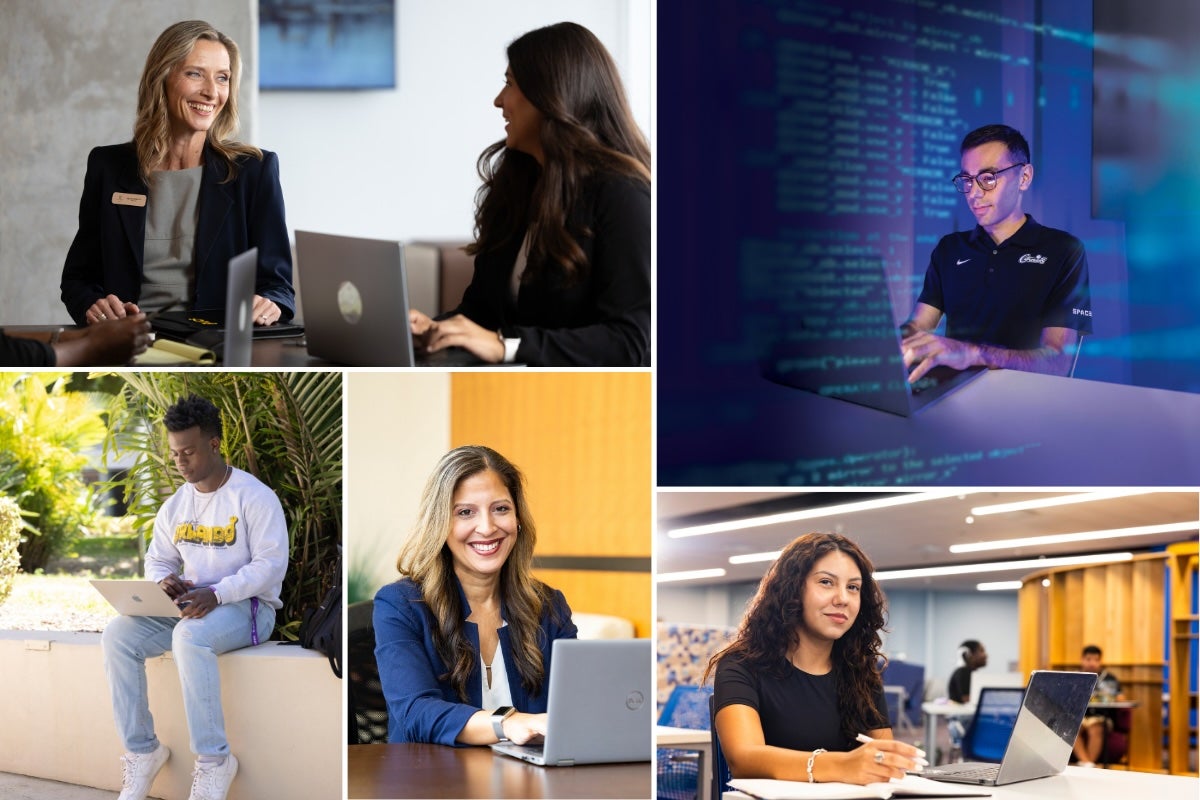
UCF is a leader in how to support learners who don’t fit the traditional academic mold, says Thomas Cavanagh ’06PhD, vice provost for digital learning. These students are parents, working professionals, people with disabilities, those caring for loved ones in need and many others with distinct life circumstances.
UCF Online provides 9,000 students annually a path to a degree that may otherwise be impossible.
“Taking online classes was the best way for me to be efficient as a mom and a detective at the Seminole County Sheriff’s Office,” says Melissa Schuck ’25, a criminal justice alum and a Florida Army National Guard sergeant. “Being able to show my children that through two careers and being a full-time mom that I could still be a full-time student and be successful [makes all my hard work worth it].”
Shuck says she’s even considering the added challenge of pursuing an online graduate degree in criminal justice, which UCF ranks No. 17 for nationally and No. 10 among veterans.
How We Lead at Scale Without Compromise
Behind each online course is a deeply collaborative process. By investing in faculty development and support, UCF Online offers an accessible path to degrees without comprising on quality.
Each semester up to 40 faculty members complete a rigorous, graduate-equivalent course to prepare them for how to best teach students in the unique environment of online learning while meeting academic standards.
“The same faculty who teach on campus , teach online, which is a hallmark of our quality,” Cavanagh says. “We partner with faculty to develop intentionally designed, media-rich courses for our students. We emphasize that the proven practices of consistent assignment schedules, engagement and responsiveness lead to a more engaging learning experience for students, as well as achieve better outcomes.”
More than 150 Center for Distributed Learning staff members work with 2,000 faculty across the university to develop and enhance UCF’s online programs.
That same intentionality extends to student success. UCF Online’s dedicated coaching staff supports prospective and current students with the application process, applying for financial aid, signing up for classes, connecting them to resources and more.
“We meet students where they are — and we walk with them,” says Tasha Williams ’12 ’17MNM, director of student coaching for UCF Online.
Redefining Online Education for Tomorrow’s Workforce
This year’s recognition reflects that UCF Online continues to be at the forefront of digital learning. To lead this charge, instructional designer, multimedia specialists, assessment experts and other staff combine their insights with tools such as artificial intelligence to evolve academic offerings.
This includes exploring opportunities to redesign courses for disciplines like nursing — which UCF ranks No. 17 for online graduate programs nationally — from 16 weeks to eight weeks while meeting industry standards.
“We’re never finished,” Cavanagh says. “Continuous improvement is part of our culture — whether that’s refining how we support faculty, enhancing the student experience or rethinking how programs are structured to meet today’s workforce demands.”