Highlights
-
UCF Department of Industrial Engineering and Management Systems Professor Luis Carlos Rabelo leads the project, with aerospace engineering graduate student Carson Gray ’26 helping develop the digital twin software.
-
Using student-built robotic platforms, the team generates real-time virtual representations of rovers and their surroundings that allow operators to simulate movements before executing commands.
-
The technology could eventually help coordinate autonomous robots exploring distant environments, where communication delays present significant operational challenges.
Landing humans on the moon was just a dream when UCF was founded in 1963. But we dared to believe — developing the talent and inventing the technologies to make it reality. That same spirit still drives us today.


Where Global Leaders Unite to Forge the Future of Space
A rover’s next move on another planet could begin in a UCF lab.
Before its wheels encounter a rocky slope or an unexpected obstacle, a virtual assistant could help operators answer a critical question: Can it get through?
Luis Rabelo, a professor in UCF’s College of Engineering and Computer Science, is leading a team of UCF undergraduate researchers/engineers developing an AI-driven digital twin to investigate how the technology could support robotic exploration when communication with Earth is delayed.
Digital twins are virtual representations of physical systems that can use data from their physical counterparts to model and simulate behavior. By testing a rover’s movements virtually before executing commands, operators could anticipate obstacles and evaluate potential actions without waiting for every instruction to travel to the robot and back.
The research builds on an international collaboration involving Rabelo and UCF planetary scientist Phillip Metzger ’00MS ’05PhD, director of UCF’s Stephen Hawking Center for Microgravity Research and Education. UCF aerospace engineering graduate student Carson Gray ’26 has helped develop the digital-twin software and advised the student teams that constructed UCF’s rover prototypes.
Connecting Physical and Virtual Systems
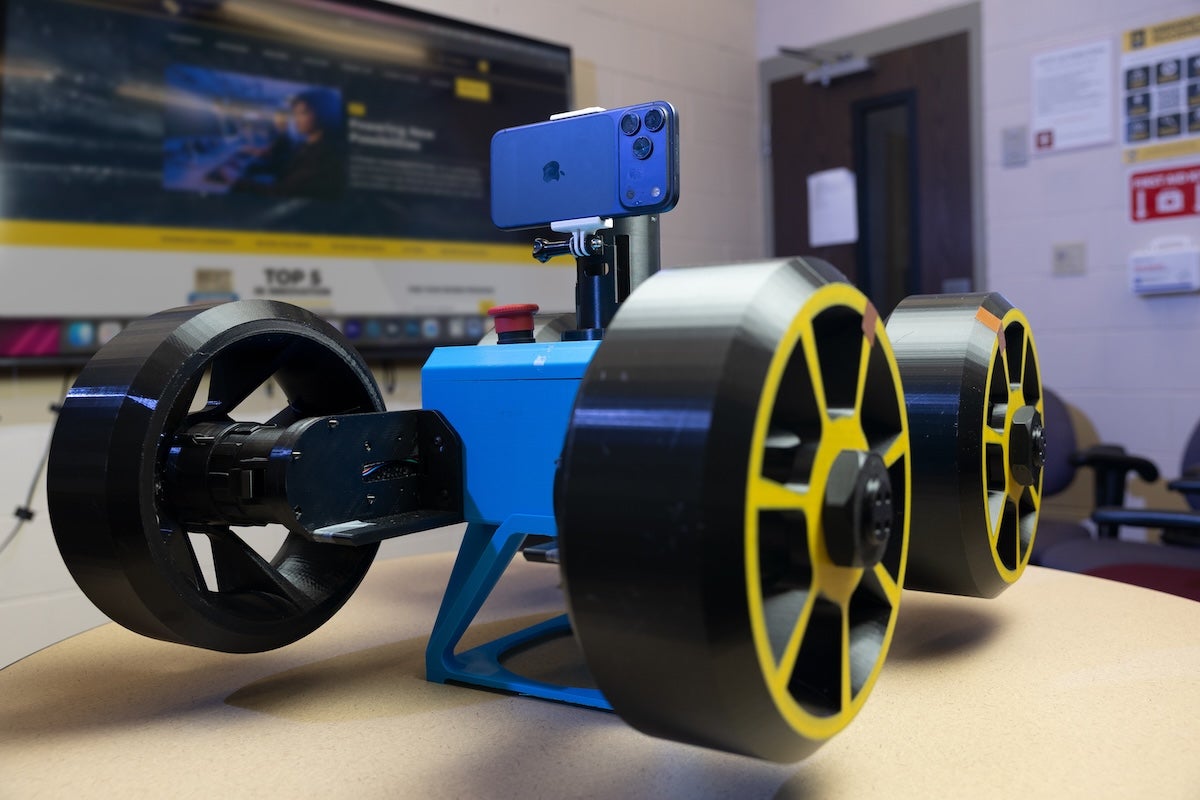
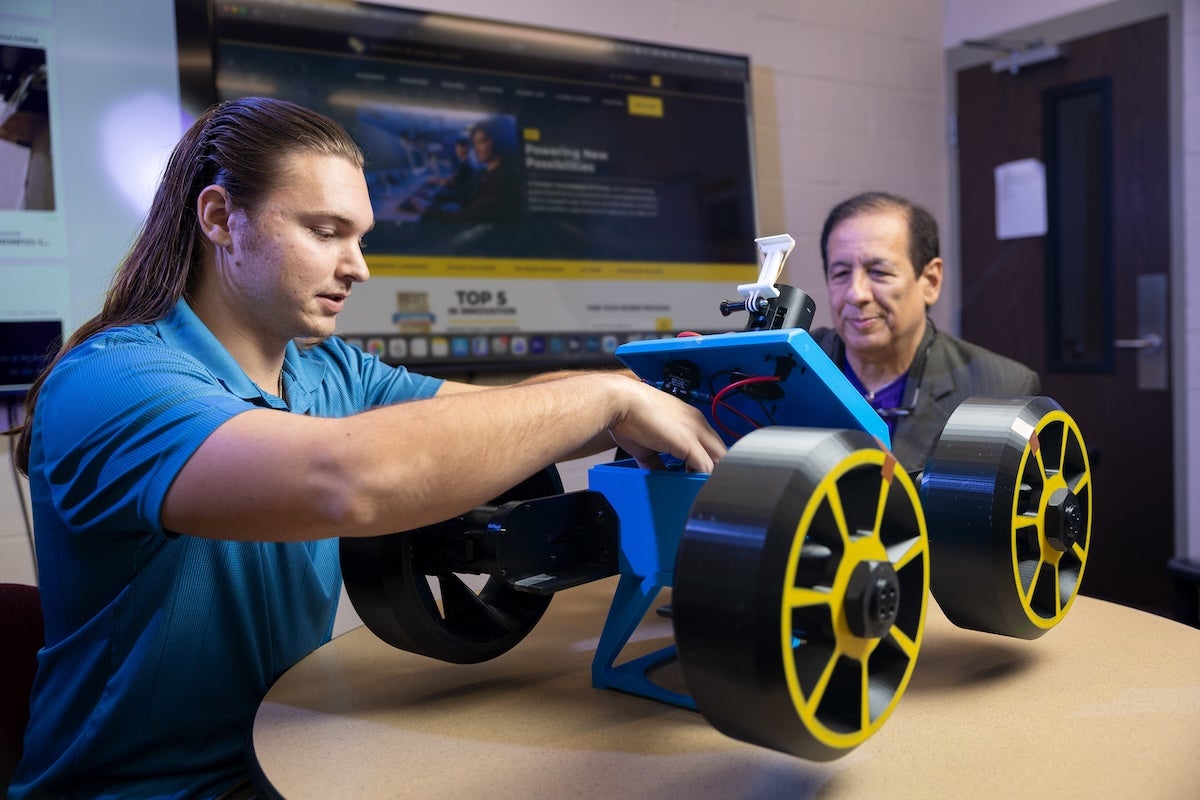
The team uses RE-RASSOR, the Research and Education Regolith Advanced Surface Systems Operations Robot, a low-cost, 3D-printed educational platform adapted from NASA’s original RASSOR mining robot.
Each rover costs approximately $400 to produce, allowing students to experiment with digital twin software on comparatively inexpensive hardware, says Gray, a mechanical engineering alum. That accessibility could make advanced robotics research more feasible for university laboratories with limited resources.
During a demonstration, Gray showed how an iPhone’s camera and LiDAR sensor, mounted on the rover, help the system construct a 3D virtual representation of the robot and its surroundings in real time.
“It’s a two-way street. The robot is constantly sending its position — you can move it in the digital twin, and then that will be sent to the robot. … At the end of the day, you want them mirroring each other,” Gray says.
Rabelo says a digital twin’s update frequency must reflect the behavior of the physical system it represents. For robotic systems, that means accounting for changes second by second rather than relying on the longer-term predictions used in conventional simulations.
“The digital twin depends on the time constant of the system,” Rabelo says. “That’s the difference.”
That connection between physical and virtual systems could help operators make more informed decisions in unfamiliar lunar or planetary terrain.
“Say on the moon, if the environment is very bumpy, rocky, you might not always know if a command is going to be successful or not,” Gray says. “So you can see in the simulation if it can go over this bump successfully. And then if it does, then you can do it on the real rover with a lot more confidence than if you didn’t have the simulation.”
Building on Earlier Research
The work grew out of a collaboration between UCF and the Universidad Politécnica de Durango in Mexico. During the 2025-26 academic year, Rabelo and Metzger advised an international senior design project focused on developing an AI-driven digital twin of RASSOR.
A central objective was to investigate how digital twins could help operators work around communication delays. The farther a robot travels from Earth, the longer commands and information can take to pass between it and the people directing it.
Rabelo describes a test scenario with a simulated three-second delay in each direction, creating a six-second round trip. The digital twin could help operators anticipate the rover’s behavior and identify potential problems before they occur.
Preparing for Future Space Exploration
Rabelo envisions expanding the research beyond individual rovers to groups of autonomous robots collaborating on complex logistics tasks at the moon’s south pole.
Different robots could perform specialized tasks, from surveying terrain and identifying resources to collecting materials and transporting equipment. A shared digital twin could help coordinate their movements across a larger environment.
“You have to have a bigger digital [twin] of the entire piece of the moon where all of those things have to go,” Rabelo says.
Such technology could eventually help researchers coordinate robotic operations across distant planetary environments, where communication delays make continuous human oversight difficult.
For now, this student-built platform lays the groundwork for a larger ambition: helping future robotic teams explore farther, with operators better prepared for what comes next.
The research received $5,000 in support from the Florida Space Grant Consortium through UCF’s Florida Space Institute. Undergraduate senior design teams developed the rover prototypes under the guidance of Rabelo, Gray and Metzger.