Highlights
-
Agere Chair Professor Carolina Cruz-Neira, an IEEE VR Lifetime Achievement Awardee, is the virtual reality innovator behind the CAVE system, which transforms how people experience 3D digital environments.
-
Over nearly four decades, her work has powered the field of VR — securing more than $200 million in research funding, authoring over 100 publications and earning prestigious honors, including National Academy of Engineering membership, Forbes 50 Over 50 recognition and induction into the Orlando Tech Community Hall of Fame.
-
As director of UCF’s Institute for Simulation and Training, she leads cutting-edge projects that blend physical and virtual worlds, uniting researchers across disciplines.
UCF Institute for Simulation and Training Interim (IST) Director Carolina Cruz-Neira’s career in virtual reality (VR) began as a backup plan.
She spent her childhood training as a ballet dancer. When a knee injury at 21 ended her professional dance aspirations, she leaned on the engineering degree her father had encouraged her to pursue.
While earning her doctoral degree in electrical engineering and computer science at the University of Illinois Chicago, she discovered the Electronic Visualization Laboratory — and with it, a way to merge art and technology.
“My philosophy as a researcher has always been to take on projects that are a little risky.”
In 1992, she unveiled the Cave Automatic Virtual Environment (CAVE), an immersive VR system that transforms a room-sized cube into an interactive 3D digital world. Unlike early VR headsets that isolated users, the CAVE allows multiple people to step inside the same digital environment, fostering shared exploration and real-time collaboration.
Today, CAVE systems are used worldwide, from gaming and art installations to military training and automotive design, helping industries visualize complex problems, improve safety and refine products before building them in the real world.
Powering the Future of Simulation
Over nearly four decades, Cruz-Neira has made significant contributions to the fields of VR, interactive visualization, high-performance computing and digital twins, which are dynamic virtual replicas of real-world objects used for simulation and testing across industries. Her innovations have influenced training and research for NASA, the U.S. military and U.S. National Laboratories.
By the Numbers: A Lasting Impact
- Secured more than $200 million in research funding
- Authored more than 100 publications
- Elected to the National Academy of Engineering — one of the highest professional distinctions for engineers in the U.S.
- Named an IEEE fellow and Forbes’ 50 Over 50 honoree for innovation
- Inducted into the inaugural Augmented World Expo XR Hall of Fame and the Orlando Tech Community Hall of Fame for her contributions to Central Florida’s tech ecosystem
- Recognized in the U.S. Congressional Record for the national impact of her work
“My philosophy as a researcher has always been to take on projects that are a little risky,” says Cruz-Neira, UCF’s Agere Chair Professor of computer science. “I tell my students that we do research with a purpose. And yes, it’s challenging. But if we have that vision of where this thing is going, our talent and creativity have a terrific playground.”
That bold spirit of exploration drew her to UCF in 2020 — a university recognized for its strength in computer science and deep partnerships and collaborators across several sectors, including space, defense, entertainment and healthcare.
“There’s a whole community of researchers, faculty and students here who are passionate about this kind of work.”
Since arriving, she says she has found something even more powerful: a culture that pairs high-level excellence with a nurturing environment — where ambitious ideas are energized, challenged and brought to life through collaboration.
“There’s a whole community of researchers, faculty and students here who are passionate about this kind of work. That has allowed us to expand our ideas tremendously,” Cruz-Neira says. “We’re now collaborating with teams across the College of Engineering and Computer Science, the College of Medicine, the College of Arts and Humanities and the Rosen College of Hospitality Management, which broadens what we’re able to do. It’s nice to have a tribe around you, where everyone helps each other and works together.”
Among those collaborators is longtime colleague and IEEE VGTC Virtual Reality Service awardee, Gregory Welch. Cruz-Neira says they first met as “Ph.D. babies,” beginning a collaboration that has now spanned nearly 38 years. Since joining UCF, she has continued working closely with Welch and his team on several joint research projects and publications.
What’s Next: Blending Physical and Virtual Worlds
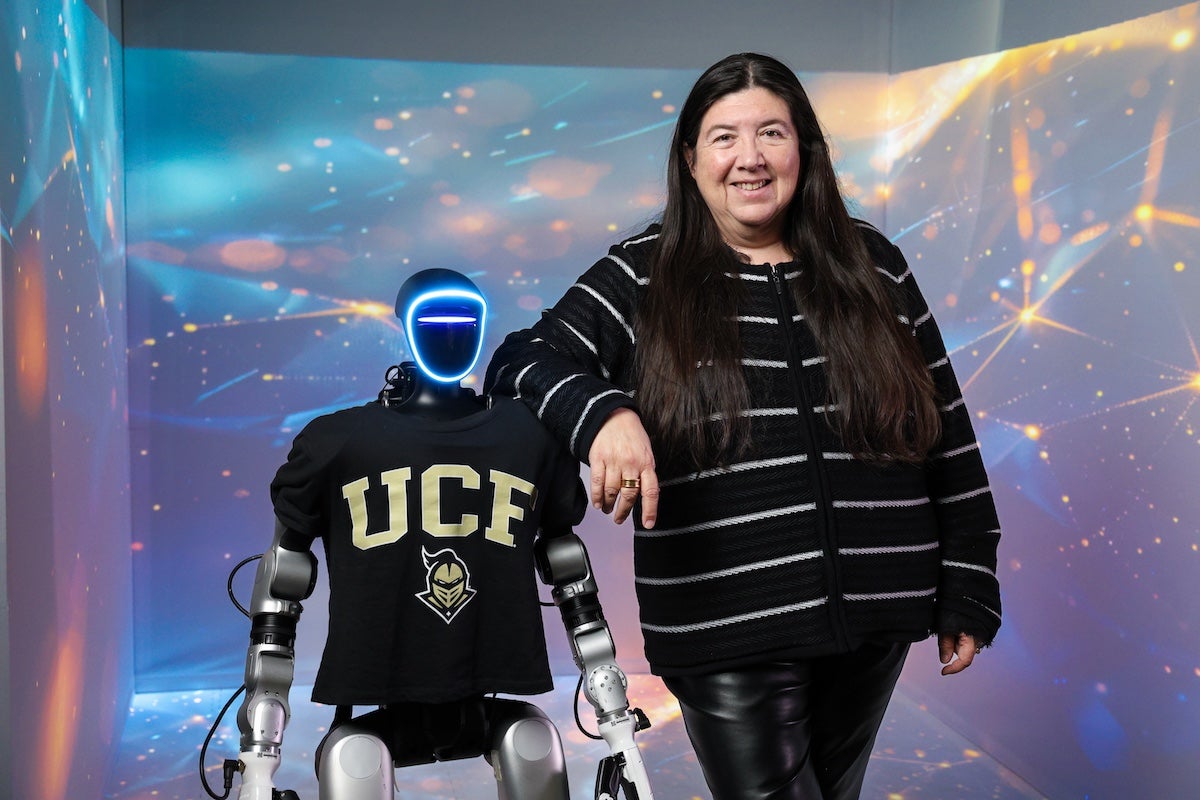
As IST director, Cruz-Neira is helping broaden UCF’s modeling and simulation legacy while leading several cutting-edge research projects in collaboration with talented students and faculty. One such project explores humanoid robots as extensions of the human body, allowing a person to navigate remote or inaccessible locations in real time. Using artificial intelligence, the robot captures its surroundings and transmits a live digital replica into the CAVE, where a human operator’s movements control the robot, creating a seamless exchange between physical and virtual worlds.
“This project opens a lot of possibilities and aligns with where we want to go at IST and UCF,” Cruz-Neira says. “We do a lot of work with defense, first responders and healthcare professionals, and in many cases, we see the need for a human [presence in locations] that aren’t feasible. By combining mature technologies available in the commercial world with some of our more advanced algorithms and system designs at UCF, we’ve finally been able to come together to make this prototype and showcase it in December 2025 at [the Interservice/Industry Training Simulation and Education Conference], a major defense training environment.”
Cruz-Neira continues to push boundaries, bringing people together and asking questions like, “What can we create next?” and “How far can we take this?”
And despite a lifetime achievement award, she’s clear about one thing: “I’m not done yet.”