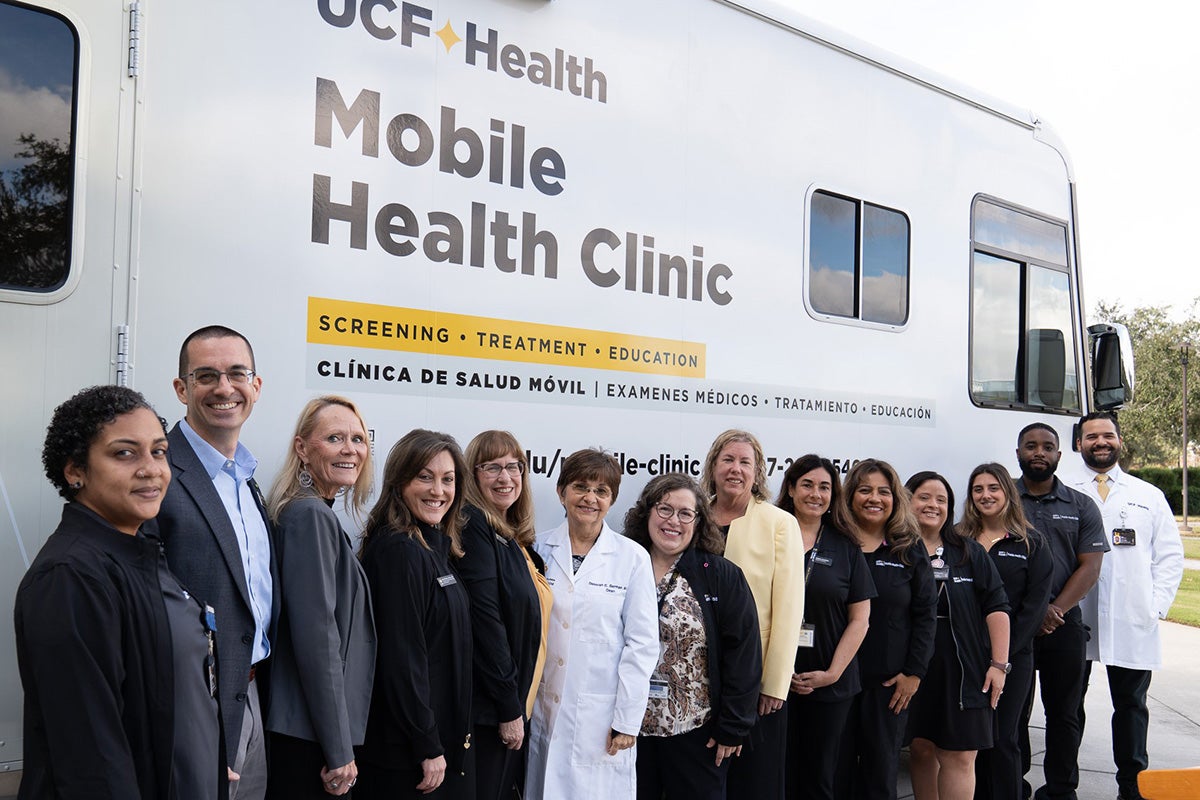
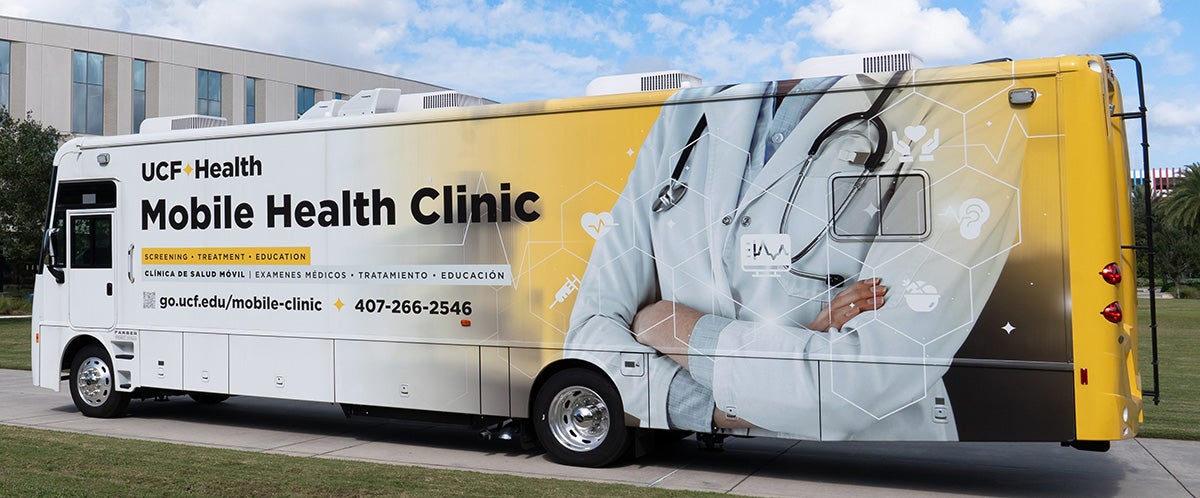
UCF unveiled a new 38-foot UCF Heath Mobile Health Clinic on Wednesday, designed to bring free, high-quality healthcare directly to communities that need it most.
The clinic also serves as a mobile classroom, preparing UCF healthcare students in programs including medicine, nursing, physical therapy and speech-language pathology with hands-on experience delivering community-based care.
The clinic is the first interdisciplinary clinical care program offered by UCF’s Academic Health Sciences Center (AHSC). The center unites UCF’s colleges of Health Professions and Sciences, Medicine and Nursing to create more interprofessional health education, research and patient care efforts.
“This new mobile health clinic is expanding access to healthcare in our community,” says Deborah German, who as vice president for health affairs leads the AHSC and serves as College of Medicine dean. “Our goal is simple and powerful – when healthcare providers work together, the patient receives better care.”
The clinic is focused on low income, uninsured and underinsured populations in Orange and Osceola counties, helping patients who face transportation, mobility or financial barriers that restrict their access to healthcare.
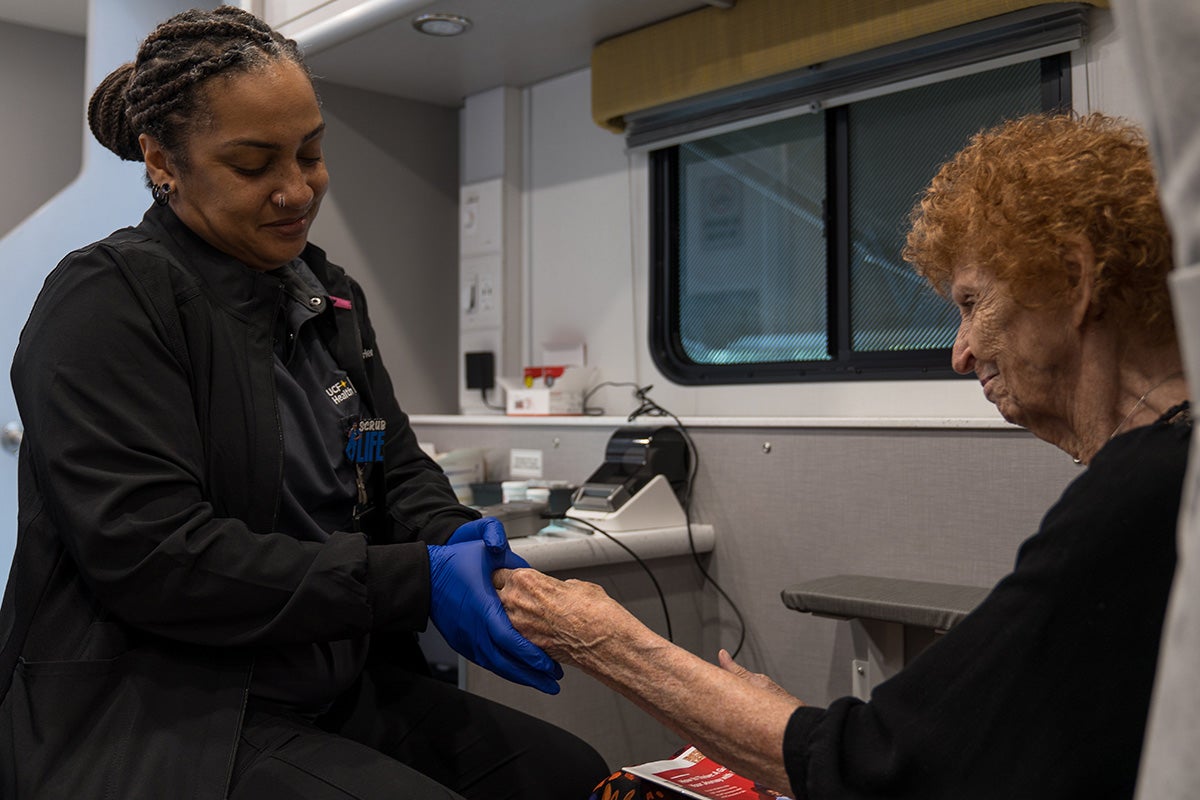
Services include screenings for blood pressure, diabetes, cholesterol and hearing, along with chronic disease monitoring, fall-risk assessments, medication reviews, audiology services and health education.
With two private exam rooms, diagnostic equipment, and point-of-care testing capabilities, the clinic is aiming to reduce preventable conditions and improve long-term health for the Central Florida region.
“The UCF Health Mobile Health Clinic is designed to complement the incredible work being done by community health centers, federally qualified health centers and charitable clinics across Central Florida,” says Caridad Hernandez, chair of medical education at the College of Medicine, who has worked for years to make the mobile clinic a reality. “Our goal is to fill gaps and meet people where they are, working hand in hand with these organizations to amplify resources and create a seamless continuum of care.”
Training Future Health Leaders
UCF’s Academic Health Sciences Center is made up of healthcare providers, faculty, researchers, staff and students committed to improving healthcare. It is focused on educating the next generation of healthcare leaders and finding better ways to treat disease through innovation, discovery and collaboration.
The mobile clinic serves as a classroom on wheels that provides future UCF physicians, nurses, audiologists, physical therapists, occupational therapists and others with the opportunity to learn in real-world settings, side by side, as part of interprofessional teams.
“These experiences prepare graduates who are not only clinically skilled but know how to work and communicate better in healthcare teams.” — Caridad Hernandez, chair of medical education at the College of Medicine
“They will see firsthand how life and social circumstances impact health and care, and how collaboration strengthens outcomes,” Hernandez says. “These experiences prepare graduates who are not only clinically skilled but know how to work and communicate better in healthcare teams. That training stays with them when they go into clinics and hospitals to care for us all.”
Mimi Alliance ’22 is a family nurse practitioner doctoral student at UCF’s College of Nursing who is providing care on the mobile health unit and conducting doctoral research on hearing screenings for seniors.
“UCF’s mobile health clinic is an incredible and innovative tool that will allow us, as a group of providers, the ability to care for patients by serving them where they are,” she says. “Ultimately, this is going to improve the health of our communities.”
Addressing a Community Need
The mobile clinic serves Florida residents who are uninsured or underinsured with income levels at or below 300% of the Federal Poverty Level. Nearly 15% of both Orange and Osceola County residents are not insured, regardless of income level. In addition, 27% of Floridians say they do not have a personal physician.
Since March, almost 500 patients have visited the clinic for blood pressure checks, hearing screenings and point-of-care testing for blood sugar levels and cholesterol. It has provided care at Four Roots Farm, Kinneret Council on Aging, Grace Medical Home, the Central Florida Fairgrounds and four Central Florida YMCA locations. UCF has also reached an agreement with Osceola County to provide care at community centers in the future.
Thanks to a grant from the Florida Department of Health, the clinic is working to improve care for the community’s diabetic patients with limited access to care.
Diabetes is a worldwide epidemic. In Florida, at least 2.17 million adults have been diagnosed with diabetes and an estimated 550,000 more are unaware they have it. The state’s diabetes rate is higher than the national average and it is getting worse – an additional 6 million adults in Florida have prediabetes.
“Many of our neighbors with diabetes have no access to healthcare. That leads to premature death, blindness, loss of limbs and kidney failure,” Hernandez says. “Through the FDOH grant, we can help provide these patients with needed care. We screen patients for diabetes, can provide prescriptions at no cost, and offer education on diet changes that will help them manage their disease.”
As one recent patient at Kinneret Council on Aging explains, “UCF helped me know what kind of food and protein I can eat to help my blood sugar not get too high or too low. Thank you so much. You are helping.”
The clinic also started a diabetic foot program after one of the Kinneret patients said she and other diabetics lacked mobility and eyesight to regularly check their feet for ulcers or blisters. Diabetes increases a patient’s risk for foot ulcers that can lead to amputation. Thanks to the foot program, UCF College of Nursing faculty and students are providing hands-on education and preventive screenings to patients, who also received their own telescoping mirrors to do regular foot checks at home.
Providing Needed Audiology Care
One of the clinic’s major health services is hearing health and the prevention of hearing loss.
“This is not just a ‘nice to have’ screening,” says Bari Hoffman ’96 ’98MA, associate dean for clinical affairs at UCF’s College of Health Professions and Sciences and a certified speech pathologist who has helped lead the mobile clinic effort. “Hearing loss is linked to diabetes, cardiovascular and cardiometabolic conditions, balance, cognition and overall health. When we catch hearing loss early, we can intervene before it affects someone’s safety, memory, their social connections, or their long-term health trajectory.”
Thanks to a gift from the Edyth Bush Charitable Foundation, UCF purchased diagnostic hearing equipment to provide clinical-grade hearing assessments in the community. And though a collaboration with Central Florida Hearing Aid Recycling Programs, the mobile clinic can help connect patients with reprogrammed, refurbished hearing aids at no cost.
“This is such a meaningful addition,” Hoffman says. “Identifying hearing loss is important, but ensuring people have access to hearing aids is what truly changes lives.”
The mobile unit is also supported by the Community Fund of our teaching hospital – UCF Lake Nona Hospital and our partners HCA Florida Healthcare and The Jules B. Chapman MD and Annie Lou Chapman Private Foundation.
Stephanie Garris is CEO of Orlando’s Grace Medical Home, which provides high-quality, continuous care to some of Orange County’s more than 160,000 uninsured residents. Grace patients have received audiology care from the UCF mobile clinic.
“This mobile clinic is an incredible resource for our patients, offering essential services they otherwise wouldn’t have access to.” —Stephanie Garris, CEO of Orlando’s Grace Medical Home
“This mobile clinic is an incredible resource for our patients, offering essential services they otherwise wouldn’t have access to,” Garris says. “Through our partnership with UCF, we are expanding access to care—especially for the working poor, whose jobs often don’t include healthcare benefits.”
Expanding Efforts
Mobile clinic leaders are eager to expand services and work with additional community organizations.
Plans also include expanding the mobile clinic into an innovation hub to pilot and evaluate emerging aging-in-place and digital health technologies and integrate new diagnostic and disease prevention tools.
UCF research faculty also want to use the vehicle’s services to study better ways to advance health accessibility and chronic disease management. Educators from the AHSC’s three colleges also plan to grow interdisciplinary student training across areas including audiology, nursing, medicine, physical therapy and speech language pathology.
Community organizations wishing to partner with the mobile health clinic can contact anna.cisneros@ucf.edu.