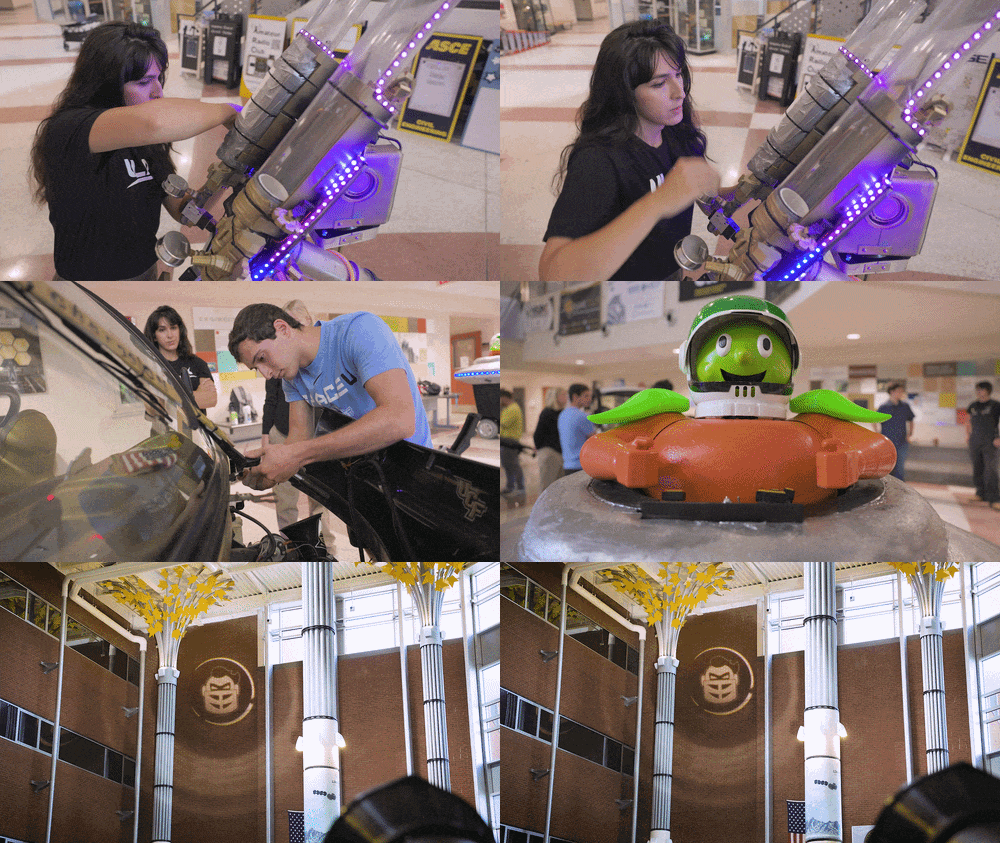
In the atrium of the Engineering II building, a group of students gathers around an assortment of creations.
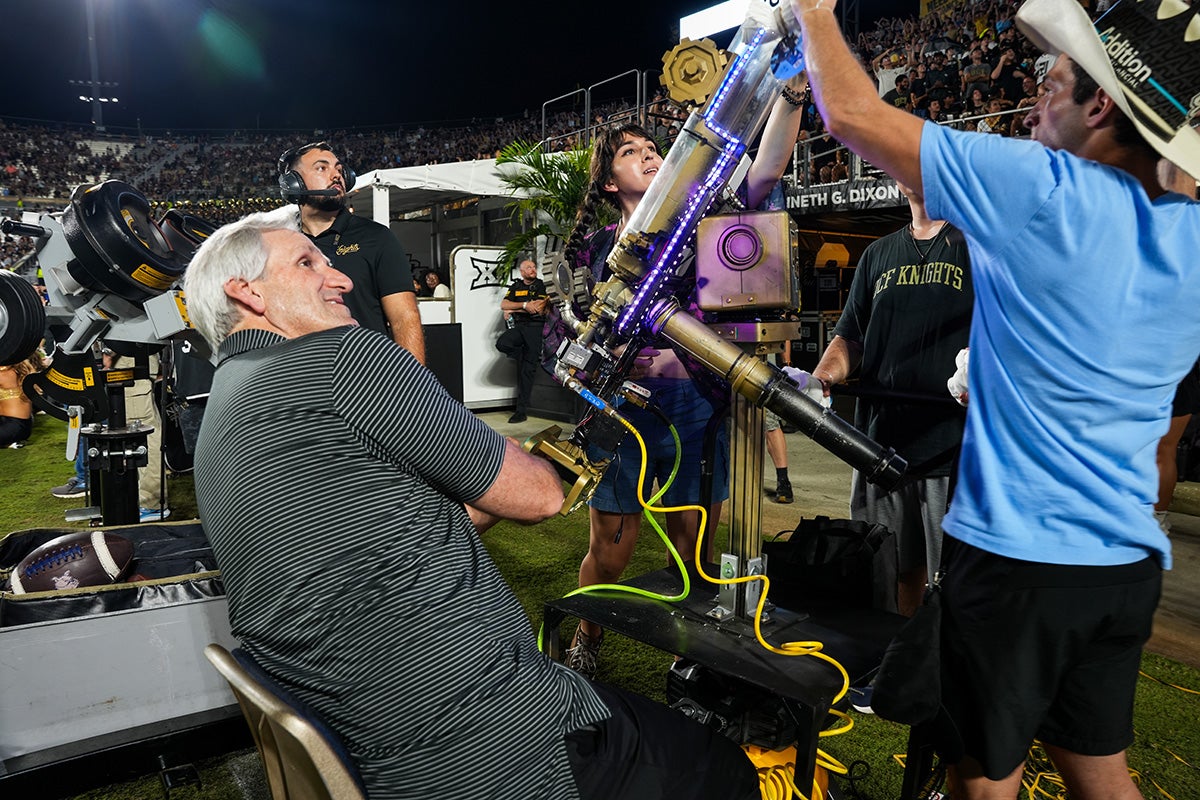
A double-barreled T-shirt launcher that can fire shirts higher than the 60-foot walls of Acrisure Bounce House.
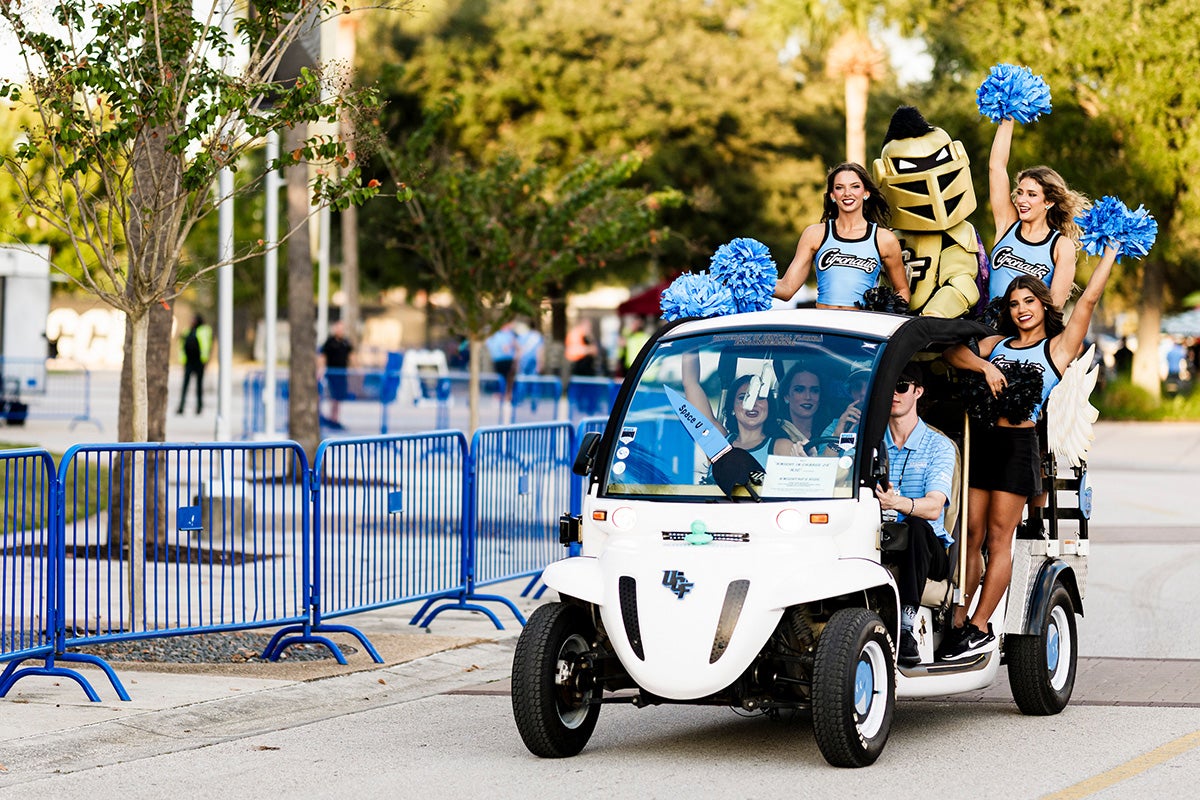
A decked-out golf cart, rescued from its fate at the salvage yard and repurposed instead into Knightro’s preferred mode of transportation.
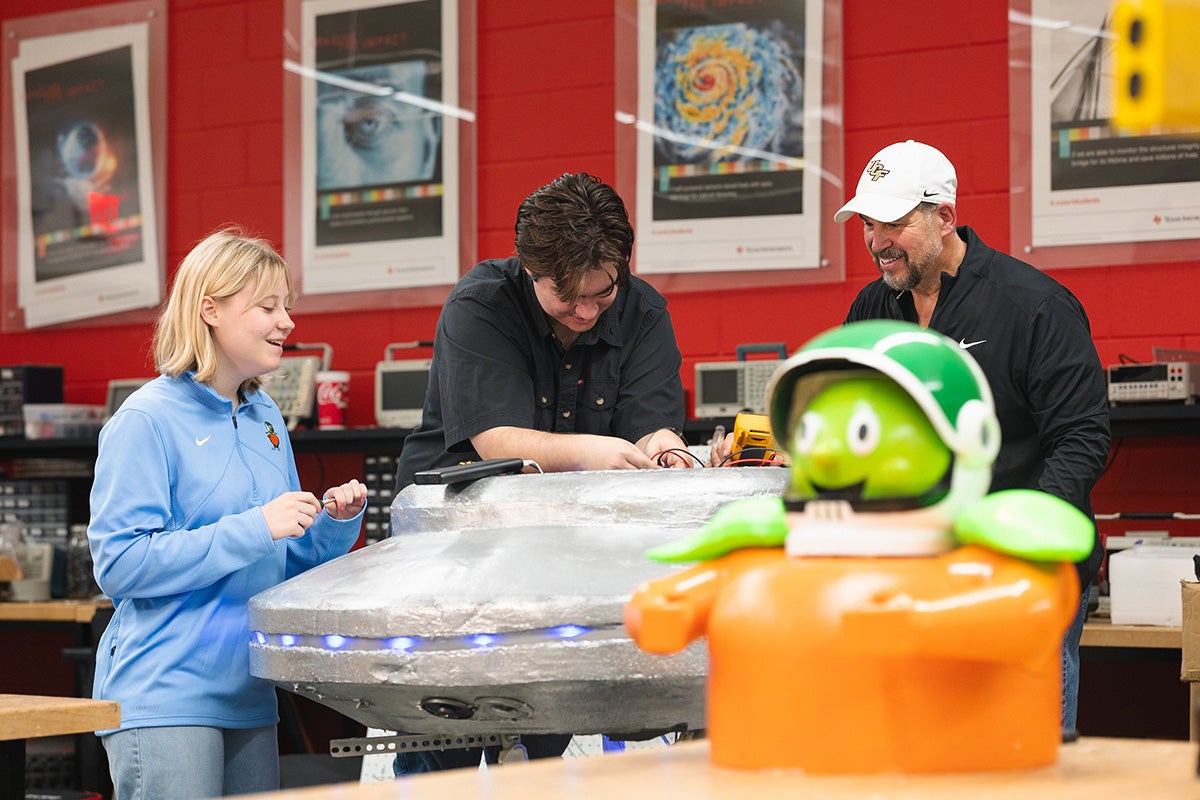
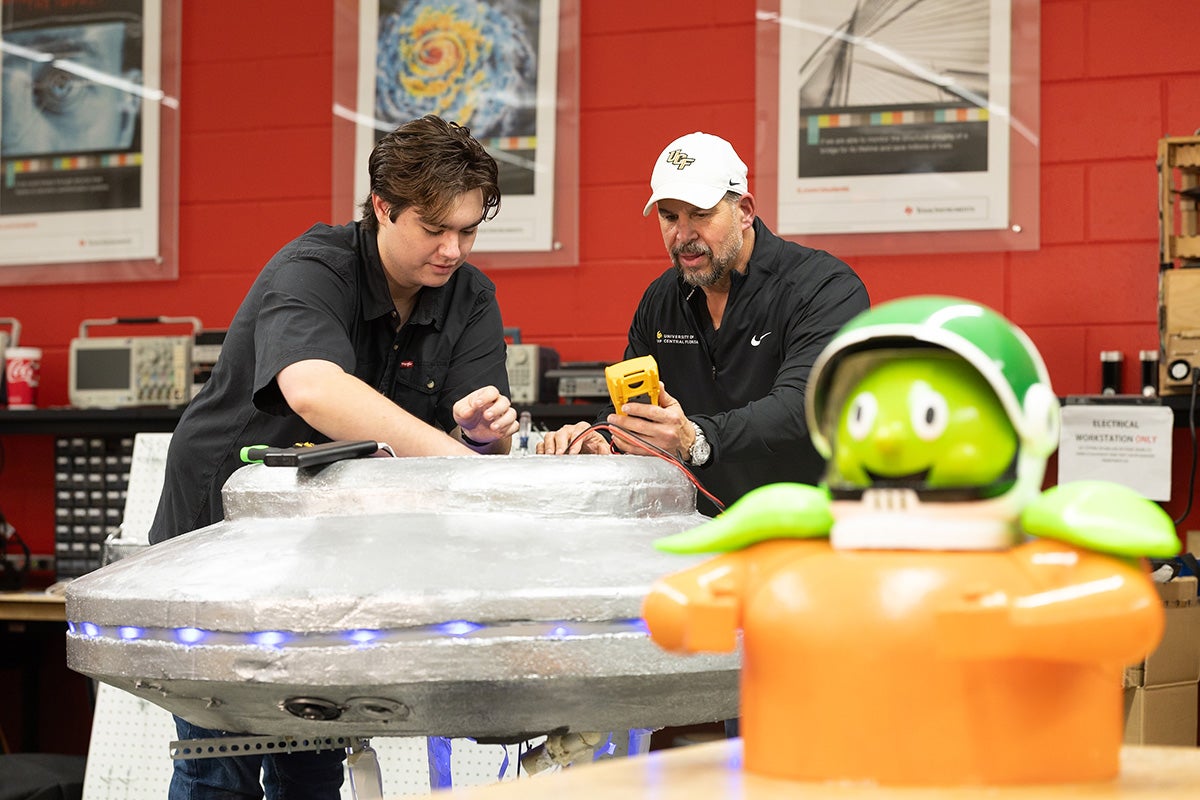
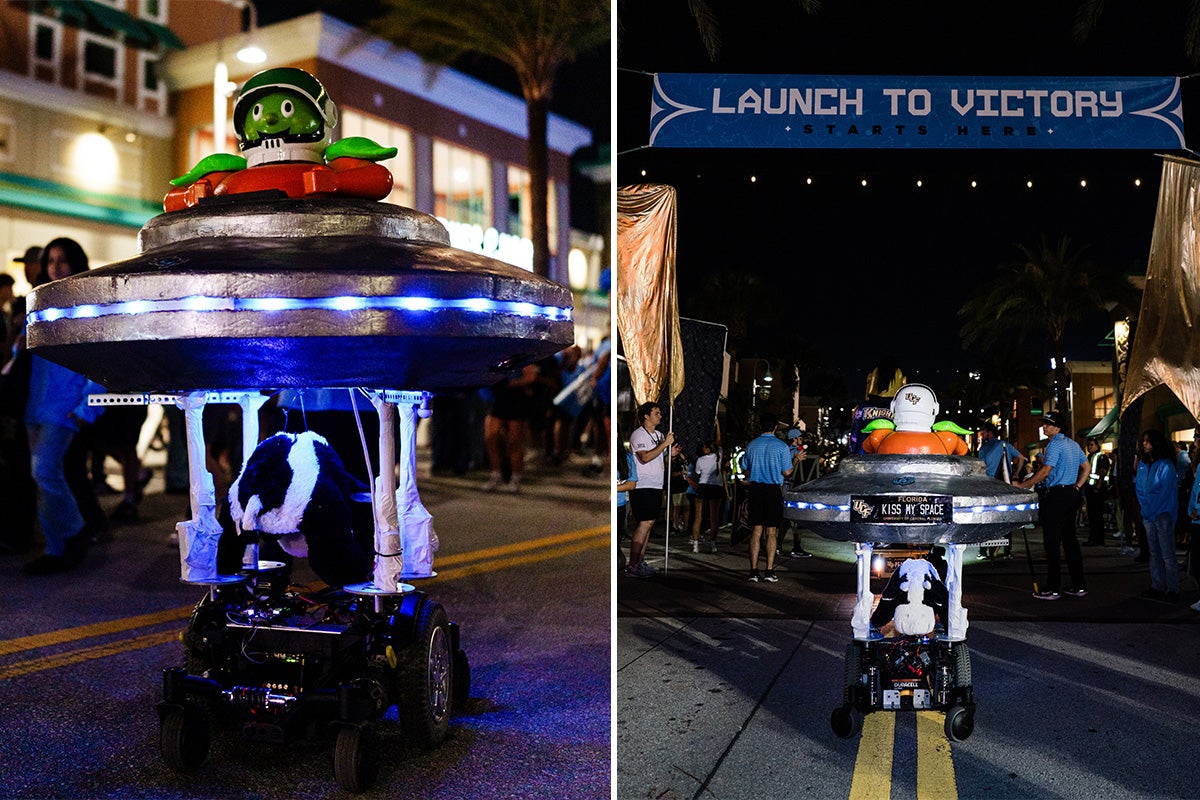
A 3D-printed, robotic Citronaut piloting a spaceship that blasts AC/DC’s Thunderstruck through surround-sound speakers.
And set to make its debut later this year, a powerful projection spotlight designed to summon Knightro onto the field — his own version of Batman’s iconic bat signal.
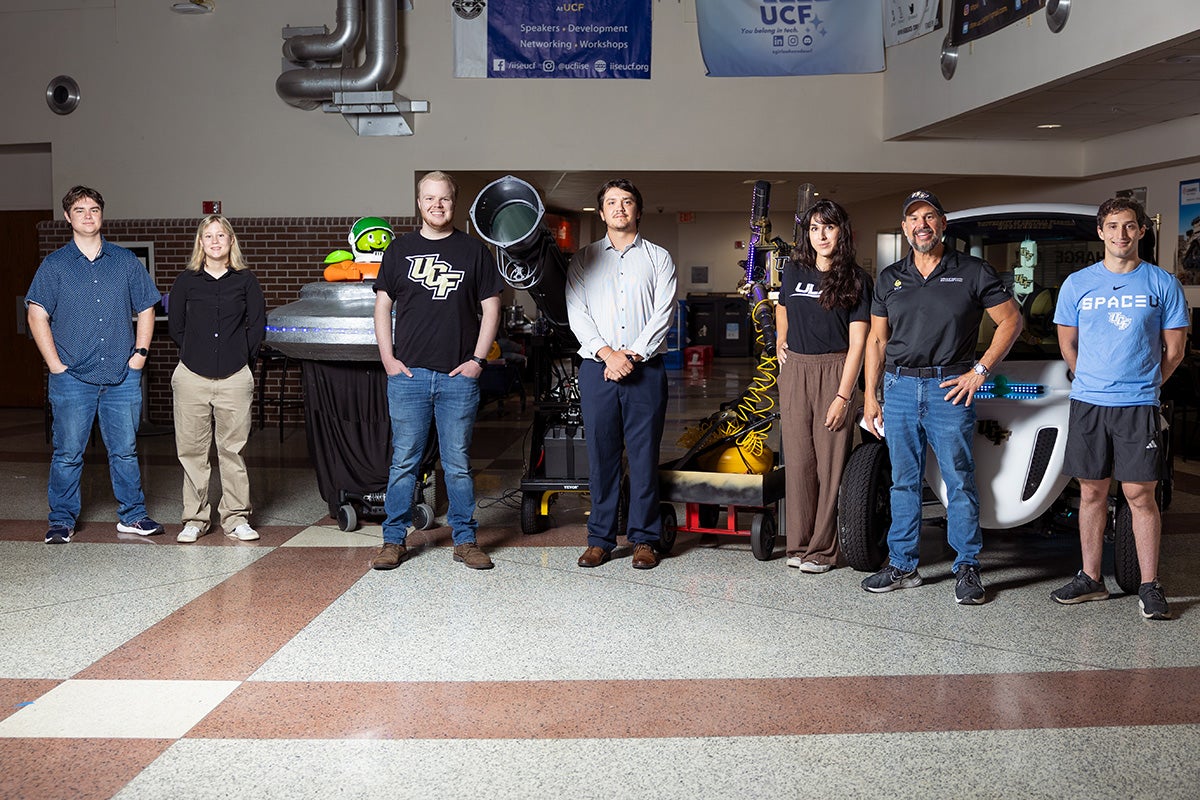
As the students explain the ins-and-outs of these custom innovations — all built in university labs with tools, technology and machines at their disposal — facility manager Pete Alfieris stands off to the side with a dash of pride on his face.
“Remember what Pete stands for,” the longtime UCF staff member calls out. “Preparing engineers through education.”
They collectively groan, but in a tone that clearly shows they cherish this man and his dad jokes.
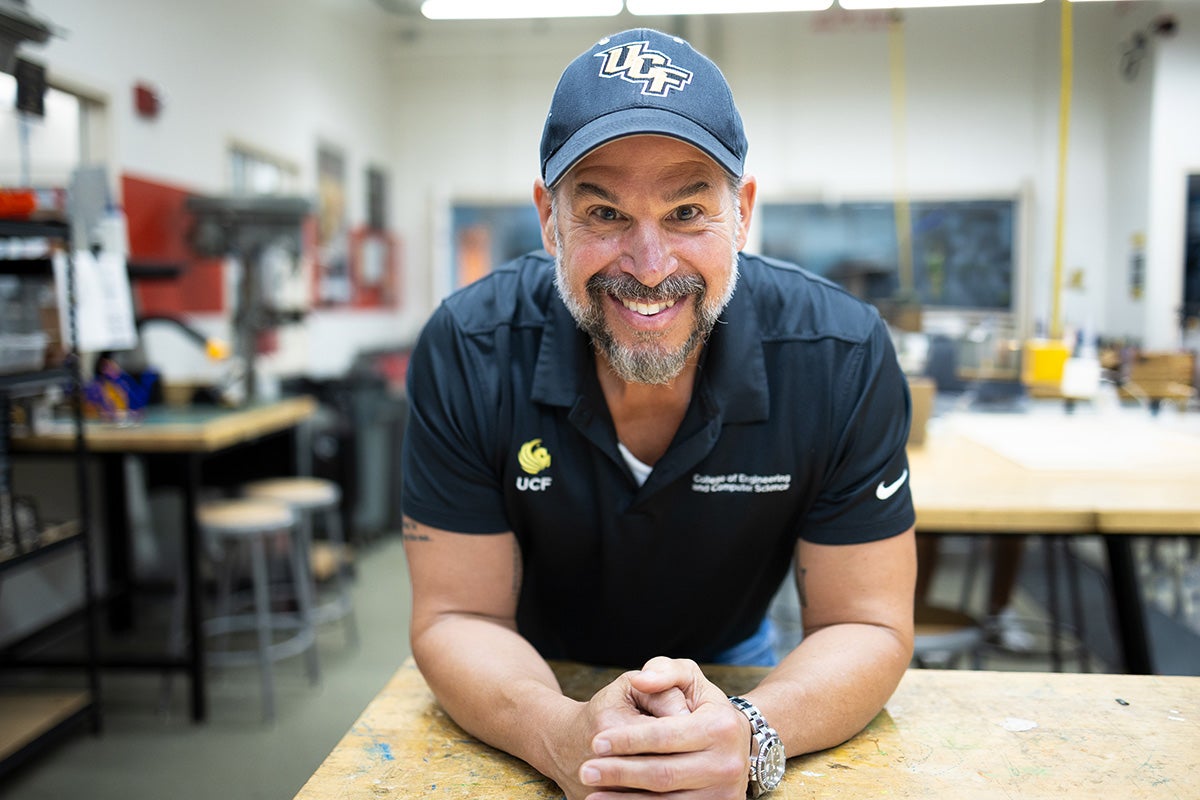
“If you graduate from [UCF’s] engineering college without meeting Pete, you didn’t really go to the engineering college,” says Caden Peters ’26, a computer engineering alum who co-created the Knight signal. “He really shows that anyone can make an impact. You don’t have to be a professor. You don’t have to be an advisor. He’s the facilities manager of the engineering building. And he still has such a strong impact on the college and inspires so many students. There’s really no one like him.”
Alfieris oversees daily operations, lab safety and security for UCF’s College of Engineering and Computer Science buildings since he took the role in 2008. Nowhere in his job responsibilities does it list mentoring and collaborating with students.
Yet for the past five years, since the football season ticket holder was first inspired to introduce a T-shirt launcher at UCF football games, Alfieris has been the driving force behind the growing partnership between the college and UCF Athletics, pitching his ideas to elevate the game-day experience for fans.
The partnership reflects what UCF does best: connecting classroom learning with real-world experience. As SpaceU, UCF Athletics provides a fitting stage for students from the College of Engineering and Computer Science — the nation’s No. 1 supplier of talent to the aerospace and defense industries, according to Aviation Week Network — to apply their academics and flex their skills.
“For years I have seen the potential in these students,” Alfieris says. “A lot of them go on to work at SpaceX, NASA, Blue Origin, L3 Harris, Northrop Grumman. They’re so smart and talented.”
The students are always on board to oblige in bringing his visions to life because he believes in them; sometimes more than anyone.
“There are only a few people here that I would say even scratch the surface compared to Pete when it comes to their belief in students,” says recent mechanical engineering grad Ayden Jordan ’26, who also created Knightro’s signal. “Pete believed in us from day one.”
Peters interjects: “Day zero.”
That belief and hard work have led to some of the most engaging moments in UCF football’s game day experience today.
The Idea That Started it All: A T-Shirt Launcher
Austin Harkins ’24 ’26MS had listened through two weeks of senior design project ideas, waiting for one worth claiming. The year-long group projects require engineering students to design, build and present a functional prototype before graduation.
Then his professor said two words: T-shirt launcher.
“You could just see everyone’s ears kind of perk up around the room,” says Harkins on a call from Texas, where he’s currently working as a mechanical design engineer for L3 Harris. “I grew up in Oviedo, Florida. My parents went to UCF. I couldn’t tell you how many UCF football games I’ve been to. I thought, ‘Yeah, I’m doing this.’ ”
Harkins led one of the teams to score the project. Mechanical engineering graduate student Luciana Carreras ’25 led another.
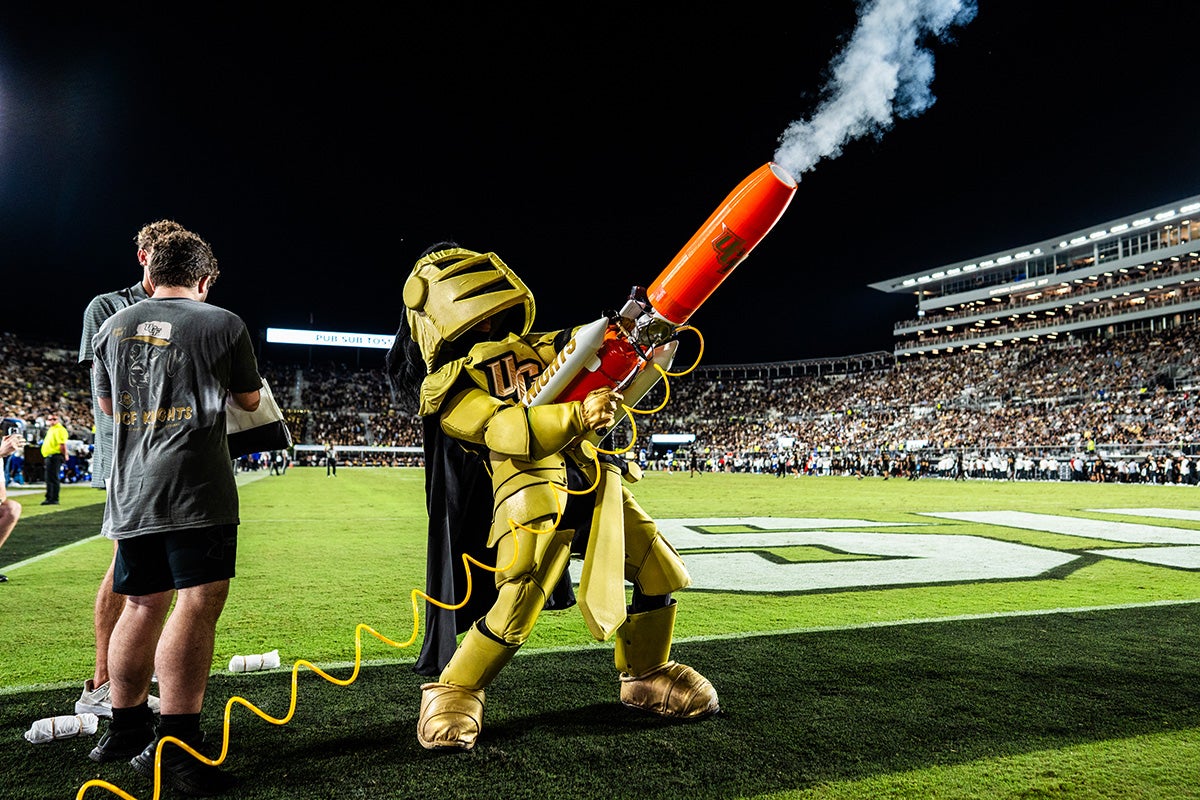
Over the next several months, both teams designed launchers capable of firing dozens of shirts into the stands during the brief 30-second window they’d have on the field between plays.
When the prototypes were ready, Carreras and Harkins brought them to the football stadium in the summer for a test run in front of UCF Athletics’ game day operations staff.
“I think [UCF Athletics] had some hesitations, which I understand because they didn’t know who we were,” Alfieris says. “We were launching [T-shirts] all over the field — one even went out of the stadium — and [UCF Athletics staff] all looked at me and said, ‘Oh, we’re definitely doing this.’ ”
While the athletic department staff has worked hard to build and protect traditions that span generations of Knights fans, they always embrace trying new things.
“I think some of UCF’s best qualities have always been a spirit of collaboration and an attitude of, ‘what if we try…?’ Pete and the engineering students embody that completely,” says Alex Cesarano, associate athletics director for brand experience. “What they’ve delivered over the last few years is a testament to what’s possible when we have a strong partnership between the university and athletic department. We are immensely grateful for all they’ve added, and continue to add, in service of our fans and student-athletes’ experiences.”
Beyond practicality, the teams took design aesthetic into account.
Harkins’ launcher resembles a rocket, a nod to UCF’s SpaceU identity. Carreras’ team chose a double-barreled design that maximizes the number of shirts they could launch before leaving the field.
“I never went to a football game until I had to launch this thing,” Carreras says. “But seeing it out there on game day and seeing the excitement from everyone, it’s great to leave something behind, especially when it’s a place that you’ve gotten education from, and you’ve found your friends and a life around the campus.”
Knightro’s Wheels
Once word spread that Alfieris and the engineering students were behind the T-shirt launchers, the UCF spirit team wanted in.
Knightro head coach Michael Callahan ’05 ’09MBA ’17EdD, who also serves as director of knowledge management for UCF’s College of Medicine, invited Alfieris to tour the Kenneth G. Dixon Athletics Village and discuss future collaborations.
As they drove around in a standard golf cart with Knightro on board, Alfieris couldn’t help but notice the mascot clinging to the seat.
“Knightro was holding on for dear life, and I looked at Michael and said, ‘How come Knightro doesn’t have his own cart?’ ” Alfieris says. “He looked at me and said, ‘Good question.’ ”
Without a dedicated budget or funding, Alfieris has gotten good at being resourceful. He scoured the university’s surplus property system database, which offers discounted equipment and items in need of repair. One person’s trash is another’s treasure.
He found a cart in serious need of electrical work to run again. He turned to the Knights Racing student organization looking for some talent.
Josh Alper, then a first-year mechanical engineering student, answered without knowing a single detail about what he was showing up for.
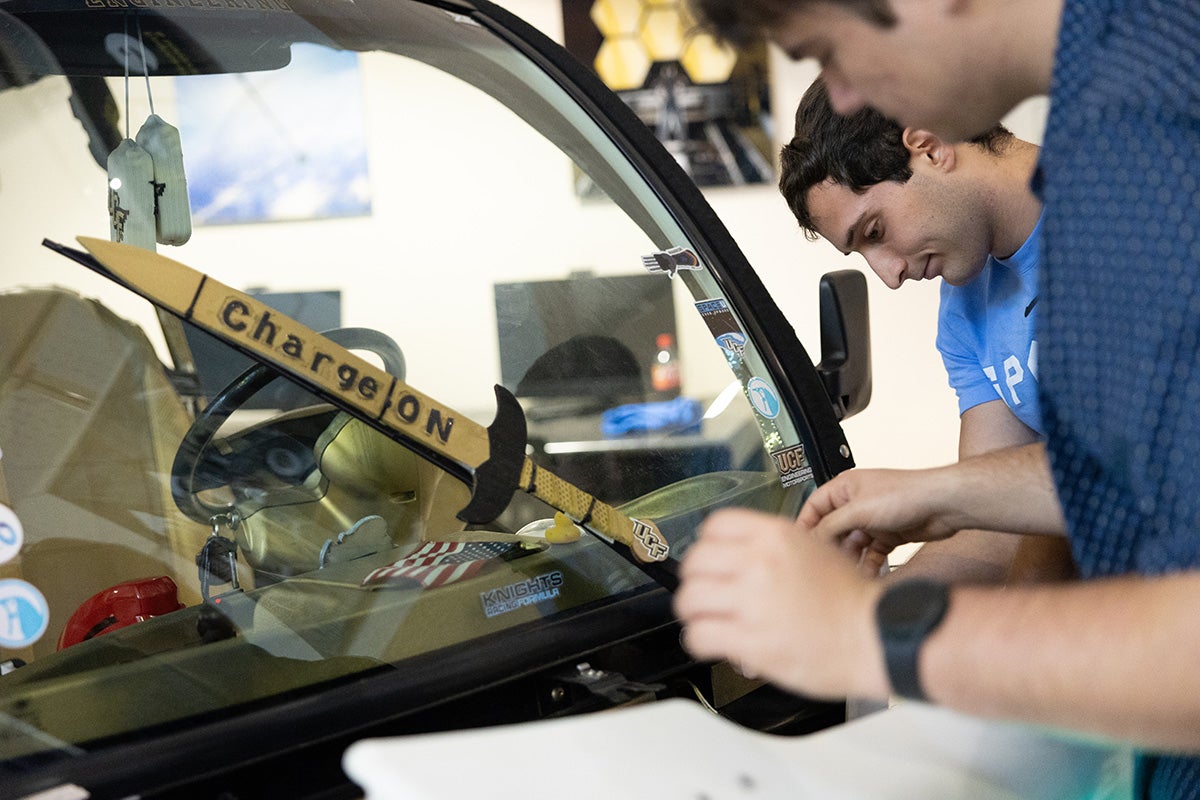
Alper, who is primarily self-taught, rewired the cart’s electrical system and fixed the battery charger. He installed LED lighting, four surround-sound speakers and a custom “Bounce Button” horn to the tune of Zombie Nation’s Kernkraft 400. He even rigged a “Knightro phone” that pauses the music for Team Knightro to interact with fans while tailgating. When the phone is placed back on the receiver, the music immediately resumes at maximum vibe levels.
“I was a new student who basically knew nothing about the school, and in my first few weeks, Pete was touring me around and introducing me to lab managers and faculty,” Alper says. “I was able to use 3D printers and tools in the TI (Texas Instruments Innovation) Lab. I’ve gone to football games and shot the T-shirt cannon, which was a really cool experience for my first football season. Working with Pete has opened so many doors.”
Here Comes Citronaut
Alfieris’ next big idea was a robot. Mechanical engineering student Andrew Anderson thought Citronaut seemed like a logical choice.
Anderson, who has completed professional internships with Pegasus Partner Universal Orlando Resort and Walt Disney World Resort refurbishing high-profile rides, spent a year creating what the team affectionately refers to as “Citronaut’s Thunderstruck” — a 3D-printed Citronaut piloting a spaceship that rolls through campus blasting AC/DC’s hit song.
The project began as an oversized foam cube measuring roughly 5 feet on each side.
“Figuring out how to safely cut the foam and see it take that saucer shape, it felt like I was working at Disney,” says Anderson, who has dreamed of developing theme park rides since he was 9 years old.
The team equipped the spaceship with tilting and movement capabilities and an accelerometer to give it a sense of flight.
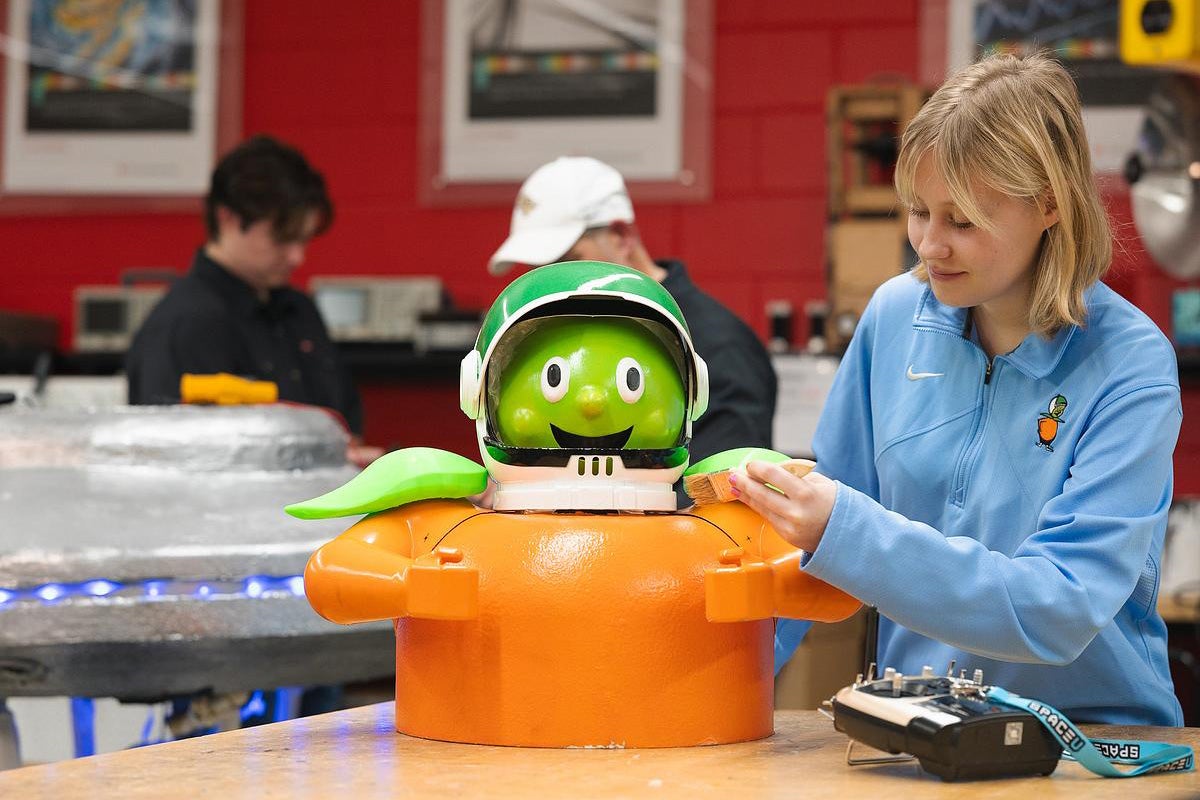
Meanwhile, computer science major Melanie Allen became Alfieris’ go-to team member for precision work. She designed, laser cut and 3D-printed the Citronaut figure to fit snuggly in his spaceship.
“I’ve taken advantage of our machine shop, our 3D printers, laser cutters [and] the 5-axis CNC machine to make aluminum parts. I didn’t think I would ever be good at painting, and now I know how to paint. So I think a lot of these experiences have given me skills that really make me stand out,” Allen says.
Citronaut’s Thunderstruck debuted at the 2025 Mission IX Space Game as part of the pregame march to the stadium and was an immediate hit.
“A lot of kids were really excited when they saw it, and fans wanted to take pictures with it. It was fun to be part of the march and know that I helped create something that looks cool and something that people want to interact with,” Allen says. “I didn’t feel like I was just another student commuting and taking classes. I felt like I was making a difference and actually contributing to the university.”
Coming Soon: Knightro’s Own ‘Bat’ Signal
One of Alfieris’ most theatrical, ambitious ideas yet is expected to debut this year thanks to Peters, Jordan and the other three engineers of their senior design project team.
Similar to Batman’s “bat signal,” the team designed a custom cylinder-shaped light projector capable of summoning Knightro into action to amp the crowd.
“We faced a lot of questions and doubt when we pitched this for senior design. Could the physics actually work out? Will [the light] actually project at that far of a distance?” Jordan says. “When you have a good team, anything is possible. And we believed we could make the impossible happen.”
The biggest hurdle came early.
The specialized lights required for the design cost $700, leaving Jordan unsure if the project would ever get off the ground.
A week later, his team got an email that the lights were in, purchased by the Department of Aerospace and Mechanical Engineering from the budget dedicated to supporting senior design projects.
“Pete worked his magic,” Peters says.
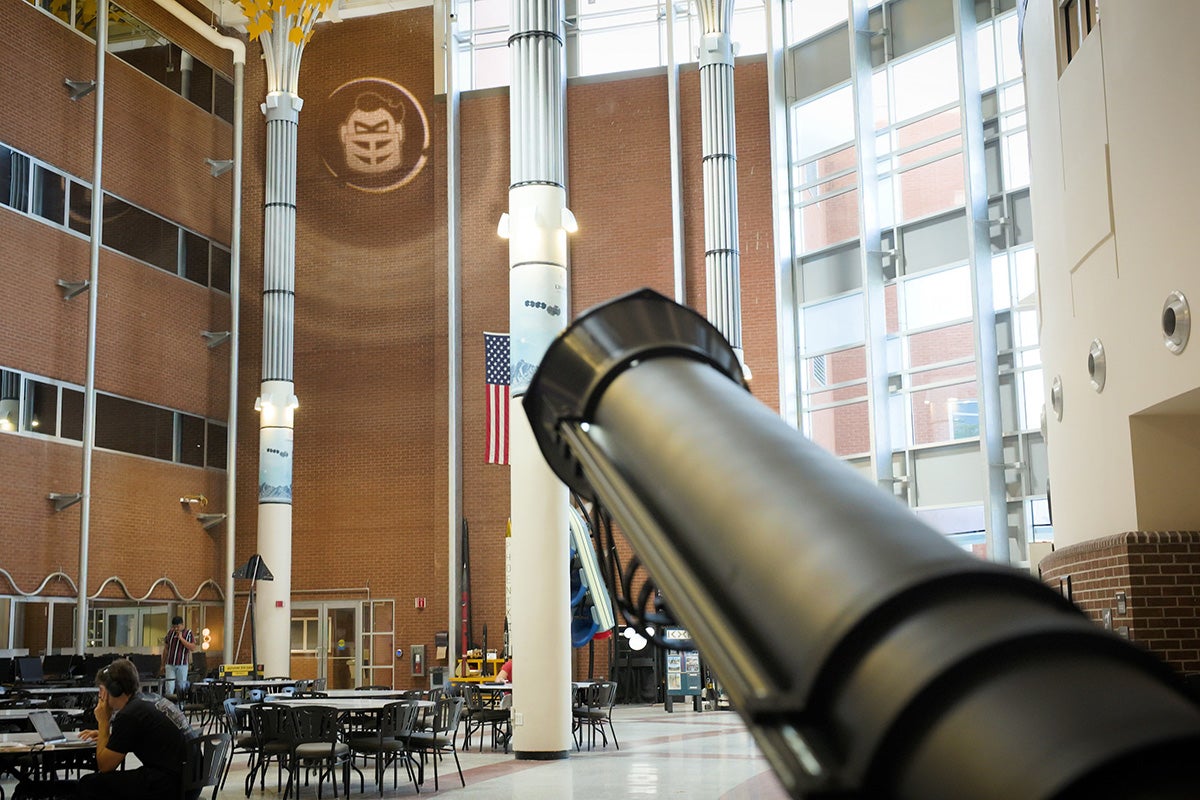
Engineering this from a concept drawing into an actual functioning contraption was no small feat.
The high-powered lights generated enough heat to require radiators and a water-cooling loop. The team also developed an innovative method to display the projected image by using a laser cutter to burn away the coating on mirror slides. And ensuring safety throughout their design, down to the emergency stop button, was paramount.
When their first successful test happened at 3 a.m. on the side of Engineering II, the first person they told was Alfieris.
“I remember walking up my apartment stairs that night thinking, I want this feeling for the rest of my life,” Peters says.
Funds and hours in a day are the only things holding back Alfieris and the students at this point. They have a few more ideas and projects in the works that they’re eager to share with Knight Nation when they’re ready.
Alfieris says he’s grateful to his supervisor, College of Engineering and Computer Science Associate Dean for Academic Affairs and NCAA faculty representative Manoj Chopra, for allowing him to engage with the students in these ventures. It’s been one of the greatest gifts of his career.
“All [the] stuff that I wanted to do is coming to life, and it’s so much fun,” Alfieris says. “I don’t have any kids, so they’re like my kids. I get that proud parent moment when they come to me and say, ‘Thank you.’ And I’m like, ‘What are you thanking me for?’ And they say, ‘You helped me. You were just always there.’ And it just makes me feel really good. It really does.”