Highlights
-
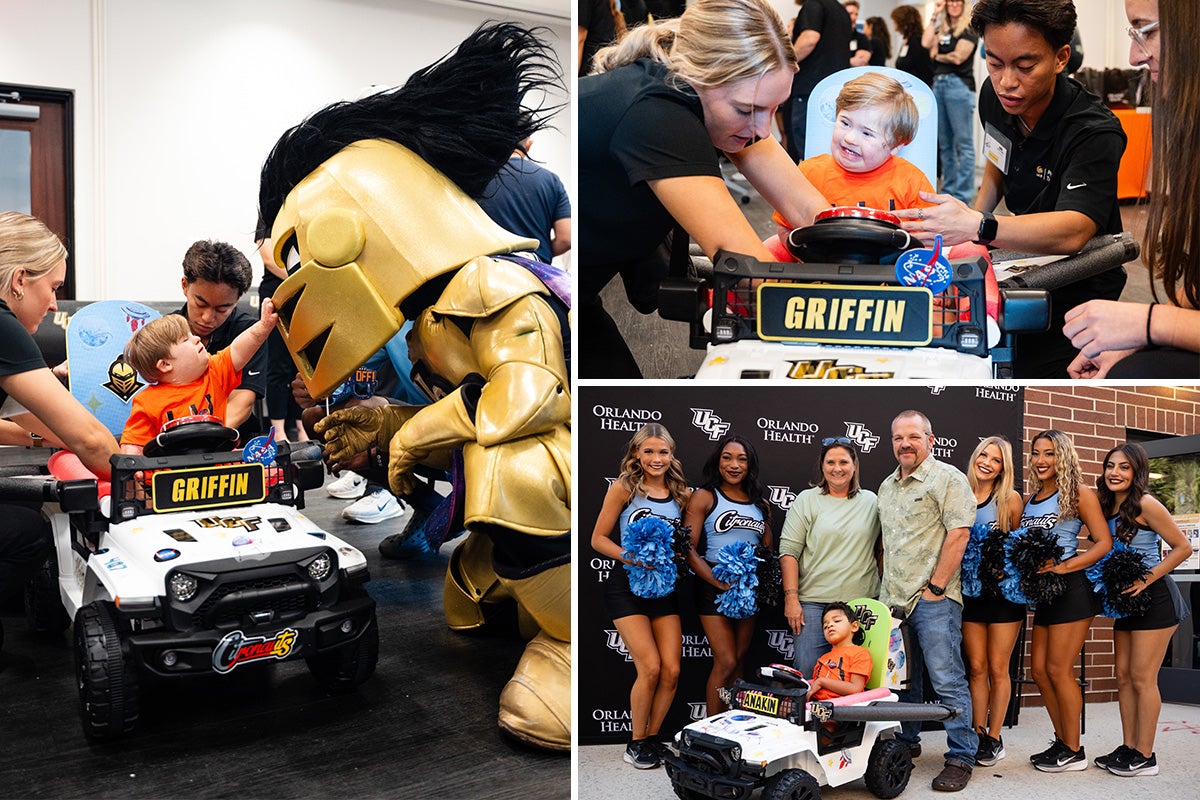
Ahead of the 10th anniversary of UCF’s Space Game, student-athletes, physical therapy doctoral students and Orlando Health professionals built 10 space-themed mobility cars for children with disabilities, showing how the university’s signature tradition creates meaningful impact far beyond football.
-
The customized “spaceships” featured NASA, SpaceU, Citronaut and UCF branding, connecting the excitement of Space Week and the Space Game to hands-on service that reflects UCF’s mission of advancing innovation, opportunity and community impact.
-
Through UCF’s Go Baby Go! program, families received free adaptive vehicles designed to help children gain independence and participate more fully in everyday play.
Rocket sightings are commonplace from UCF’s campus and Acrisure Bounce House, whose 50-yard-line is on the same latitude as NASA’s historical Launch Complex 39A. But for a crowd of dozens gathered on Monday on the concourse of the football stadium, this wasn’t a typical “launch.”
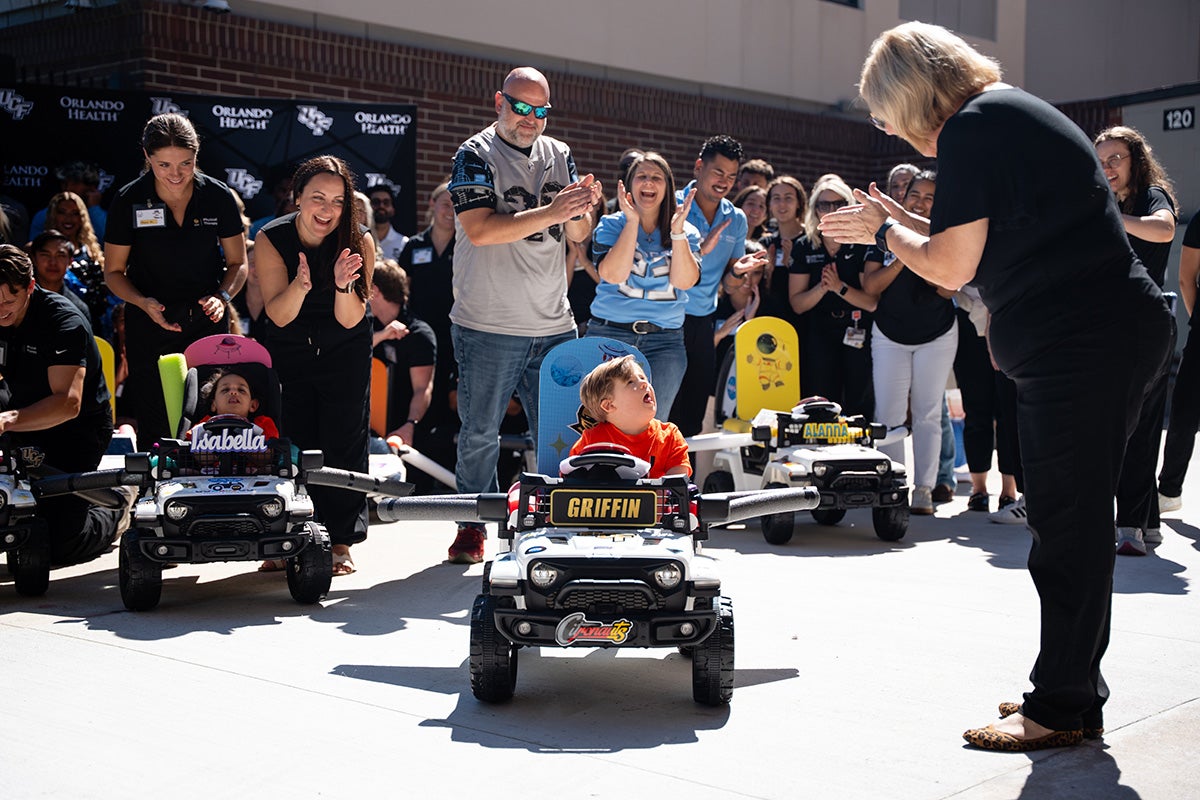
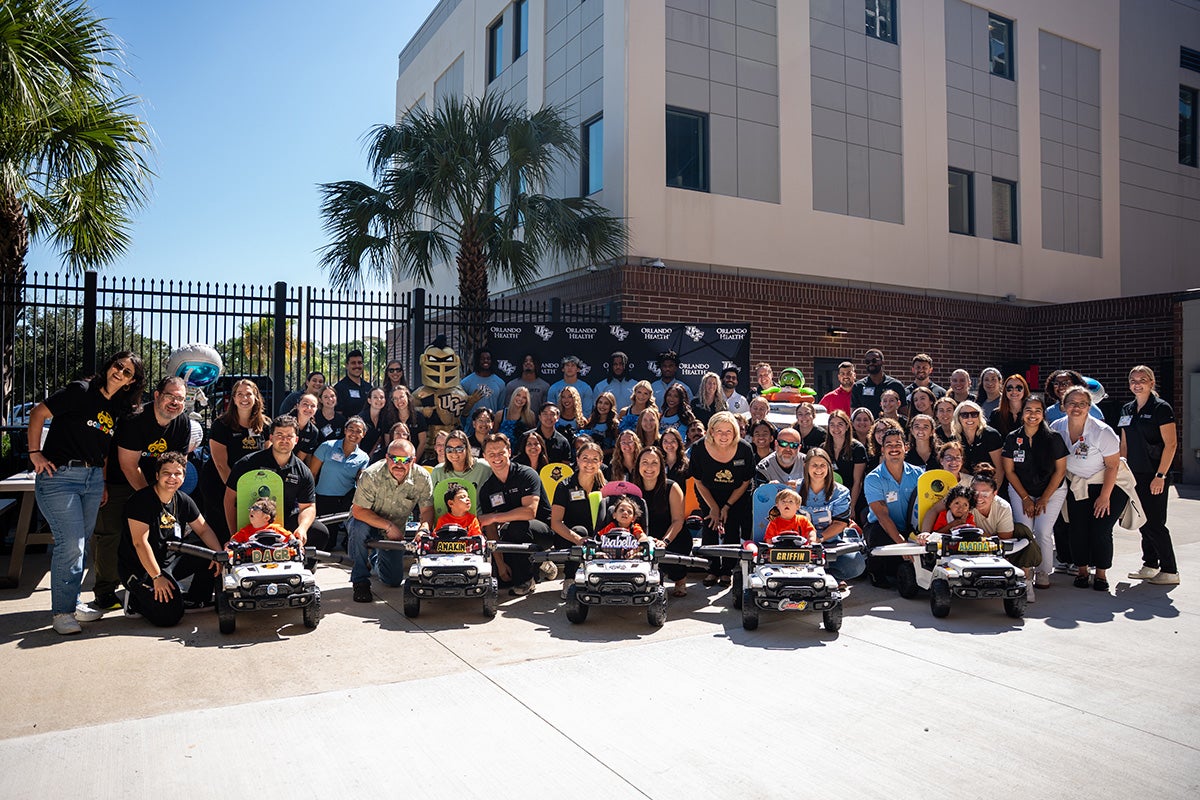
Five toddlers from Greater Orlando and the I4-Corridor were on site to receive space-themed motorized cars built especially for them by UCF student-athletes, physical therapy doctoral candidates from UCF’s Go Baby Go! program, and healthcare professionals from Orlando Health Jewett Orthopedic Institute.
A national, community-based research, design and outreach program, Go Baby Go! provides accessible and inexpensive solutions for kids and adults with limited mobility at no cost to their families.
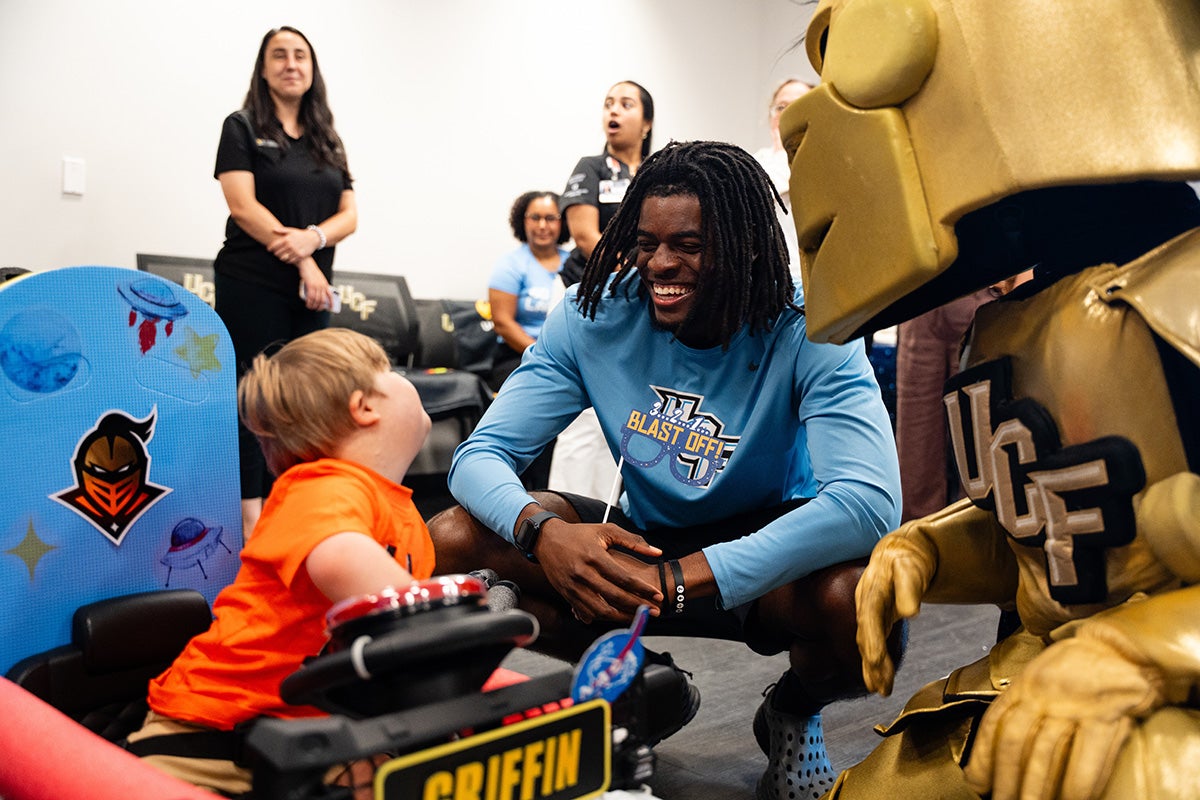
Nicholas Antoine ’25, a senior defensive back on the football team from Daytona Beach, Florida, who graduated last December with a bachelor’s degree in kinesiology, jokes his construction skills need some improvement, but he was thrilled nonetheless to be an active part of the collaboration that made an impact for the families.
“Being able to bring joy to somebody else, there’s no greater joy than that,” Antoine says.
A total of 10 cars were built ahead of the 10th anniversary of the UCF football team’s Space Game, an annual event that celebrates UCF’s reputation as America’s Space University.
The Space Game presented by Orlando Health Jewett Orthopedic Institute is now one of the signature events of a larger Space Week held at the university, which launches Oct. 25. The football team will take on Baylor University on Friday, Oct. 30, at 7:30 p.m. on ESPN.
Monday’s build is yet another example of how the beloved tradition’s impact has spread beyond an annual football game. It continues to illustrate UCF’s integral role as a driver of impact for Central Florida, whether in the space industry, health sector or beyond.
“When we look at the Space Game, we’re excited to be in that same space to walk alongside these athletes and create an opportunity that celebrates all the things that we do here at UCF,” says UCF Clinical Associate Professor of Physical Therapy Jennifer Tucker ’23PhD.
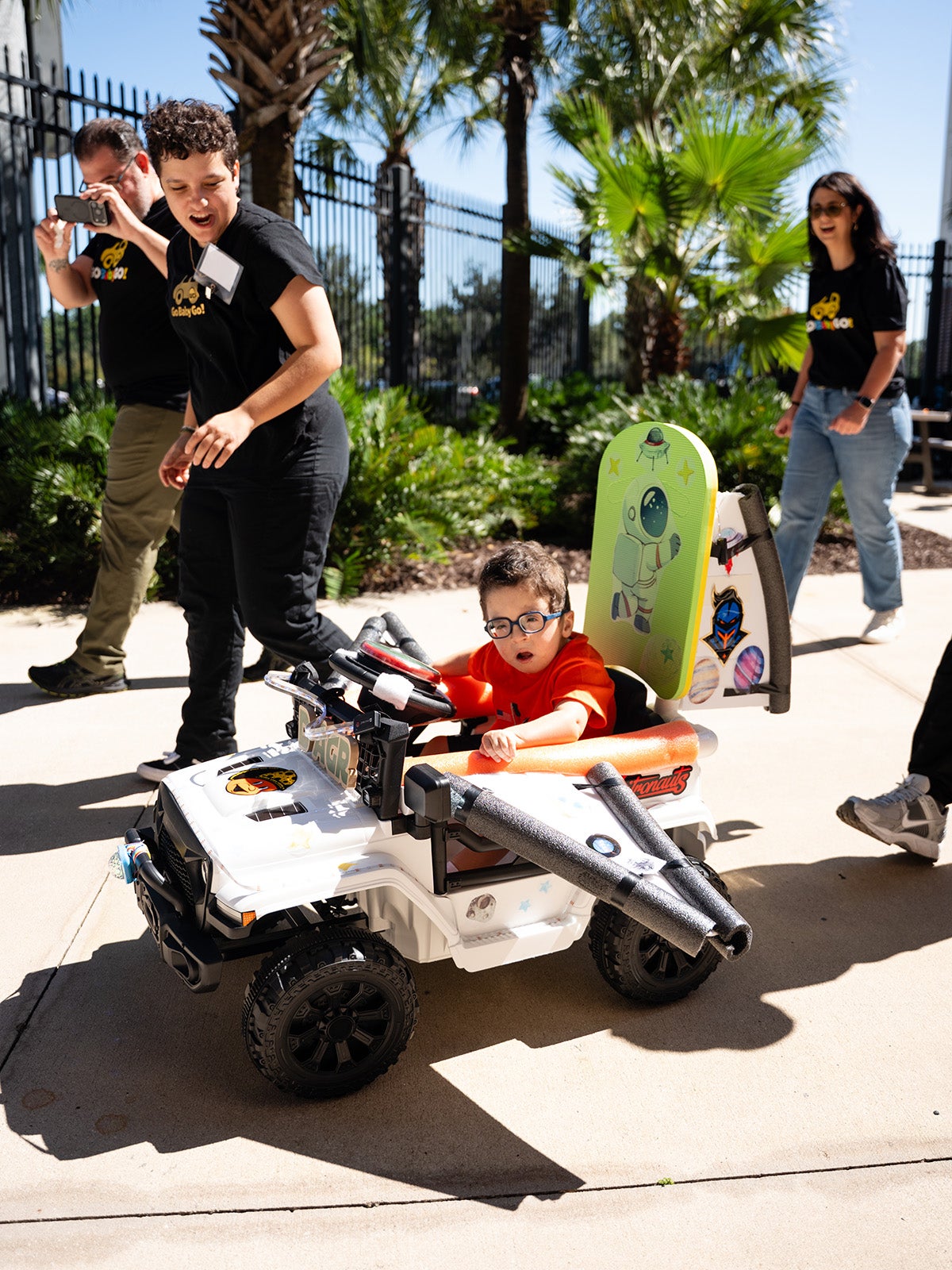
The Magic of Go Baby Go!
Tucker started UCF’s chapter of Go Baby Go! in 2015 and has led an average of 10 to 15 workshops annually — just like the one held Monday in Athletics Village — to benefit children between the ages of 6 months and 5 years old with mobility issues stemming from Down syndrome, muscular dystrophy, cerebral palsy and osteogenesis, among others.
Over the last decade, UCF’s Go Baby Go! has built up such a reputation that prospective students talk about it in their interviews as they look to gain acceptance into the doctoral physical therapy program.
It’s gone international, too, with partnerships in Belgium and Wales. It has welcomed students from the College of Engineering and Computer Science, College of Sciences and College of Medicine all interested in contributing their talents.
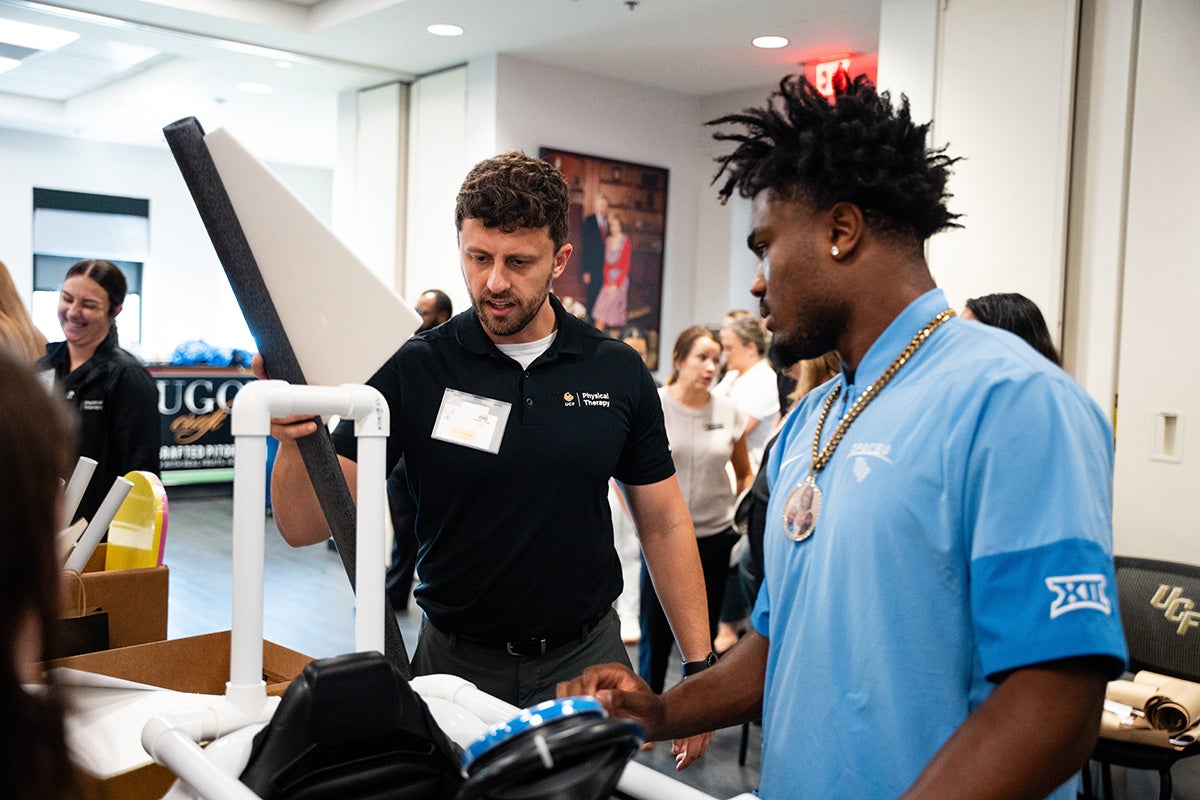
UCF’s students are a key component that keeps the engine running. Philanthropy is another.
Orlando Health, a UCF Pegasus Partner and a premier sponsor for UCF Athletics, has been one of Go Baby Go!’s biggest supporters since its inception as part of its mission to advance education, research, workforce development and community impact across Central Florida. It’s often personal for the clinical teams at Orlando Health who participate in these builds, since many of the recipients are longtime patients.
“It’s exciting to work alongside our partners UCF Athletics and UCF Go Baby Go! to help create this special event for these families,” says Sara Osborne ’14 ’17MHA, Orlando Health senior director of community benefit. “Go Baby Go’s mission aligns with Orlando Health as we look for ways to support our communities beyond the clinical care we provide every day. We’re proud to help play a part in making increased mobility and independence possible for these kids.”
Kid-Sized Astronauts Ready for Warp Speed
Sean Calamigan ’23 kneels next to 2-year-old Griffin Bordner, who had just plopped happily into his custom-fitted “space ship” and was already testing the sound level on his “go for launch” horn.
The third-year physical therapy doctoral candidate playfully warns the toddler of speed limits inside the Wayne Densch Center for Student-Athlete Leadership.
Griffin’s parents look on with mile-wide smiles. His father hails from a family of Knights who have been football season ticket holders since the 1990s. His mother, Jennifer Bordner ’15MEd, graduated with a master’s in exceptional student education.
They were referred by their son’s care team to apply to UCF’s Go Baby Go program! and underwent their first consultation in May. As Griffin test drove along the concourse of Acrisure Bounce House on Monday, Jennifer was already envisioning her son in their neighborhood’s cul-de-sac, spinning his wheels alongside his older sister.
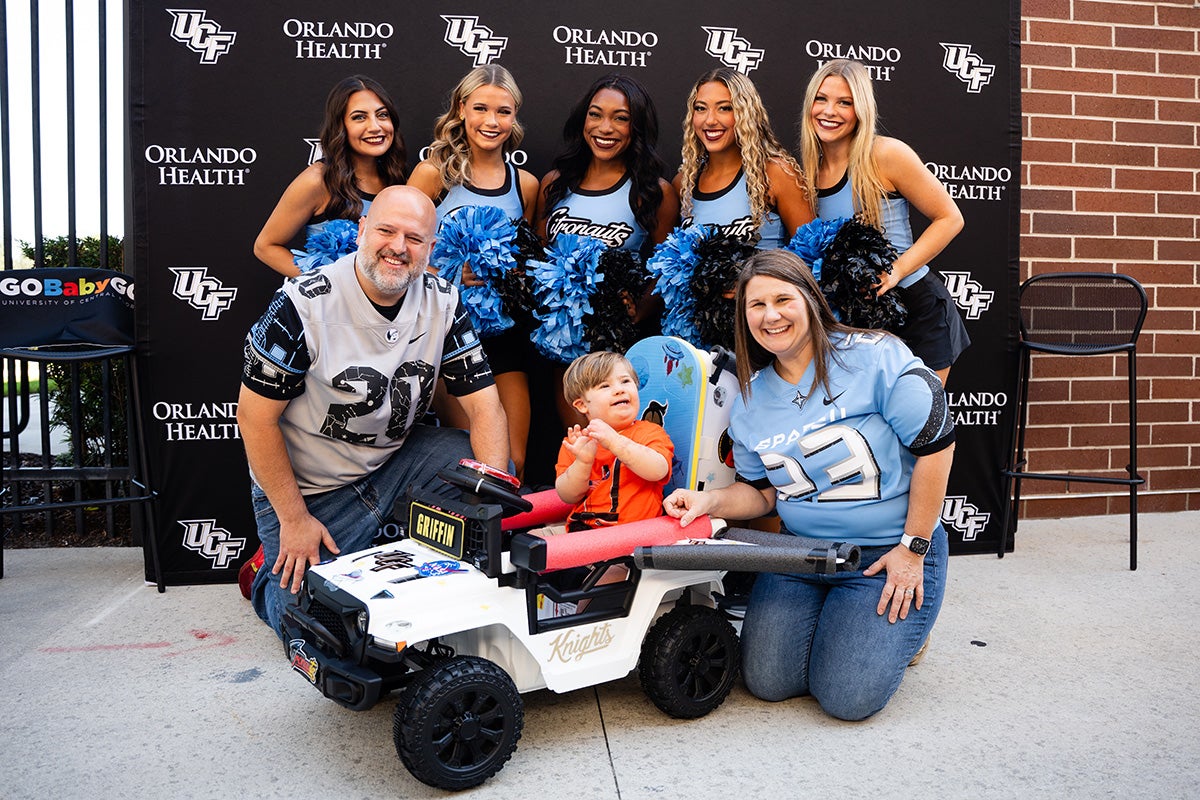
“Griffin is a happy, joyous little boy. There is nothing that slows him down — he just goes, goes, goes, but he’s normally in a stroller while his sister is on her bike or scooter. This opportunity is so exciting for him to be included in that fun,” she says. “It just gives me chills knowing that there are that many people in the community and organizations who donate the cars to allow kids with mobility issues the opportunity to be included in their communities, just to get out and play and have fun.”
UCF faculty and physical therapy students took meticulous steps ahead of the build day to ensure the vehicles would have everything they needed to launch smoothly. Each child was individually assessed to determine communication, seating and positioning needs for his or her set of wheels, and a team of volunteers assisted with a workshop to pre-wire the cars and pack kits with the necessary tools and supplies.
Faculty from the School of Communications and Sciences Disorders made the experience extra special for the recipients by innovating a switch-activated plush toy rocket that lights up they could take home as a memento along with their car.
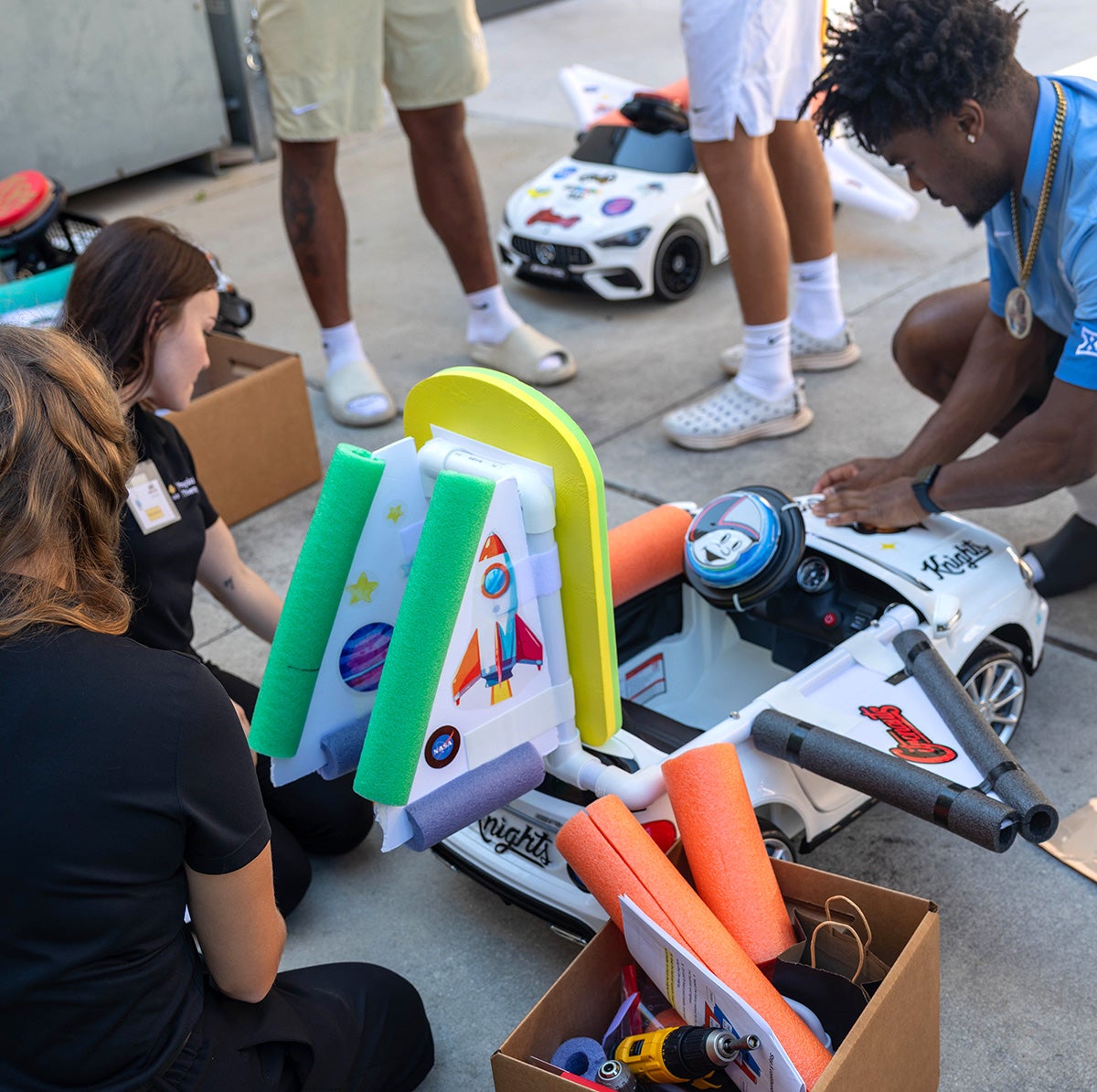
Calamigan, who spent his entire morning working at the event despite a final exam on his calendar at 1 p.m., says nothing compares to the practical, hands-on experience and witnessing the families’ reactions and delight to cars they worked on so diligently.
“I think the UCF DPT program really prepares us for a lot of things, but one of the main things they do for us is make sure we’re ready to face the real world, and this is the real world,” Calamigan says.
And it’s a real world that, at the end of the day, Tucker aims to make feel a little more connected.
“We’re providing an opportunity for play, and play is a universal shared rite of passage of childhood. But we’re also building community,” Tucker says. “My hope is that the impact of today extends far outside of this moment in time, and it helps us build a better community and a better tomorrow for Central Florida.”