
Key Takeaways
- Autonomous vehicles are gradually becoming more common, with advanced driver-assist and semi-autonomous features expected on over 30% of new vehicles by 2035.
- Self-driving technology has the potential to reduce accidents, improve traffic flow and make roads safer for all users.
- AVs could increase mobility for people who cannot drive due to age, disability or other limitations.
- Cities and urban spaces may be redesigned as less parking is needed, opening room for green spaces, shops and housing.
- The adoption of autonomous vehicles will likely be gradual, starting with fleets and semi-autonomous consumer cars, and will depend on safety, regulation, affordability and public trust.
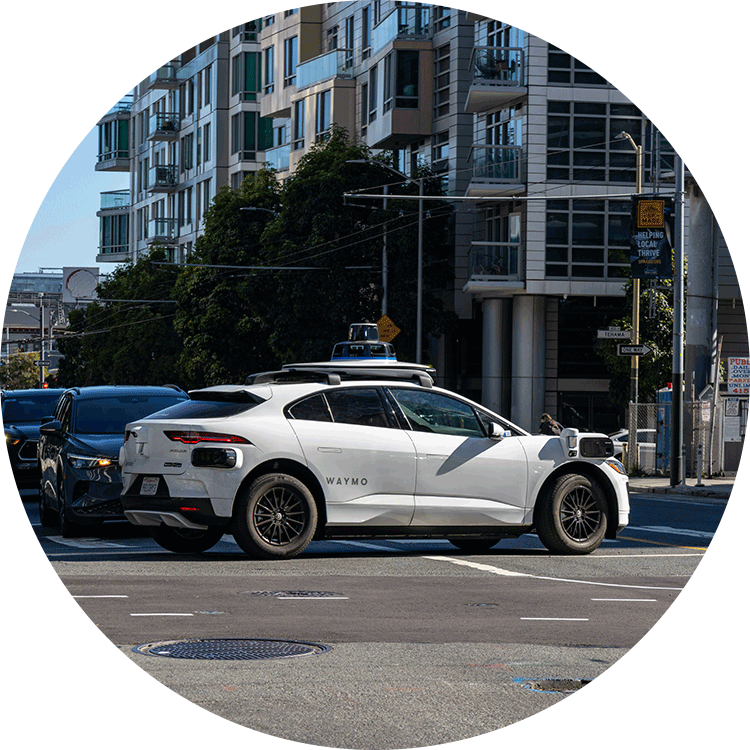
What Are Autonomous Vehicles?
An autonomous vehicle can sense its surroundings and adjust speed or direction without constant help from a driver. People often refer to these as self-driving cars.
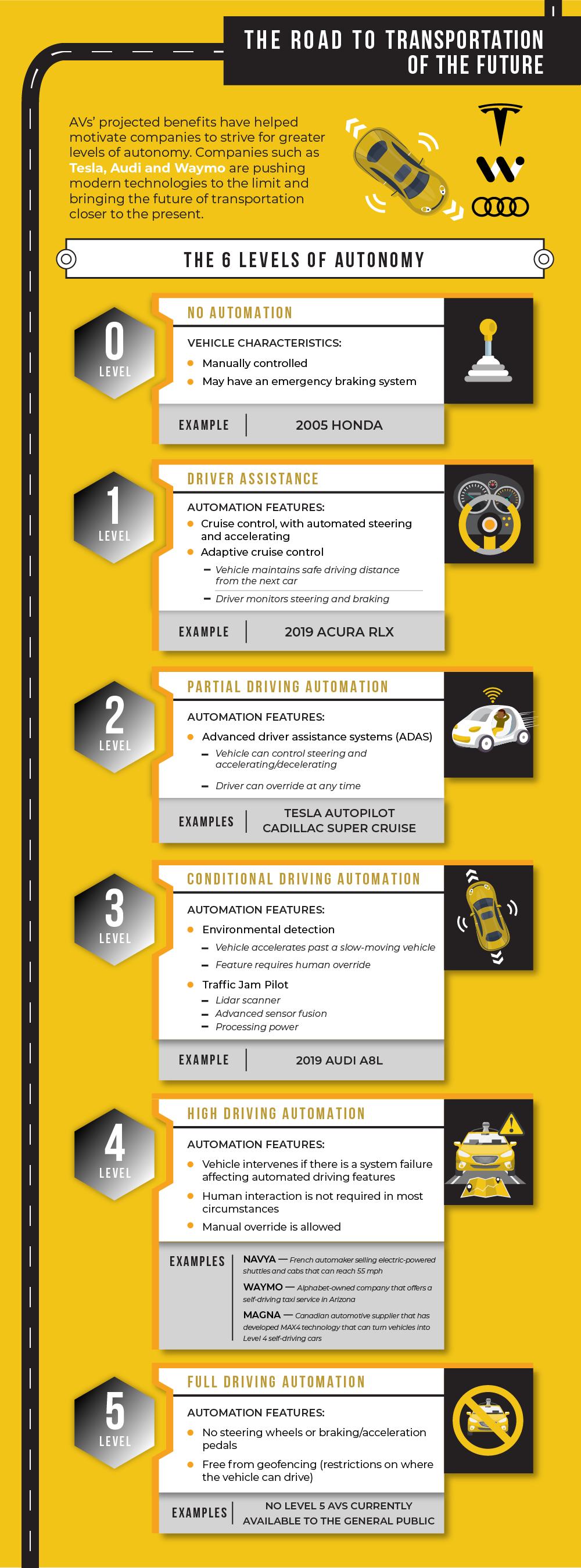
The Society of Automotive Engineers (SAE) defines six levels of automation:
- Level 0: No automation; the driver does everything
- Level 1: Driver assistance, like lane-keeping or cruise control
- Level 2: Partial automation under driver supervision
- Level 3: Conditional automation; the car can drive itself buy may need human assistance
- Level 4: High automation in specific areas, like certain city zones
- Level 5: Full automation; the car drives itself in all conditions
Today, most cars on the road are Level 2. Level 4 is used in commercial fleets, and Level 5 is still a long-term goal.
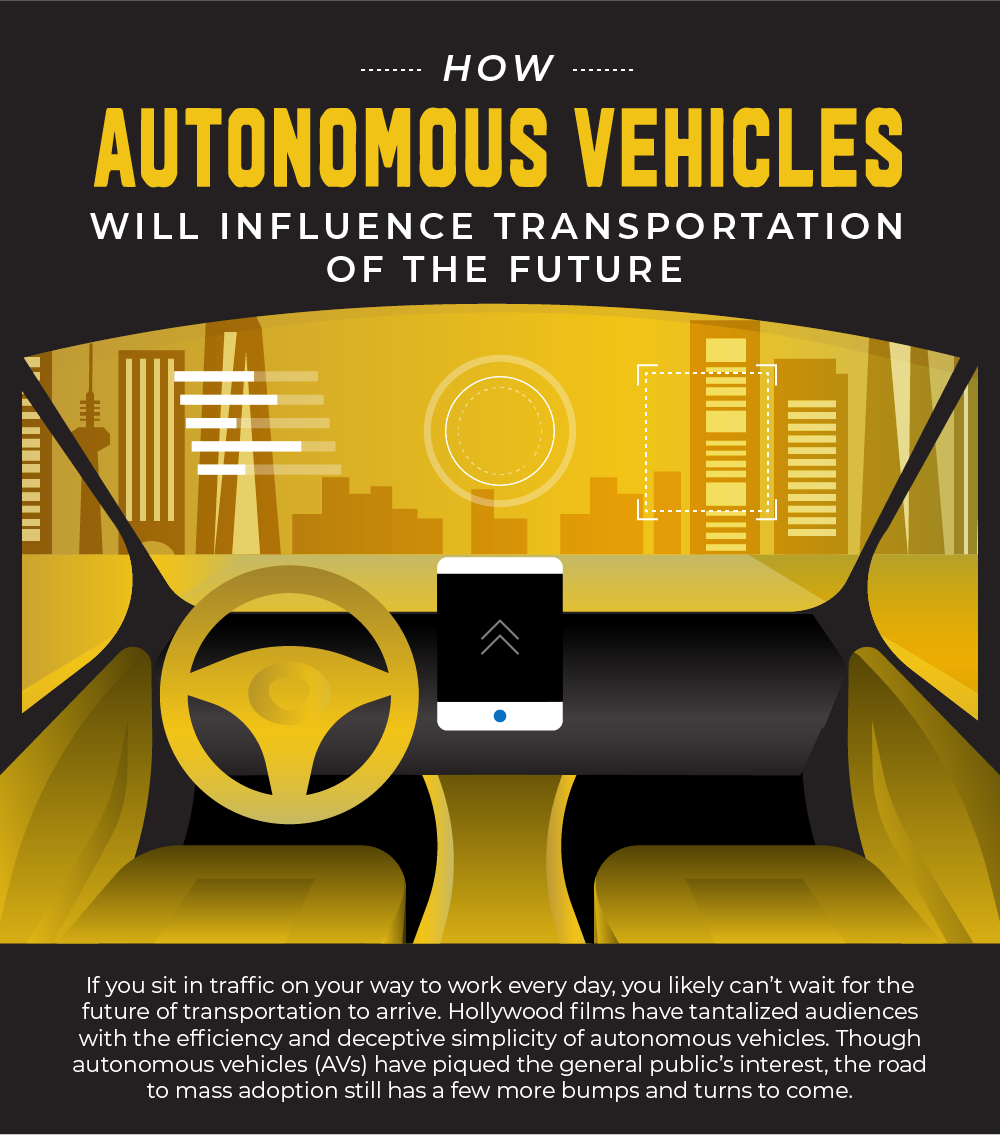
To learn more, check out the infographic below, created by UCF’s Engineering department.
How Do Autonomous Vehicles Work?
AVs use sensors, AI and automated controls to drive safely:
- Sensors: Cameras, radar and LIDAR (Light Detection and Ranging) detect lanes, obstacles and other vehicles.
- Processing: AI software analyzes the data and predicts how objects around the car will move.
- Actuators: The car automatically brakes, steers, and accelerates as needed.
Machine learning helps AVs get smarter over time. They can learn from miles of driving data and improve safety and efficiency.
What Are the Benefits of Self-Driving Cars?
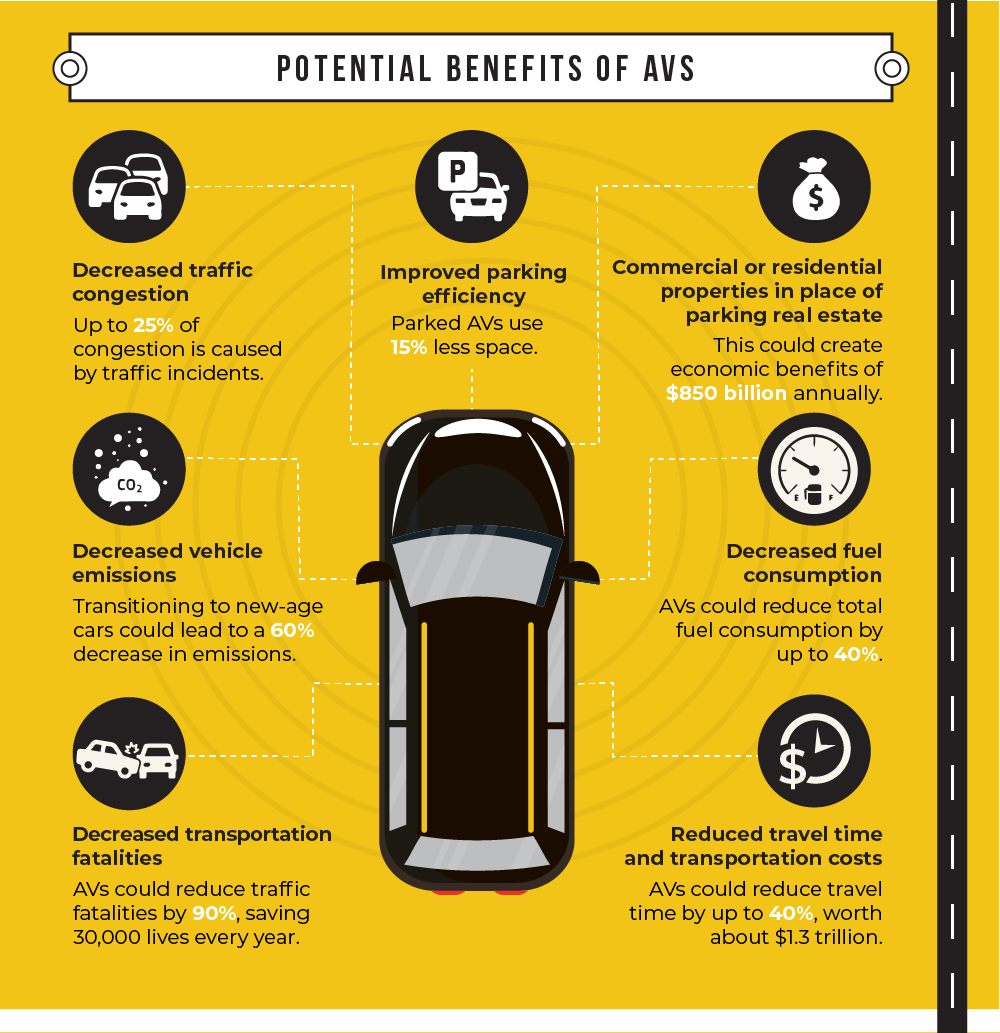
AVs offer many advantages for drivers, cities and the environment, including:
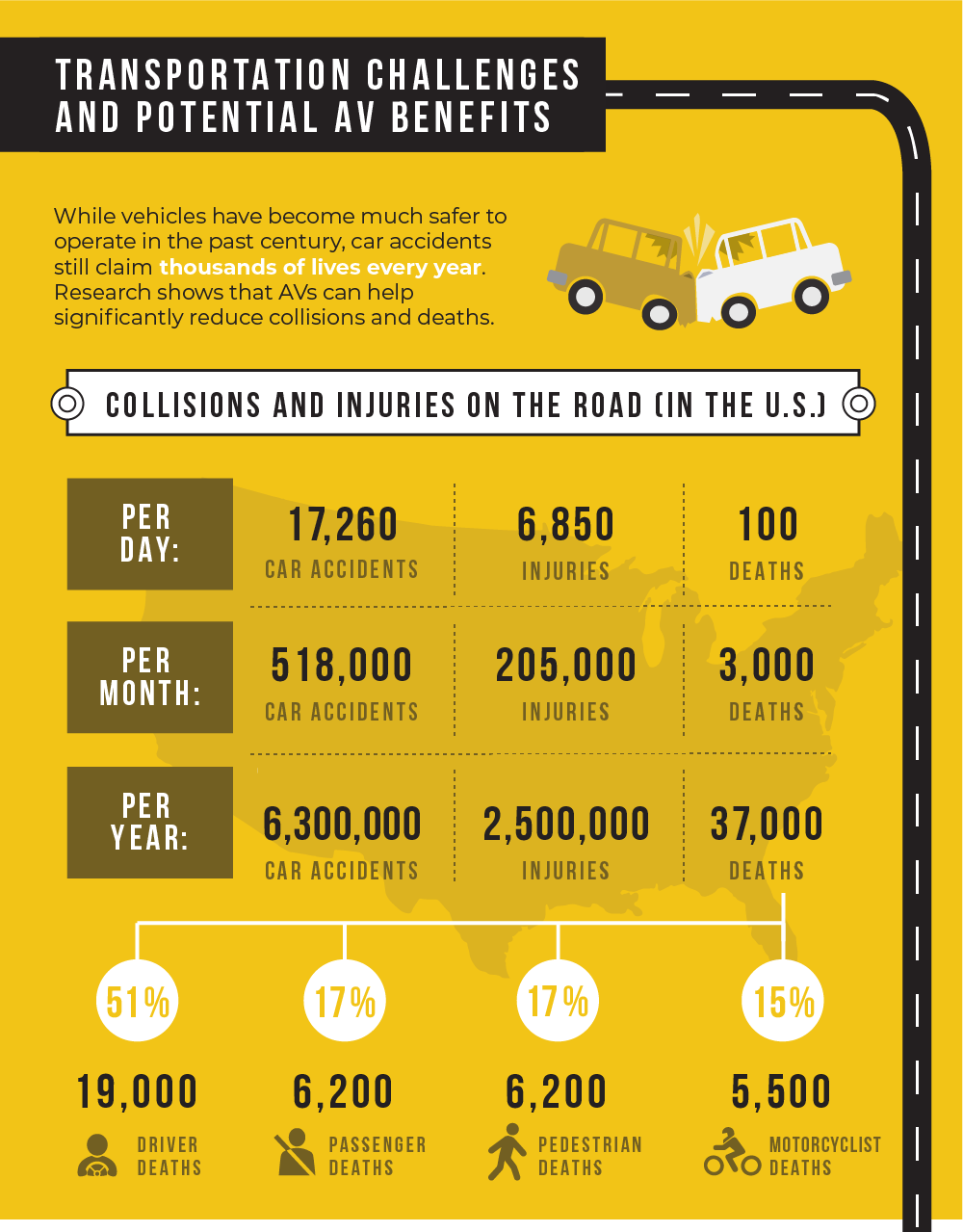
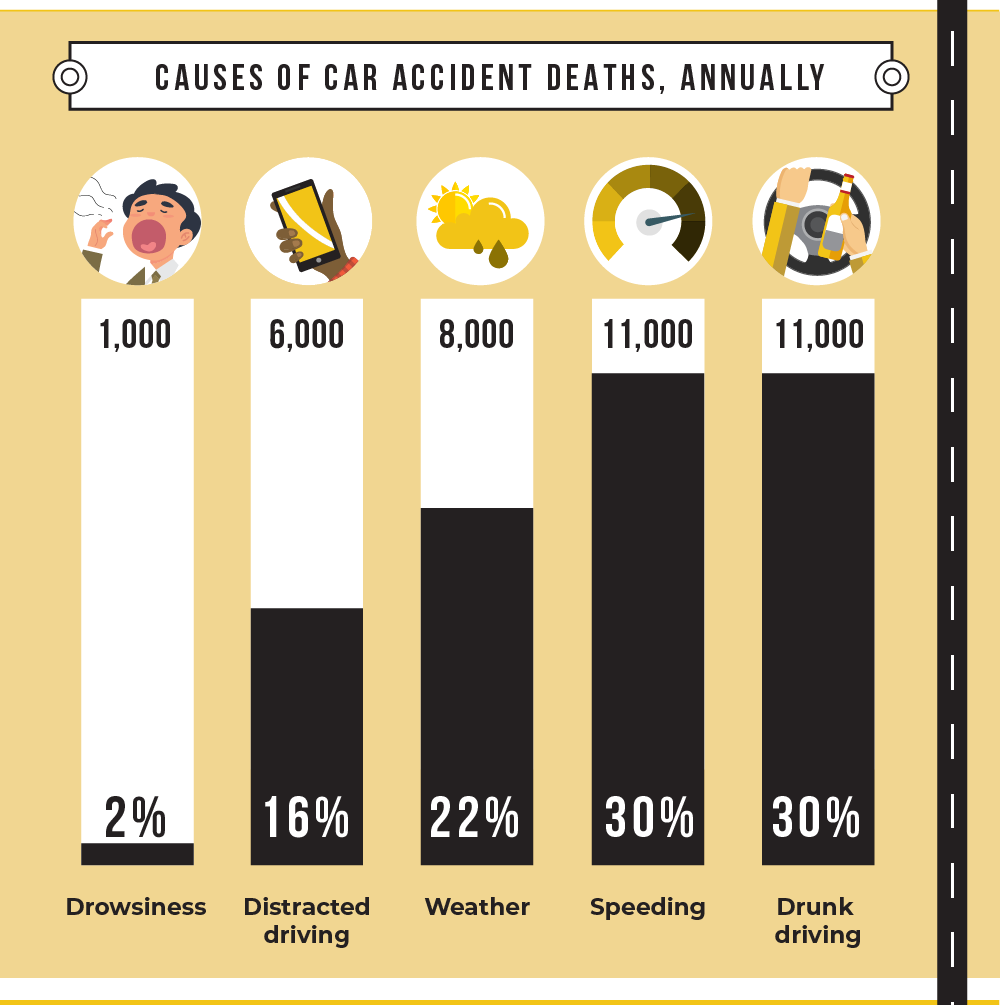
- Safety: In the U.S., there are over 6 million passenger car accidents annually, resulting in approximately 40,901 deaths in 2023, according to Injury Facts. Autonomous vehicles could help reduce these numbers by eliminating human errors, distractions and risky driving behaviors.
- Efficiency: Smart routing can reduce traffic and travel time.
- Accessibility: Elderly or disabled people can travel independently.
- Environmental Impact: Better traffic flow and smoother driving can lower emissions by up to 34%.
- Economic Opportunities: AVs are transforming ride-hailing, delivery and fleet operations.
Services like Waymo already complete over 150,000 paid trips per week, according to Forbes. Highlighting how widely AVs are working in real-world conditions.
What Are the Challenges of Widespread Use of Self-Driving Cars?
Even with advances, AVs face the following obstacles:
- Cost: Fully self-driving cars are expensive, though prices are expected to drop. By 2030, the cost of autonomous systems could fall to $50,000-$85,000, and by 2035, it may decrease further, potentially under $3,000, according to analysts from the Intelligent Transportation Systems Joint Program Office. As prices decline, AVs will become more accessible for individual owners and fleets alike.
- Safety and Ethics: Cars must make split-second decisions, raising questions about who gets protected in accidents. Developers are working on AI systems that can predict and react to complex traffic scenarios, but programming ethical decision-making is challenging, particularly in unavoidable accident scenarios.
- Regulations: Laws on AVs are still being developed, and regulations vary by region. Governments must address liability, insurance and safety standards, which can slow deployment, but these frameworks are essential to building public trust and encouraging widespread adoption.
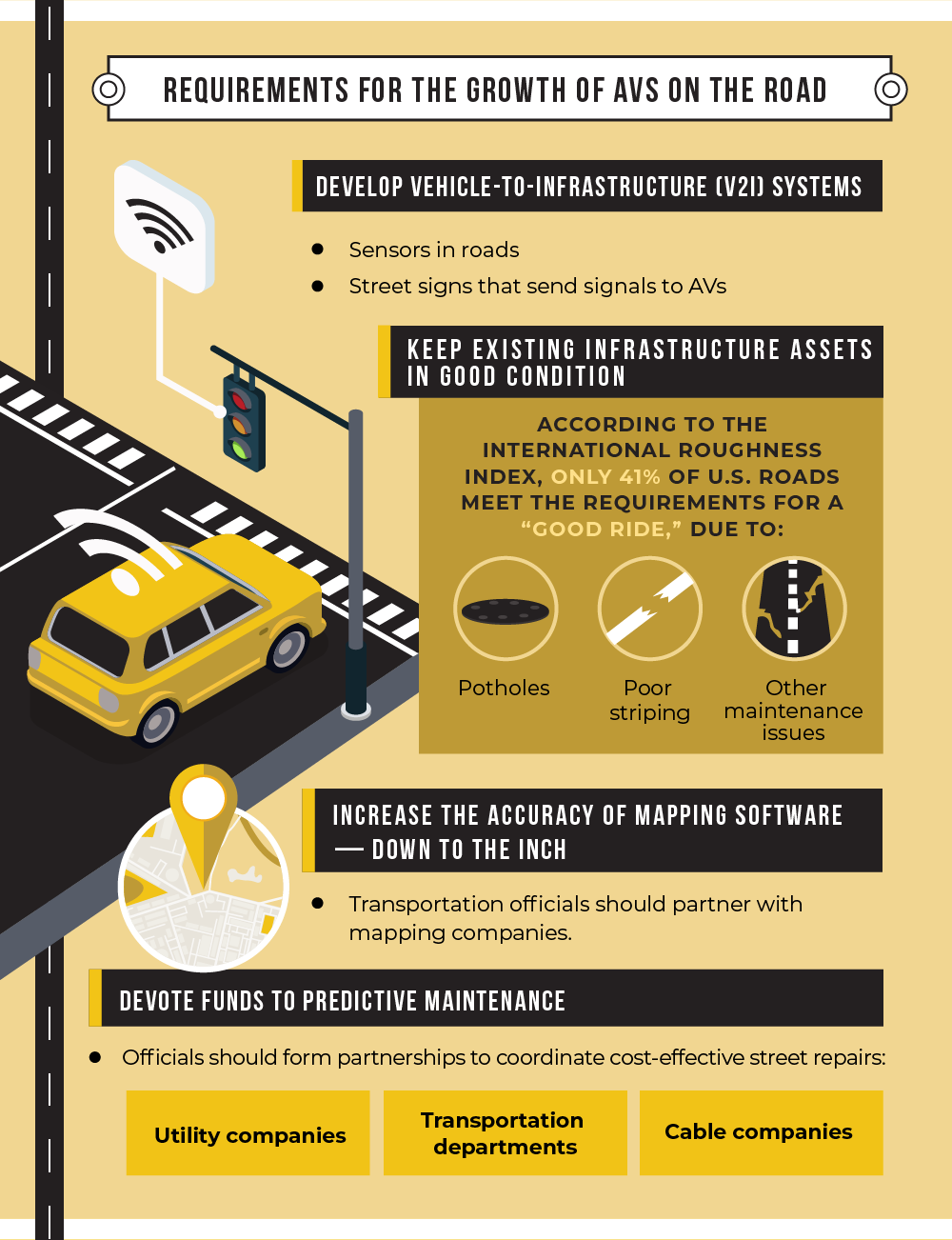
- Weather Issues: Snow, rain, fog and poor visibility can affect sensors and AI decision-making. Manufacturers are working on systems that combine multiple sensor types, advanced mapping and predictive algorithms to maintain performance in less-than-ideal conditions.
- Trust: Accidents involving self-driving cars have made some people cautious about the technology. Public education, transparent reporting on safety data and incremental deployment in controlled environments can help build confidence over time.
These challenges mean full autonomy will likely first appear in fleets and commercial vehicles.
How Are Autonomous Vehicles Used Today?
Autonomous vehicles are already being put to use in several areas. Ride-hailing and robo-taxi services operate in specific city zones, providing safe and efficient transportation without a human driver.
Delivery and logistics applications use self-driving trucks and vans to move goods between distribution centers and retail locations. Meanwhile, consumer cars increasingly feature semi-autonomous systems that assist with driving tasks on highways or in traffic.
By focusing on practical applications rather than full automation, people can take advantage of AV technology today, even as fully self-driving cars remain in development.
What To Expect in 2030 and Beyond
By 2030, more cars will come equipped with advanced driver-assist and semi-autonomous features. Analysts predict that a growing number of new vehicles could operate at Level 3 or higher, where cars can drive themselves under certain conditions. New vehicles sold globally with Level 2+ and Level 3 systems are expected to reach at least 31% by 2035, according to an S&P Global forecast.
By 2035, these systems may become even more affordable, allowing more people to access self-driving technology. Over time, fully autonomous cars could be used in city centers, on highways and in commercial fleets, making transportation safer, faster and more efficient.
How Can Autonomous Vehicles Transform Society?
Autonomous vehicles have the potential to change how we live, work and move around. With fewer accidents and better traffic flow, roads could become safer and less congested. Cities might need less parking space, opening up room for parks, shops or homes. People who can’t drive due to age or disability could gain more independence with self-driving taxis and shuttles. AVs could also make deliveries faster and reduce emissions from idling cars. Overall, self-driving technology could make daily life more convenient, safer and better for the environment.
Discover Robotics and Autonomous Systems at UCF
UCF’s Master of Science in Robotics and Autonomous Systems prepares students to shape the future of intelligent technology. This program combines engineering, computer science and machine learning to explore how robots and autonomous systems interact with the world around them. Students work alongside faculty researchers, gaining hands-on experience through projects that mirror real-world applications. Graduates leave with a strong foundation, ready to excel in today’s most in-demand fields, shaping the future of automation.
Explore UCF’s Robotics and Autonomous Systems Program
Career Opportunities With Autonomous Vehicles
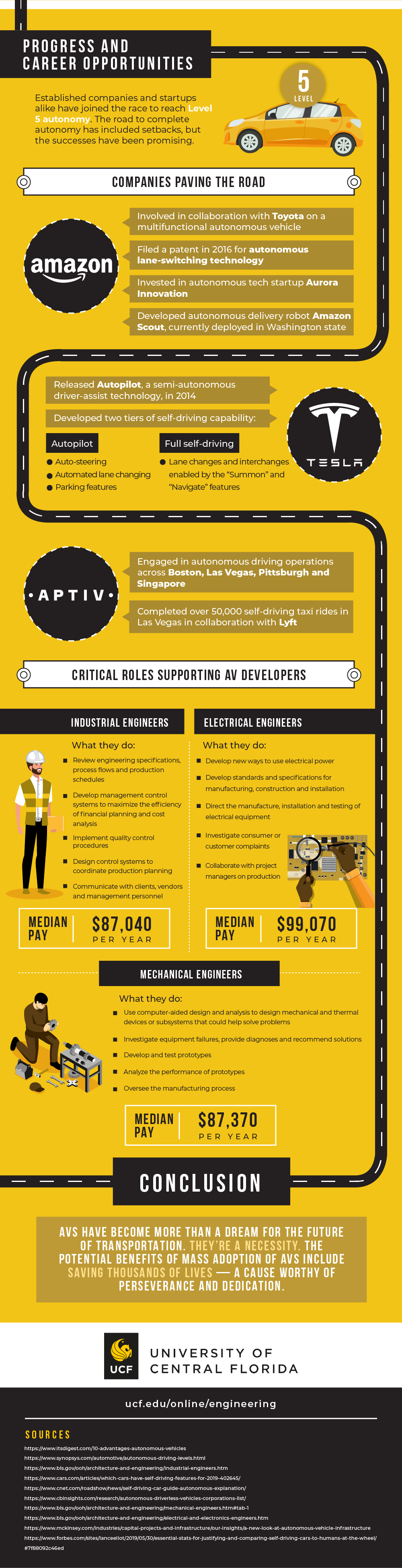
The growth of autonomous vehicles is creating in-demand roles for engineers and tech specialists. Whether you’re interested in developing the technology behind the cars or managing the systems that make them work, several key roles are shaping the industry:
- Industrial Engineer: Reviews specifications, coordinates production planning and ensures quality control.
Median Salary: $101,140 - Electrical Engineer: Develops vehicle electronics, directs testing and installation and collaborates with project managers.
Median Salary: $111,910 - Mechanical Engineer: Designs and tests prototypes and subsystems, and oversees manufacturing processes.
Median Salary: $105,220
You can start building the skills you need for these career paths at UCF.
What’s Next for the Future?
Globally, the rollout of autonomous vehicles is progressing at different speeds. The United States and China are leading in the deployment of robotaxis and autonomous trucks, while Europe is making strides with supportive regulatory frameworks for AV commercial use, according to the World Economic Forum.
While fully self-driving cars may still be decades away, AVs are already changing transportation through ride-hailing, commercial fleets and ADAS features in consumer vehicles. They promise safer roads, better mobility and smarter cities, but success depends on collaboration, regulation and public trust. Instead of waiting for a fully driverless world, we are seeing gradual progress that is already improving the way we move, work and live.
Want to be part of the future of autonomous vehicles? Whether you want to be an industrial engineer, robotics specialist or AI developer, check out our robotics and autonomous systems program. You can start building the skills today that will drive tomorrow’s innovations.
Frequently Asked Questions About the Future of Autonomous Vehicles
How long until we have fully autonomous cars?
Fully autonomous, or Level 5, cars that can drive anywhere without human input are years away. Experts predict that widespread adoption may not happen until 2035 or later, as technology, regulations and cost need to align.
Why are autonomous vehicles not the future?
It’s not that AVs aren’t the future — rather, full adoption will take time. Challenges like safety, cost, ethical decisions and legal regulations mean that self-driving cars will be gradually integrated, starting with semi-autonomous features and limited city or highway use.
How close are we to level 5 autonomy?
Level 5 autonomy, where cars require no human driver at all, is still in development. Today, most AVs operate at a Level 2 or 3, which assists drivers rather than replacing them completely. Level 4 vehicles, which can operate autonomously in certain areas, are being tested in cities with commercial fleets.
Can self-driving cars ever be 100% safe?
No vehicle can be perfectly safe, whether human-driven or autonomous. However, studies suggest AVs could reduce accidents compared to human drivers. For example, some autonomous systems have shown up to 92% fewer bodily injury claims in real-world tests. Safety can continue to improve as technology and AI become more advanced.
Source References
- McKinsey & Company. (2023, January 6). Autonomous driving’s future: Convenient and connected. https://www.mckinsey.com/industries/automotive-and-assembly/our-insights/autonomous-drivings-future-convenient-and-connected
- Society of Automotive Engineers (SAE). (2021, April). Taxonomy and definitions for terms related to driving automation systems for on-road motor vehicles (J3016_202104). https://www.sae.org/standards/j3016_202104-taxonomy-definitions-terms-related-driving-automation-systems-road-motor-vehicles
- National Safety Council. (2023). Motor vehicle – Introduction. Injury Facts. https://injuryfacts.nsc.org/motor-vehicle/overview/introduction/
- Ercan, T. (2022). Autonomous electric vehicles can reduce carbon emissions by up to 34%. https://www.sciencedirect.com/science/article/abs/pii/S136192092200298X
- Intelligent Transportation Systems Joint Program Office. (2020, April 13). Autonomous vehicle technology for self-driving cars can cost up to $100,000 per vehicle, but is expected to drop to around $3,000 by 2035. https://www.itskrs.its.dot.gov/2020-sc00454
- S&P Global Mobility. (2023, September 25). Autonomous vehicle reality check: Widespread adoption remains at least a decade away. https://www.spglobal.com/mobility/en/research-analysis/autonomous-vehicle-reality-check-widespread-adoption.html
- U.S. Bureau of Labor Statistics. (2025, August 28). Industrial engineers. Occupational Outlook Handbook. https://www.bls.gov/ooh/architecture-and-engineering/industrial-engineers.htm
- U.S. Bureau of Labor Statistics. (2025, August 28). Electrical and electronics engineers. Occupational Outlook Handbook. https://www.bls.gov/ooh/architecture-and-engineering/electrical-and-electronics-engineers.htm
- U.S. Bureau of Labor Statistics. (2025, August 28). Mechanical engineers. Occupational Outlook Handbook. https://www.bls.gov/oes/2023/may/oes172141.htm
- World Economic Forum. (2025, May 30). Which countries are ahead in the global autonomous vehicle race? https://www.weforum.org/stories/2025/05/autonomous-vehicles-technology-future/
- Waymo. (2024, December 19). New Swiss Re study: Waymo is safer than even the most advanced human-driven vehicles. https://waymo.com/blog/2024/12/new-swiss-re-study-waymo#