MS in Robotics & Autonomous Systems
The Master of Science in Robotics and Autonomous Systems (MSRAS) is the first and only dedicated robotics master’s program in the State of Florida. Launched Fall 2024 through UCF’s College of Engineering and Computer Science, it was designed from the ground up in direct collaboration with the companies — Lockheed Martin, L3Harris, Siemens Energy — that hire UCF graduates and need robotics engineers now.
Robotics is inherently interdisciplinary: the MSRAS is housed in Electrical & Computer Engineering but draws required coursework from Mechanical Engineering and Computer Science. Students study computer vision, machine learning, autonomous vehicles, medical robotics, and intelligent systems — choosing elective tracks that align with their career goals.
Program At-A-Glance
| Credits Required | 30 hours beyond BS |
|---|---|
| Admitted GPA | 3.0+ preferred |
| Prerequisites | STEM undergraduate degree |
| Modality | On-campus + V (hybrid remote) |
| Program Director | Yaser Fallah, Ph.D. |
| Home Department | ECE, CECS |
$107,500
Avg. FL Salary for Robotics Engineers
Range $85K–$145K
Robotics is a very interdisciplinary field and UCF’s program ensures that students are exposed to courses from multiple engineering specialties.”
| Common Roles | Salary Range | Career Path / Industry | |
|---|---|---|---|
| Robotics Engineer | $107,500 (FL avg.) $85K–$145K |
Engineering: Lockheed Martin, L3Harris, Northrop Grumman via CWEP | |
| Machine Learning Engineer | $100K–$175K | AI Development: Perception, planning & learning systems for defense and industry | |
| Autonomous Systems Engineer | $95K–$160K | Defense & Aerospace: UAV, UGV, and maritime autonomy programs | |
| Medical Robotics Engineer | $90K–$165K | Healthcare: Surgical robots, assistive devices & diagnostic AI | |
| Space Systems Engineer | $90K–$155K | Space: Rover design, orbital robotics & spacecraft autonomy | |
| Controls / Automation Engineer | $80K–$140K | Manufacturing & Energy: Industrial automation & cobotic integration |
Robotics research specializations
Research Specialization
Computer Vision & Perception
Visual object detection, video understanding, activity recognition, and sensor fusion — built on CRCV’s world-class research. The algorithms that allow robots to see and interpret their environment in real time.

Research Specialization
Machine Learning & AI
Deep reinforcement learning, intelligent systems, and AI-driven
control. Electives here prepare students for ML Engineer roles —
one of robotics’ fastest-growing and highest-paying specializations,
via UCF’s IAI and CRCV.
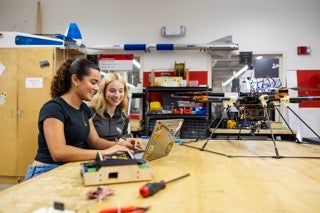
Research Specialization
Autonomous Vehicles & UAS
Connected autonomous vehicles, drone systems, SLAM, path planning,
and V2X communication — taught with access to CAVREL’s live vehicle
testbeds. Funded by Toyota, Ford, and the U.S. Department of
Transportation.
Research Specialization
Medical Robotics & Assistive Tech
Surgical systems, assistive cobots, and biomedical AI — supported by a $600K NIDILRR grant and direct clinical partnerships with Orlando Health. Cross-disciplinary with UCF’s College of Medicine at Lake Nona.
UCF’s Master’s in Robotics & Autonomous Systems is Unmatched
Many universities offer robotics concentrations inside larger engineering programs. UCF’s MSRAS is a dedicated, standalone degree — the only one in Florida — with required cross-disciplinary coursework, direct faculty research access, and an active industry hiring pipeline built into its structure.
| Feature | UCF’s Robotics Master’s | Other University Programs |
|---|---|---|
| Standalone robotics MS degree | Concentration only | |
| Only robotics MS in the state | ||
| Required cross-dept. coursework (ECE, ME, CS) | Rarely | |
| Access to CRCV (top-10 global vision lab) | ||
| CWEP paid co-op (Lockheed Martin) | ||
| Hybrid remote option (V-modality) | Varies | |
| Florida’s 3rd-largest robotics job market on doorstep | ||
| IAI Institute (25+ faculty, 4 colleges) | ||
| No state income tax | Depends on state |
Research mentors
who are shaping the field.
The MSRAS leverages expertise from faculty across computer science, computer vision, artificial intelligence, modeling and simulation, biomedical engineering, and more. As a graduate student, you work alongside — not just under — researchers with active funded projects at NSF, DoD, NASA, and the nation’s leading defense and aerospace companies.

Mubarak Shah
Trustee Chair, Computer Science · Founding Director, CRCV Inaugural Director, UCF Institute of Artificial Intelligence
Computer Vision Pioneer: One of the world’s most-cited computer vision researchers, Shah founded CRCV three decades ago and now leads UCF’s Institute of Artificial Intelligence — uniting 25+ faculty across four colleges.
Real-World Impact: His research in video understanding, activity recognition, and visual tracking underpins how autonomous robots perceive and respond to the world. CRCV alumni lead AI teams at Google, Microsoft, and the NIH.
Computer VisionVideo UnderstandingRobotics Perception

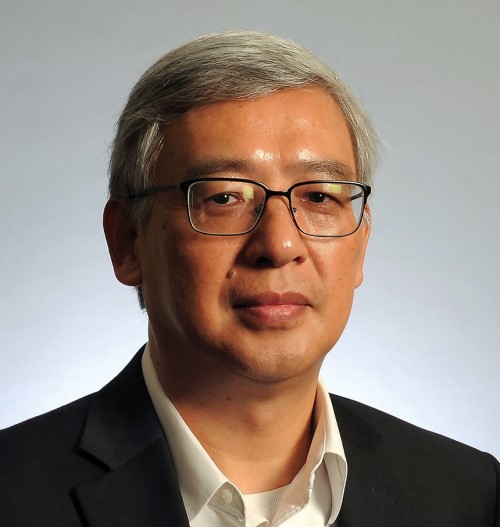
Yaser Fallah
Professor, ECE · Director, CAVREL (Connected & Autonomous Vehicle Research Lab) · MSRAS Graduate Program Director
Autonomous Vehicles at Scale: NSF CAREER Award winner (2015) and MSRAS program director, Fallah leads UCF’s Connected & Autonomous Vehicle Research Lab. With 140+ peer-reviewed publications, his research spans cooperative AI for automated driving, V2X communication, and intelligent transportation systems.
Industry & Federal Partnerships: Funded by NSF, Ford, Toyota, and the U.S. Department of Transportation. He holds a PhD from the University of British Columbia and held a research scientist post at UC Berkeley.
Autonomous VehiclesV2X CommsSmart CitiesNSF CAREER

Aman Behal
Professor, ECE · Director, Assistive Robotics Lab · $600K NIDILRR Grant (2025)
Robots That Restore Independence: Behal’s lab focuses on one of robotics’ most consequential frontiers — building cobotic assistive arms for people with disabilities caused by stroke or multiple sclerosis, evaluated with actual users in unstructured home environments.
Designed for the Real World: Funded by a $600K NIDILRR grant with Orlando Health Rehabilitation Institute in 2025, his work is built around affordability and access. “People who need assistive robotics are often not the richest,” he says.
Assistive RoboticsCobotsML for Disability TechNIDILRR Funded
Zhihua Qu
Pegasus Professor, ECE · Thomas J. Riordan & Herbert C. Towle Chair
Multi-Robot Autonomy & Control: Qu’s research includes multi-agent control and optimization with application to autonomous vehicular systems — developing the theoretical foundations and algorithms that enable multiple robots and autonomous vehicles to coordinate, cooperate, and operate safely in complex, dynamic environments.
Multi-Agent ControlOptimizationAutonomus Vehicles

Mohsen Rakhshan
Assistant Professor, ECE · Director, LIMB Lab
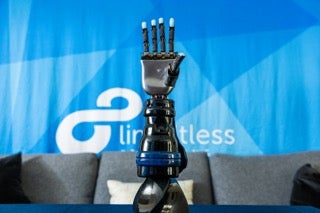
Bridging Neuroscience & Robotics: Rakhshan came to UCF from a Biomedical Engineering Distinguished Fellowship at Johns Hopkins, where his research focused on brain-machine interfaces and neural prostheses. At UCF’s LIMB Lab, he develops non-invasive technologies for sensory restoration in limb amputees.
Tactile Sensing & Neuromorphic Systems: His work spans scalable tactile sensing for robotic arms and neuromorphic encoding — sitting at the crossroads of neuroscience, robotics, and control theory.
Brain-Machine InterfacesNeural ProsthesesTactile RoboticsControl Theory
25+ world-class faculty. 4 colleges unified. Robotics at the core.
UCF’s Institute of Artificial Intelligence unites faculty from Engineering & Computer Science, Medicine, Business, and Sciences in a single cross-disciplinary structure.
For MSRAS students, the IAI means access to:
- 25+ affiliated researchers
- New graduate fellowships
- A research environment where computer vision, surgical robotics, and autonomous systems share the same intellectual home
You don’t just study robotics here.
You build it.
As a student in this program, you learn the fundamental concepts of robotics technology through both coursework and research in state-of-the-art laboratories. The MSRAS connects directly with IST, CRCV, IAI, Biionix, and the Disability, Aging and Technology cluster — giving you access to research infrastructure from day one, not after a waiting period.
Center for Research in Computer Vision (CRCV)
Director: Mubarak Shah · IAI Founding Pillar
Three decades of world-class computer vision research — now anchoring UCF’s Institute of Artificial Intelligence. Video understanding, object detection, visual tracking, and multi-camera analysis. CRCV alumni lead teams at Google Brain, Microsoft Research, and the NIH.
Astro Robotics Lab & CAVREL
Director: Yaser Fallah · Funded by NSF, Ford, Toyota, US-DoT
Fallah directs two complementary labs. The Autonomous Systems and Space Robotics Lab (Astro) advances cooperative AI and collaborative perception for robotic and autonomous systems. CAVREL provides live vehicle testbeds — including a Hyundai Ioniq EV and F1Tenth platforms — for V2X networking, HD mapping, and cooperative AI for automated driving. 140+ peer-reviewed publications across both.
Assistive Robotics Lab
Director: Aman Behal · NIDILRR $600K Grant (2025)
Cobotic assistive arms for people with upper extremity disabilities — trained via machine learning to operate in unstructured home environments. Evaluated with real users at Orlando Health Rehabilitation Institute. Focused on robots that actually reach people who need them.
Astrodynamics, Space & Robotics Lab (ASRL)
Director: Tarek Elgohary Ph.D. · MAE Department
Orbital mechanics, autonomous space vehicle control, and robotic manipulation in microgravity — feeding directly into careers at NASA Kennedy Space Center, where 30% of employees are UCF Knights. Connected to the Florida Space Institute.
Institute for Simulation & Training (IST)
Focus: World-renowned applied simulation research · Defense & healthcare
Robots are trained in simulation before real-world deployment. UCF’s IST — internationally recognized for defense training, medical education, and autonomous vehicle validation — gives MSRAS students access to the simulation pipelines that make robotics safe and deployable at scale.
Space Robotics Lab
Coming Soon: HEC 118 · MSRAS Graduate Open Lab Space
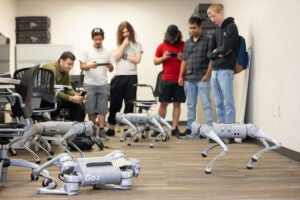
A new open-access lab in the Harris Engineering Center (HEC 118), designed specifically for robotics graduate students. The Space Robotics Lab houses the ECE humanoid robot and robotic dogs, giving MSRAS students a dedicated workspace to build skills, run experiments, and prepare for competitions. Competitive teams including Knightmare and Daydream will train here as the program grows. No appointment needed — graduate students in the robotics program can drop in and build.
LIMB — Laboratory for Interaction of Machine and Brain
Director: Mohsen Rakhshan · ECE Department · Disability, Aging and Technology Cluster
Rakhshan’s LIMB develops non-invasive technologies for sensory restoration for individuals using prosthetic devices, scalable tactile sensing for robotic arms, and neuromorphic encoding systems. The lab works directly with the ECE robotic dog and humanoid platforms — bridging neuroscience, control theory, and robotics to advance human-collaborative autonomous systems.

Standout LIMB Moment
TapeMeasure went viral. It’s also a research tool.
UCF’s Boston Dynamics robotic dog became a social media sensation — but it’s used daily by students in the LIMB Lab and Robotics Club for locomotion research and autonomous navigation.
Industry Partnership & Hiring Pipelines
UCF is #1 in Florida and Top 5 nationally for supplying graduates to aerospace and defense — five consecutive years. That ranking is built on four decades of intentional partnership with the companies that hire robotics engineers. For MSRAS students, the pipeline is structural: labs, co-ops, research grants, and career connections are embedded in the program itself.
Lockheed Martin: UCF’s #1 employer.
UCF and Lockheed Martin partnership includes a growing research investment in AI, robotics, and hypersonic technologies, and expanding the College Work Experience Program (CWEP).
Lockheed hires more UCF graduates than from any other university in the country and is the #1 employer for CECS graduates.
The CWEP places enrolled CECS students in paid co-op positions at Lockheed Martin — doing real engineering work on live programs while remaining full-time students at UCF. On average, 60% of CWEP participants receive full-time job offers upon graduation.
Paid CWEP internships/yr
Offered full-time jobs
UCF employer nationally
Years of partnership
Defense Technology

Headquartered in Melbourne, FL with major Orlando operations — electronic warfare, communications, and autonomous systems. One of the most proximate defense tech employers to UCF, and a direct MSRAS hiring partner.
Space Exploration
30% of KSC employees are UCF Knights — the highest concentration from any single university. NASA funding flows directly into UCF’s Florida Space Institute and ASRL space robotics research programs.
Energy Innovation

A Pegasus Partner advancing energy innovation with UCF — with significant robotics investments in Central Florida. Sukthankar’s MSRAS program was designed in explicit conversation with Siemens’ workforce needs. A direct graduate hiring partner.
Healthcare

Pegasus Partner and clinical evaluation site for UCF’s assistive and surgical robotics research. Co-developed the AIMS surgical AI system with CECS seniors, and hosts clinical trials for Prof. Behal’s cobotic assistive arms at their Rehabilitation Institute.
Defense & Aerospace

UCF’s Northrop Grumman Work Experience Program (NGWEP) mirrors the CWEP — placing enrolled students in paid co-op roles across defense autonomy, space systems, and cyber while they remain at UCF full-time.
Research & Innovation

NeoCity (Kissimmee) is an emerging smart sensor and photonics hub where UCF is an academic partner. The Central Florida Research Park, adjacent to campus, hosts Army, Navy, and Air Force R&D — student-accessible from day one.
Robotics is more than a curriculum.
It’s a community.
From a club that’s been building robots since 1972 (now 150+ members strong) to brand-new student organizations born from senior design projects that placed Top 10 at international competitions — UCF’s robotics community gives students the hands-on, collaborative, career-building experience that no classroom alone can provide.
What Our Students Are Saying
Israel Charles ’25
MS Robotics & Autonomous Systems · ECE
“We founded the AI Racer Club to build a self-sustaining student community around autonomous vehicles here at UCF. We provide a structured pathway that helps anyone interested in the field develop confidence as they collaborate on meaningful, multidisciplinary projects.”
Top 10 at ICRA Roboracer Autonomous Grand PrixFounded AI Racer Club
Alen
Robotics Club of Central Florida · 2+ Years
“There’s something for everybody in the robotics club. We always tell students that just because their major is in a certain field doesn’t mean they have to stick to it. The club brings together mechanical, electrical, CS, and every other engineering background.”
TapeMeasure TeamMars Rover Build150+ Member Club Community
Student Organizations & Clubs
Robotics
Robotics Club of Central Florida (RCCF)
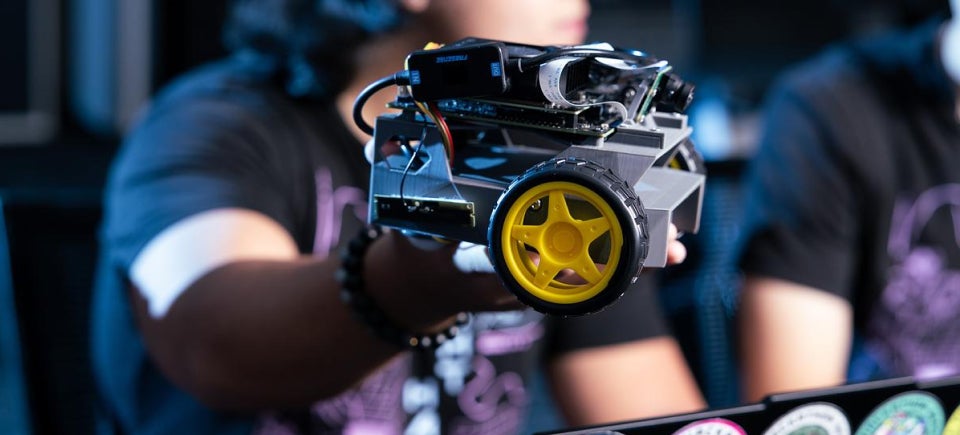
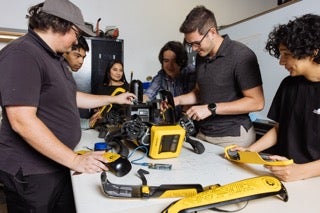
Founded in 1972 and now 150+ members strong, RCCF is UCF’s flagship robotics student org — building battle sumobots, electric racing boats, Mars rovers, and new hardware for TapeMeasure. 32 projects completed and counting. Drop-in certified — no prior skills required. Faculty advisor: Crystal Maraj (IST).
Autonomous Vehicles
AI Racer Club (F1Tenth@UCF)
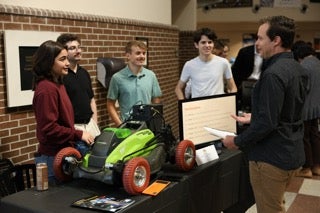
Born from a senior design project that finished Top 10 at the IEEE ICRA Roboracer Autonomous Grand Prix. Founded by MSRAS student Israel Charles ’25, the AI Racer Club builds small-scale autonomous vehicles, hosts internal competitions, and runs technical workshops on key autonomy stack components — perception, planning, and control.
Engineering
IEEE @ UCF
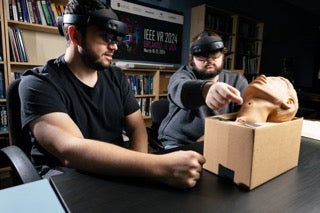
UCF’s IEEE student chapter runs F1Tenth autonomous racing, Micromouse (fully autonomous maze solvers), the Great Naval Orange Race, and an open project incubator — funding student builds from sensors to 3D-printed structures. Collaborates with RCCF and ACM on shared competition entries at ICRA and other major conferences.
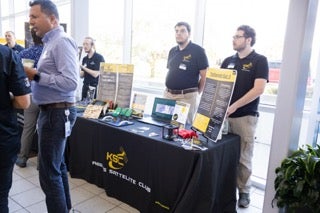
Space Systems
Knights Satellite Club
Space systems engineering with a student-led twist — developing CubeSats, payload systems, and orbital mechanics projects with direct connections to UCF’s Florida Space Institute and the KSC ecosystem. Aerospace robotics experience for students heading to NASA and defense careers.

Community
ECE Student Organizations
UCF’s ECE Department hosts a range of student organizations directly relevant to robotics careers, including the IEEE Student Branch, Eta Kappa Nu (HKN, the ECE honor society), the Society of Women Engineers (SWE), and the Society of Hispanic Professional Engineers (SHPE). Each provides mentorship, networking, and competition opportunities for robotics-track students.
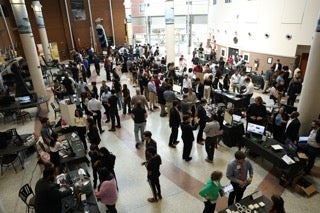
Hackathon
Knight Hacks
UCF’s hackathon organization — hosting one of the Southeast’s largest annual hackathons. For robotics students, Knight Hacks is where autonomy stacks meet software sprints: teams have built ROS-based robot controllers, computer vision systems, and autonomous navigation demos in 24-hour builds.
Knightmare and Daydream: UCF’s Competitive Robotics Teams
The UCF Robotics Club offers two competitive student teams — Knightmare and Daydream — that compete in national and international challenges throughout the year.
The teams won a total of 83 head-to-head matches over the past year alone, besting teams from Georgia Tech, Purdue, and Texas A&M University.
With Central Florida’s reputation as a leader in dynamic, high-tech fields, they envision the next phase of success and growth for their program in industry partnerships.
Looking ahead, UCF teams are also preparing to compete in Lunabotics — NASA’s annual student lunar excavation competition — as the program continues to expand its national footprint.


UCF Robotics News
The city that made UCF robotics possible.
Orlando isn’t a backdrop for UCF — it’s a structural advantage. The intersection of aerospace, defense, simulation, healthcare tech, and smart manufacturing within a 60-mile radius of campus creates a career ecosystem that no geography in the country replicates. Florida is the third-largest robotics job market in the U.S. — and UCF sits at its center.
Kennedy Space Center
30% of KSC employees are UCF Knights — the highest concentration from any single university. NASA funding supports ASRL and FSI robotics research directly.
Cape Canaveral, FL · ~45 min
Lockheed Martin (Orlando)
Missiles & Fire Control division — #1 UCF graduate employer nationally. CWEP places students on live engineering programs while enrolled full-time.
Sand Lake Road, Orlando · ~20 min
Central Florida Research Park
Adjacent to UCF’s main campus — Army, Navy, and Air Force R&D operations, hundreds of tech companies, direct student research access.
UCF Main Campus · On campus
NeoCity (Smart Sensors & Photonics Hub)
UCF academic partner — developing the sensing hardware that enables autonomous robots to perceive their environment with precision.
Kissimmee, FL · ~30 min
L3Harris Technologies
Major Central Florida defense employer — electronic warfare, autonomous platforms, communications. Recruits CECS graduates actively every semester.
Melbourne, FL · ~60 min
UCF Lake Nona Medical City
Medical robotics, surgical AI, and assistive technology — connected to Orlando Health (Pegasus Partner) and UCF’s College of Medicine.
Lake Nona, FL · ~25 min
Florida: The Robotics Job Market Facts
| 3rd largest robotics job market in the U.S. | |
| Florida engineers average $107,500/yr in robotics roles | |
| Global robotics market: $165B by 2029 | |
| UCF: #1 aerospace/defense supplier in FL, 5 yrs | |
| 200,000+ UCF alumni working in Florida | |
| No state income tax |
Florida’s only robotics master’s.
Apply now.
Designed for the industry. Built in Orlando. Ready for wherever you want to take it.
MS Robotics & Autonomous Systems