Key Takeaways
- Human patient simulators use digital projection on physical forms to create lifelike training patients that can breathe, cough and show realistic symptoms.
- Physical-virtual patient simulators are more cost effective than traditional lifelike mannequins because they can display multiple personalities, races and disease symptoms.
- HPS technology allows nursing and medical students to practice patient interactions safely before treating real patients.
- Virtual patient simulation combines computer graphics with physical forms to create interactive training experiences.
- UCF developed pediatric prototypes that address the challenge of training students to diagnose and treat children without using real child actors.
What Are Human Patient Simulators?
Human patient simulators (HPSs) are training tools that replicate real patients for medical education. They allow students to practice clinical skills, such as central line insertion, in a safe environment.
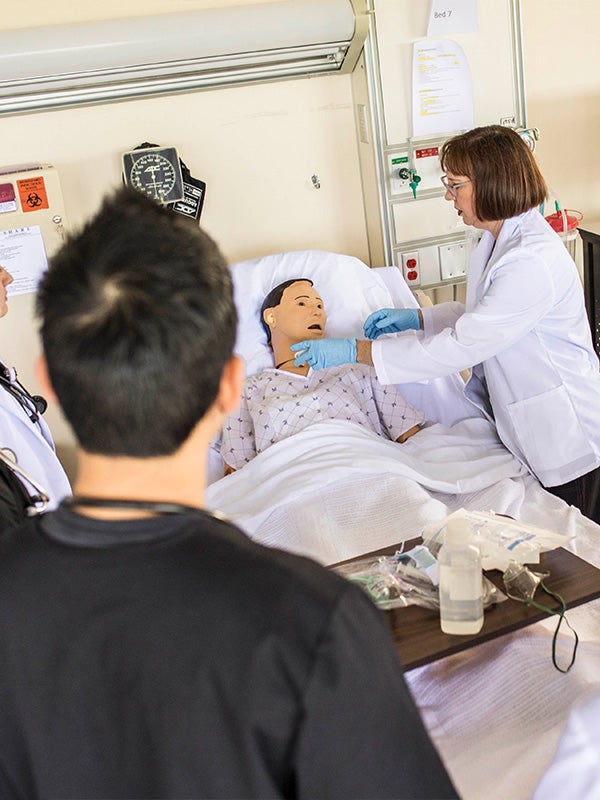
Traditional simulation training includes mannequins and human role players, but these tools have limitations in realism and versatility. HPS simulation allows students to practice physical diagnosis and treatment safely. Students can make mistakes in this scenario-based training without harming real patients. They learn to respond to medical emergencies such as nasal and endotracheal intubation in controlled settings.
The physical-virtual HPS technology developed at UCF advances this concept further. These simulators can display facial expressions, body language and subtle nonverbal cues. They respond realistically to medical procedures.
Why Pediatric Simulators Fill a Critical Gap
Welch, whose background is in hardware and software engineering, is also a professor of computer science, modeling and simulation. While he began the development of the physical-virtual patient seeking to develop an adult human patient simulator, he later decided to focus on pediatric prototypes. The decision came from recognizing the difficulties that exist in educating students to diagnose and treat children.
“For adults, you can actually leverage professional human role players to serve as patients. You can’t do that with children,” Welch says. “You can’t hire a 5-year-old to pretend to be sick. As such, you are limited to mannequins that are relatively static in their appearance and behavior. There’s really a need for something that’s more ‘alive’ than a piece of rubber to interact with.”
How Physical-Virtual Patient Simulators Work
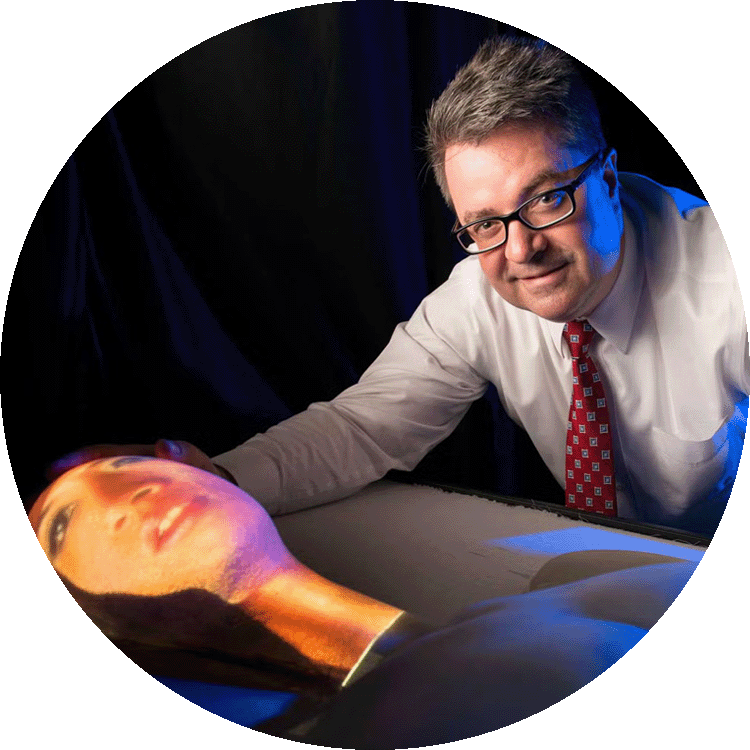
The pediatric prototypes developed at UCF are fitted with digital light projectors. These projectors beam the image of a child from below onto a child-shaped physical form.
The result is a physical-virtual patient that can appear to breathe, cough, blink and squirm. This HPS technology can wince in pain when pricked with a needle and can smile at a nurse’s joke — all things that happen in clinical environments.
Temperature controls allow for the simulation of a fever. They can cool the extremities to mimic shock or poor circulation.
A nurse can place a real stethoscope on the body. The simulator produces realistic internal sounds. Students hear wheezing in the chest. They detect gurgling in the stomach. They recognize other internal sounds of the body.
“We can make the patient simulators speak, see the lips move,” Welch says. “We are working on the ability to make the child autonomously aware so that when you walk up to the child, we want the child to naturally turn and look at you.”
Benefits for Medical Training
Having an interactive, human-like patient vastly improves a trainee’s opportunities to safely practice patient interactions. Nursing and medical students gain experience in the diagnosis and treatment of disease without risk to real patients.
“We are trying to get closer to reproducing the appearance and complete set of signals that a patient sends — speech, sounds and facial expressions,” Welch says. “Diagnosing a patient is very dynamic, tactile, hands-on and fluid. You are watching the patient, you are asking questions, judging everything they say and everything they do. For example, subtle nonverbal patient behaviors resulting from a question could indicate there is more going on than the patient is telling you.”
Students in UCF’s Nursing program learn to read these subtle cues, practice responding appropriately and develop clinical judgment in realistic clinical scenarios.
The Birth of an Innovative Way To Learn How To Treat Patients
For Welch, the idea for physical-virtual avatars began more than 15 years ago. A conversation at the Pentagon with a physician-turned-administrator sparked the concept.
The administrator expressed a longing to go back to practicing medicine. He wondered about the possibility of creating a physical robotic persona of himself. This would allow him to be with patients without leaving his Pentagon office.
Welch’s first reaction was that the scenario belonged in the pages of a sci-fi novel. But the more he thought about it, the more intrigued he became by the idea of developing a physical-virtual persona.
“Then I had this idea out of the blue that you could actually use computer graphics and projected imagery to present the appearance of that exact physician on a physical form like a robot,” he says.
Welch also brainstormed ideas with the director of a burn center. They explored how physical-virtual avatars could help burn victims, who are often isolated to avoid risks of infection.
They came up with a clinical scenario where a homebound burn patient could sign up for a mobile physical-virtual avatar in a mall. The patient could project his or her own image on the avatar. They could browse store racks, visit cafes and chat with salespeople. “It would offer a way for them to re-engage with society in a very safe and gentle way,” he says.
When Welch came to UCF, his office happened to be right across from the College of Nursing. In his conversations with nursing faculty, he began to understand the challenges and needs in nursing and healthcare education.
He learned about the role of mannequins in how nursing students gain knowledge and patient-care skills. It struck him that the ideas that had long simmered in his mind could be used to develop a new kind of patient stand-in.
The Next Generation of Nursing Simulation
Welch and UCF colleagues are working on adding touch sensing to the prototypes for pediatric care. They’re developing other enhancements as well. The next step is the experimental use of the physical-virtual avatars in regional hospitals. Professional nurses and doctors will test the technology.
Among other things, Welch wants to explore how physical-virtual patients can help students become better trained in the diagnosis of disease in patients of different racial and ethnic backgrounds. He is also interested in using human patient simulators to study how implicit biases can affect patient care.
Beyond the experimental stage and in the longer term, Welch expects to see widespread use of physical-virtual patient simulators. These will work in conjunction with mannequins and other learning aids.
“In five to 15 years, my vision would be to start seeing physical-virtual patient simulators in existing simulation centers throughout the country and throughout the world as a complement to the other tools we have to train people.”
The Bottom Line
Human patient simulators represent a major advancement in medical training and education. HPSs combine the physical presence of mannequins with the versatility of virtual technology.
These simulators allow students to practice on realistic, responsive patients who offer real-time feedback. They can display a wide range of conditions, symptoms and patient types. Overall, HPSs offer a cost-effective solution for comprehensive medical training.
As technology continues to advance, physical-virtual patient simulators will become standard tools in nursing and medical education worldwide. Take your nursing or healthcare career to the next level with UCF’s online graduate certificate in Healthcare Simulation. Learn to design, implement and evaluate simulation training that enhances patient care.